
How to Pay Off Debt
 By
By 
Key Takeaways
- The best way to pay off debt is with the debt snowball method: List your nonmortgage debts from smallest balance to largest and attack them one at a time.
- Make minimum payments on every debt except the smallest, then throw every extra dollar you can find at that one until it’s gone.
- Once you pay off a debt, roll that payment into the next one so your debt snowball gets bigger and faster as you go.
- You can speed up your debt payoff by budgeting, cutting expenses, selling stuff and increasing your income.
- Avoid shortcuts that just move debt around, including debt consolidation, balance transfers and personal loans.
Debt has a way of calling the shots. It tells you what you can buy, how you feel on payday, and whether you sleep well at night. But you don’t have to keep living that way.
Quick Answer
The best way to pay off debt is with the debt snowball method. List your nonmortgage debts from smallest balance to largest, ignoring the interest rates, and attack the smallest balance with everything you’ve got while making minimum payments on the rest. Once that debt is gone, roll that payment into the next one.That’s Baby Step 2, and it gives you a clear plan for getting out of debt instead of just hoping those balances eventually disappear.
How Does the Debt Snowball Method Work?
The debt snowball method works by listing your debts from smallest balance to largest and paying them off in that order, regardless of interest rate. It’s the best way to get out of debt—especially if you’re juggling multiple debt payments—because those quick wins help you build momentum and actually make progress.
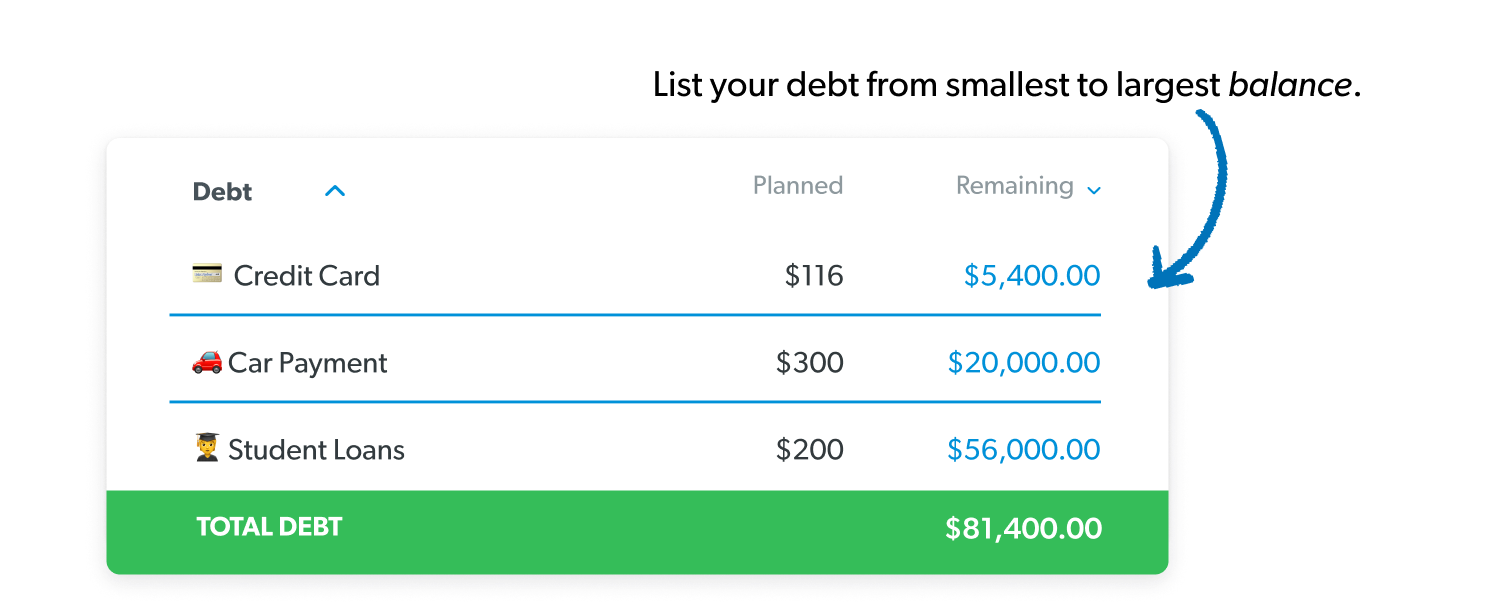
Step 1: List your debts from smallest to largest (regardless of interest rate).
Start your debt snowball by listing every nonmortgage debt you owe from smallest balance to largest. (You'll tackle your mortgage later in Baby Step 6.) To do that:
- Log in to all your debt accounts to get your numbers. (Just so you know, debt is any money you owe to anyone. You can check your credit report if you don’t know what types of debt you have.)
- Write down your current balance and minimum monthly payment for each debt.
- List your debts in order from smallest to largest balance. (Don’t worry about the interest rates.)
Why ignore the interest rates?
You ignore interest rates because paying off your smallest balance first gets you an early win and builds the momentum that keeps you going.
You might be wondering why you wouldn’t start with the highest interest rate first (aka the debt avalanche method). The math does say that the avalanche method helps you save more on interest over time—but if math was the problem, you wouldn't be in debt in the first place. You need a plan where you won't lose steam.
Paying off your smallest debt first gives you a quick victory! Plus, you immediately free up money to put toward your next debt. As each balance disappears, your debt snowball grows larger, helping you pay off the rest even faster.
That’s why the debt snowball has helped millions of people become debt-free once and for all!
Step 2: Make minimum payments on all your debts except the smallest debt.
Keep making the minimum payment on every debt except the smallest one. This keeps your accounts current while you focus all your extra money on knocking out that smallest balance.
List every debt in your budget so you don’t miss a payment and can keep track of your progress. Having all your debt payments in one place also makes it easy to see how much money you’ll free up with each payoff—which comes in handy for the next step.
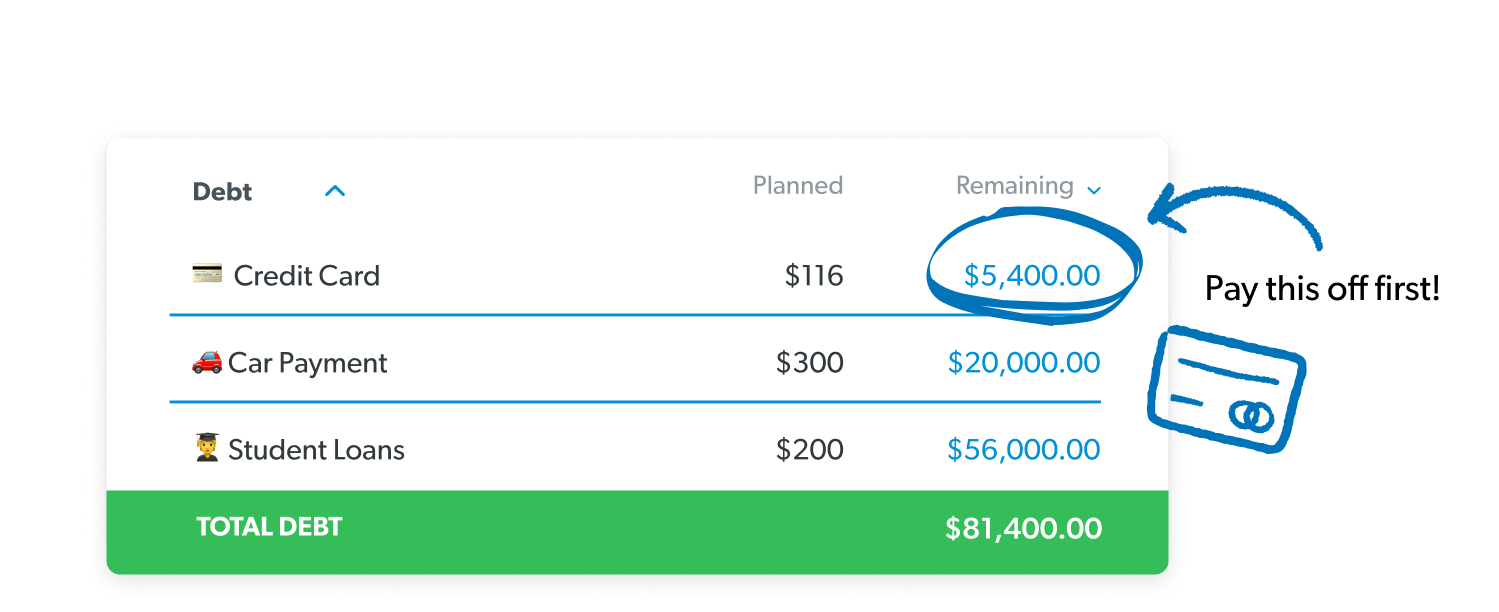
Step 3: Throw as much extra money as you can on your smallest debt until it’s gone.
After making the minimum payments on all your other debts, put every extra dollar you can find toward your smallest debt until it’s completely paid off.
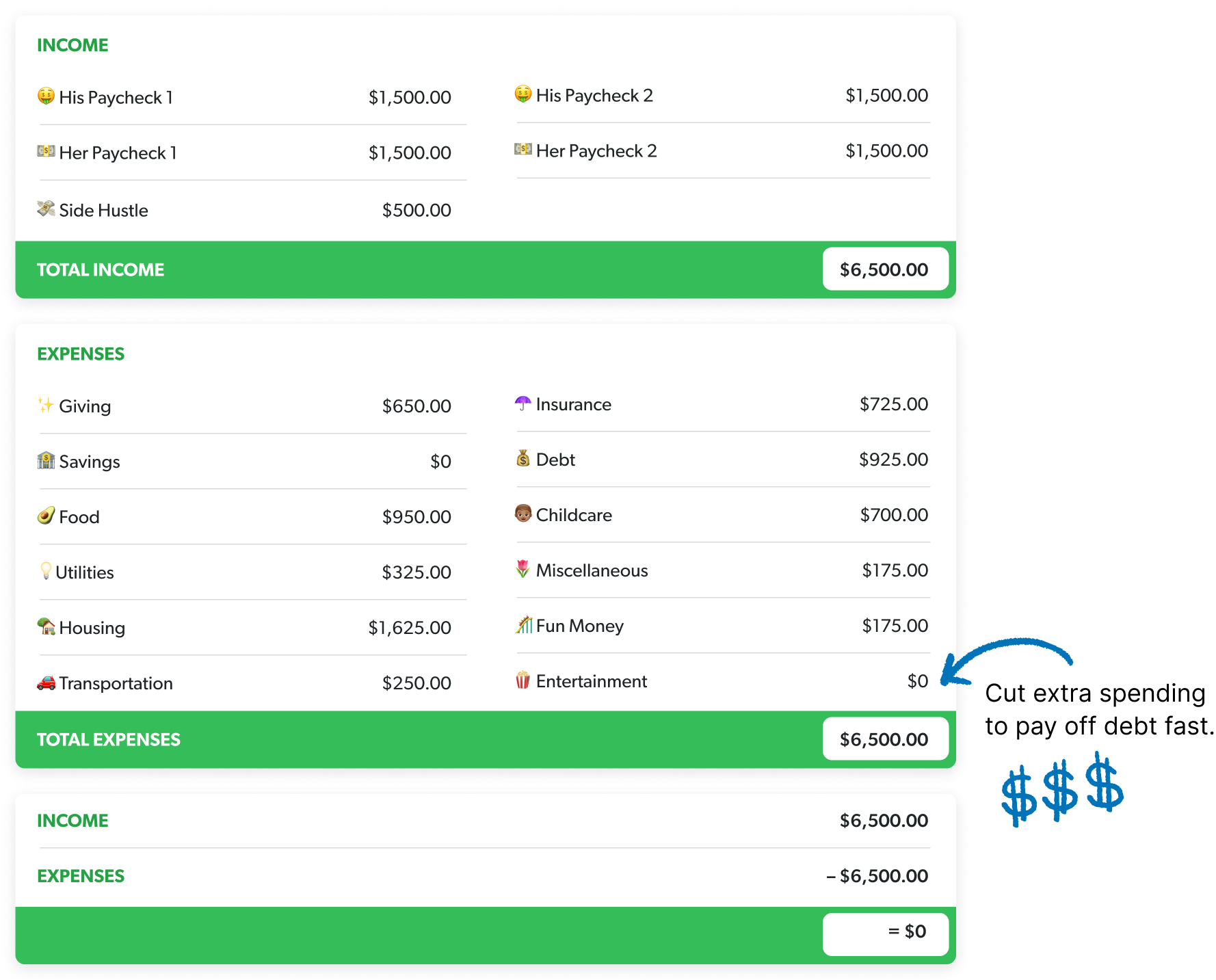
This is where your EveryDollar budget becomes your best tool. Look for ways to create more margin by cutting unnecessary expenses and increasing your income—then throw that extra money at your debt. Here’s how:
- Cut your spending. Go through your budget line by line and look for expenses you can pause or lower. Do you actually need a new outfit this month? Can you hold off on expensive sports tickets or movie tickets? What if you stopped going out to eat? (Calm down, it’s just while you’re getting out of debt!) Saying no to yourself is hard, but getting out of debt takes some sacrifice—there’s no way around it.
- Save on the essentials. Meal planning, shopping around for insurance, or even doing your own yard work can help you save some big bucks every month. Remember, every extra cent gets you one step closer to debt freedom!
Increase your income. Pick up a side hustle, drive for Uber, tutor, pet sit, or sell things you no longer use. The debt snowball is all about intensity. The more intense you are about attacking your debt, the faster you’ll knock it out!
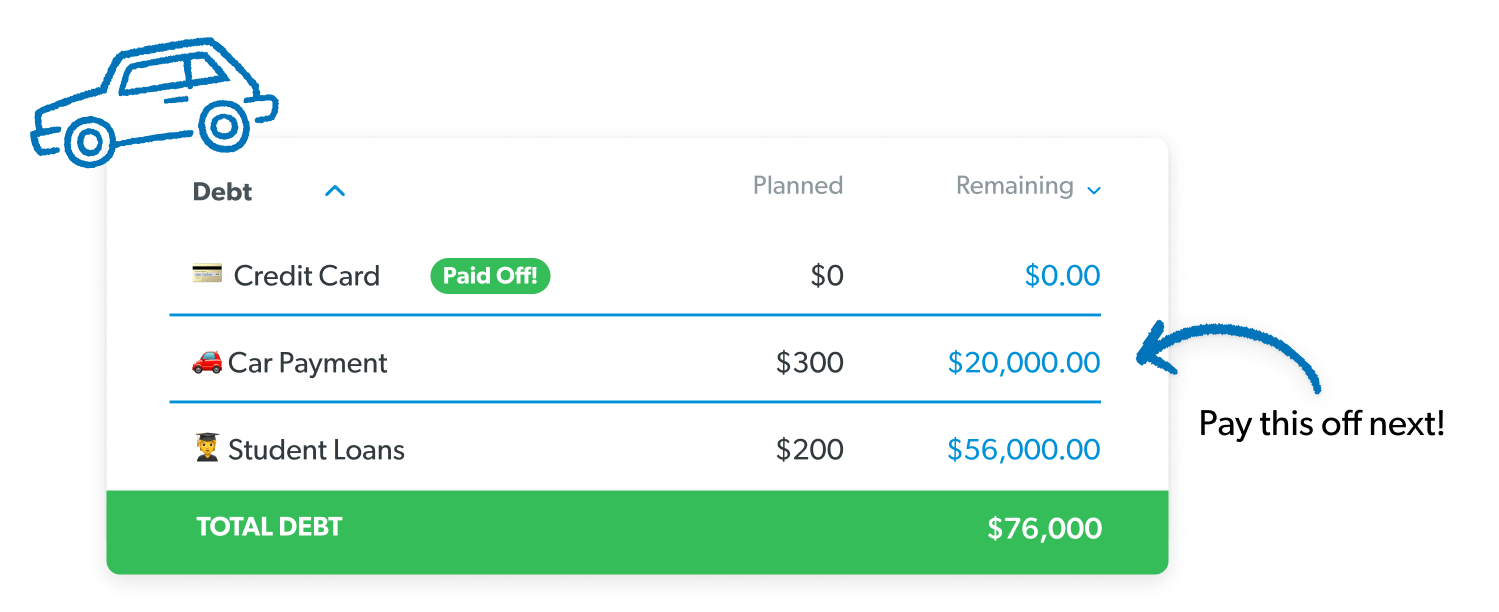
Step 4: Take what you were paying on your smallest debt and add that to your payment on the next-smallest debt until it’s gone too.
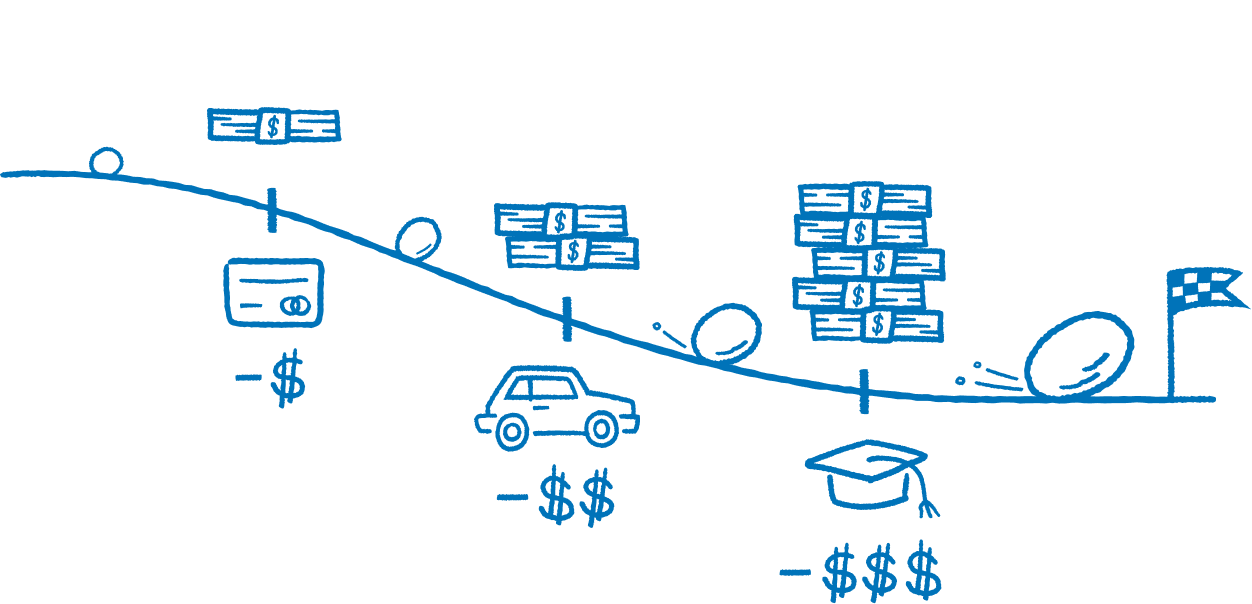
Once you pay off your smallest debt, roll that payment into your next-smallest debt. Like a snowball rolling down a hill, the amount you’re putting toward debt grows in size and gains momentum with every balance you pay off.
People who use the debt snowball method have a greater likelihood of paying off all their debt because they experience small wins early and often, which keeps them going till the end!
Say John and Mary have a $500 medical bill and a $2,500 credit card balance. Once they pay off the medical bill, they take that same payment and throw it at the credit card balance too. Now they’re attacking that $2,500 with double the money—and they’ll have it gone in half the time.
Step 5: Repeat until each debt is paid in full and you’re completely debt-free!
Keep rolling each payment into your next debt until every balance is paid off and you’re completely debt-free.
It usually only takes people 18–24 months to pay off all their debt with the debt snowball. Two years? That’s a drop in the bucket! A couple years of intensity for decades of freedom is totally worth it!
Why Does the Debt Snowball Work?
The debt snowball works because paying off small debts first gives you quick wins that build motivation and momentum. Personal finance is 80% behavior and only 20% head knowledge, so the best debt payoff plan is one you’ll actually stick with.
As each payment rolls into the next balance, your debt snowball grows larger. And before you know it, you’re knocking out bigger and bigger debts until every last one is gone.

How does the debt avalanche work?
The debt avalanche takes the opposite approach: You pay off your debts from the highest interest rate to the lowest, no matter the balance.
The math makes sense on paper because targeting higher interest rates can save you more money on interest. But if your highest-interest debt also has a big balance, you could be working on that first debt payoff for-freaking-ever. That’ll cause your motivation to die out quicker than a campfire in the rain.
Motivation inspires behavior change. And behavior change keeps you going, debt after debt after debt. If you listen to a Debt-Free Scream, you’ll probably hear some of those exact words—and they’re talking about the debt snowball.
Just ask Jessie from THE Ramsey Baby Steps Community Facebook group. After she and her family did their Debt-Free Scream, she shared what sticking with the plan had done for their family:
“If you are on Baby Step 1, 2 or 3, keep going!!! It's so worth it . . . Our whole life has been transformed over the past two years. Our marriage is better than ever, we have more patience for our kids and ourselves, and we have so much hope for our future. It’s not easy, but it’s worth the struggle! Live like no one else, so later you can live like no one else.”
Debt snowball vs. debt avalanche: Which is better?
|
Debt Snowball |
Debt Avalanche |
|
|
Payoff Order |
Smallest balance to largest |
Highest interest rate to lowest |
|
Focus |
Building momentum with quick wins |
Saving the most money on interest |
|
First Payoff |
Usually comes sooner |
May take longer |
|
Ramsey’s Recommendation |
Recommended (Baby Step 2) |
Not recommended |
How Do I Calculate My Debt-Free Date?
You can calculate your debt-free date by entering your balances and monthly payments into our Debt Snowball Calculator below. It’ll show you how long it could take to pay everything off—and how much faster you could get there by putting extra money toward your debt.
And don’t get discouraged by that first timeline. Once you start cutting expenses, increasing your income and building momentum, you may be able to move that debt-free date up.
When Should I Pause the Debt Snowball?
It’s okay to hit pause on your debt snowball during major life events like having a baby, losing your job, experiencing a family health crisis, going through a divorce, or dealing with an IRS bill.
That’s why you save money for emergencies before you start the debt snowball. But if one of these situations comes up, don’t ignore it just to stay on track. Take care of what’s most important, then jump back into your debt snowball as soon as you’re able.
You’re having a baby.
If you’re expecting a baby, keep making minimum payments on your debt, but pause the snowball and start stockpiling cash. That way, you’ve got money ready for medical bills and other expenses as they pop up. Once everyone comes home from the hospital healthy and happy, restart your debt snowball.
You unexpectedly lose your job.
If you lose your job, pause the debt snowball and go into spending survival mode. A job loss can turn your world upside down—especially if you’re suddenly living on a low income or have no income at all. Focus on paying for the Four Walls (aka the basics): food, utilities, shelter and transportation. If you can, make minimum payments on your debt, but don’t send anything extra until you’ve got income coming in again.
Your family experiences a health crisis.
If your family is facing a serious health crisis, pause your debt snowball and focus on getting the care you need. A major medical diagnosis can throw your family into a whirlwind of emotions, and this isn’t the time to worry about sending every spare dollar to debt. If a major surgery, hospital stay or expensive treatment is on the horizon, stockpile cash so you can cash flow your medical bills instead.
You’re going through a major life-change, like a divorce.
If you’re going through a divorce or another major life-change, it’s okay to pause your debt snowball while you get financially stable. You’re probably just trying to keep your head above water both emotionally and financially. So, take care of you. Take care of your family. Keep budgeting through the changes, and jump right back into your debt snowball once you settle into your new normal.
You have an outstanding IRS bill.
If you owe the IRS, take care of that debt before continuing your debt snowball. The IRS has unlimited power to collect, so this is one of those times when you don’t follow the smallest-to-largest rule. Their penalties and interest can add up fast, and they don’t need a court order to come after your wages or bank account. Once the IRS debt is out of the way, jump right back into your debt snowball.
What Debt Relief Traps Should I Avoid?
Avoid debt consolidation, debt settlement, credit card balance transfers, personal loans, retirement withdrawals, and credit repair and debt elimination scams. These so-called debt relief solutions often promise a quick fix but can leave you in an even worse financial situation.
Debt Consolidation
Debt consolidation rolls several debts into one new loan, usually with the goal of getting one payment or a lower interest rate. Sounds convenient, right? The problem is, you still have the same debt—and stretching it over a longer loan term can keep you in debt longer and cost you more in interest.
That’s why we call it debt CON-solidation. (The only version of this we might suggest is student loan consolidation.)
Debt Settlement
Debt settlement is trying to get a creditor to accept less than the full amount you owe, often through a debt settlement company. These companies charge a fee for their “service,” which is usually way more than you would pay if you cut out the middleman and settled the debts yourself.
Credit Card Balance Transfers
Credit card balance transfers just move your debt from one card to another. You may get a temporary low introductory interest rate, but you’ll typically pay a balance transfer fee and still owe the money. Listen, the only way to get out of debt is to pay it off yourself.
Personal Loans
Taking out a personal loan to pay off your credit card debt won’t solve your problem either. Even if you manage to get a better interest rate, you’ve still borrowed money to deal with money you already borrowed. So steer clear of borrowing more money to pay off debt (that includes sneaky schemes like HELOCs).
Withdrawing or Borrowing From Retirement Savings
Withdrawing or borrowing from your retirement accounts to pay off debt is a bad idea. You’ll get hit with early withdrawal penalties, owe taxes on the money you take out, and steal from your future by missing out on years of investment growth. Trust us, 401(k) loans are the worst.
The only time you should even consider taking money out of your retirement accounts early is to avoid bankruptcy or foreclosure. Otherwise, hands off the 401(k)! Instead, pause your retirement contributions during Baby Step 2 and throw those dollars at your debt. Cashing out nonretirement investments can also be a good way to pay off debt.
Credit Repair and Debt Elimination Scams
Credit repair companies may promise to “fix” your credit report for a fee, but they can’t legally remove accurate negative information just because you don’t like it.
Debt elimination scams make the same kind of empty promises. They claim they can eliminate or drastically reduce your debt for a big up-front fee, but all you’re getting is bogus paperwork that won’t solve your debt problem.
How Can I Pay Off Debt Faster?
You can pay off debt faster by stopping new debt, making a budget, using the envelope system, meal planning, selling things you don’t need, picking up a side hustle, and downgrading your car. The more money you can free up for your debt snowball, the faster you’ll become debt-free.
Break up with debt.
First things first: Stop taking on new debt. You have to draw a line in the sand and decide that you’re done. No more swiping that credit card or taking out loans for things you can’t pay cash for. Those habits have gotten you where you are now, and they won’t help you get out. Break the habit that put you in debt, or you’ll end up right back there.
Make a budget.
A budget gives you a plan for your money so you can cover what you need and find more cash to throw at debt. If you don’t intentionally tell your money where to go, you’ll have a real hard time making progress.
A budget is simply a plan for your money that you make before the month begins. By giving every dollar a job, you can confidently cover all the essentials (bills, food, gas), cut out unnecessary extras, and add more money to your debt snowball.
And our EveryDollar budgeting app can help. EveryDollar shows you how to find extra money in your budget and builds you a personalized, step-by-step plan to beat debt way faster!
Use the envelope system.
The cash envelope system (aka cash stuffing) is a great way to help you get your spending under control and stick to your debt payoff goal. You take the amount you’ve budgeted for certain categories (like groceries or clothing) and stick that cash in labeled envelopes. Your goal is to only spend the cash you’ve got in each envelope for the month.
Meal plan.
Meal planning can help you spend less on one of the biggest budget busters: food. And listen, it doesn’t have to be this overwhelming chore that takes up your whole weekend. Just choose a couple budget-friendly meals, try to use ingredients you already have, and decide which nights you’re cooking and which nights you’ll have leftovers. Easy peasy.
Sell stuff.
Selling stuff you don’t need is a quick way to find extra cash for your debt snowball. After all, one person’s trash is another person’s treasure! Dig through your kids’ rooms and search through the black hole of your closet to find things you can part with. Then sell your stuff online to make some quick cash. Or if you’d prefer to sell your stuff the old-fashioned way, host a garage sale.
Get a side hustle.
Picking up a side hustle is one of the fastest ways to pay off debt. Drive for a rideshare app, freelance, walk dogs, tutor, or pick up weekend shifts. Then throw every extra dollar you earn at your debt snowball. Even an extra $200–300 a month can shave months off your debt payoff.
Ditch your car payment.
Ditching a big car payment can free up a serious chunk of money for your debt snowball. Think about how much faster you could pay off debt if you traded in your expensive ride for a used car you can actually afford. Then every month, you could throw that car payment at your debt snowball—instead of out the window. And later, when you’re debt-free, you can save up to buy your dream car in cash!
Or if you’re a two-car family, could you downsize to one car while you pay off debt? Sure, it takes some extra coordination, but you’d be surprised how this can really help you kiss that debt goodbye.
How Can I Stay Motivated to Pay Off Debt?
You can stay motivated to pay off debt by finding your “I’ve had it” moment, remembering your why, breaking down your goals, tracking your progress, rewarding yourself, avoiding comparisons, and finding people to cheer you on. Becoming debt-free takes commitment, but these habits help you stay focused from your first debt payoff to your last.
Find your “I’ve had it” moment.
Start by getting mad enough at your debt to do something about it. Think about what debt is keeping you from doing and how those monthly payments make you feel.
If you’re sick and tired of being sick and tired, let that frustration fuel your determination to finally do something about it. To fully commit to paying off your debt, you’ve got to see debt for what it is: the enemy. You need to say, “I’ve had it!”
Remember your why.
Your why is the bigger reason you’re making all these sacrifices to get out of debt. Maybe your dream is to build a legacy—to create a home where your children will never watch their parents stress about the grocery bill or the minimum payment on their credit card. Maybe you want to pursue a passion or start a business. Or maybe you want to build wealth, live and give like no one else . . . but you have to get out of debt first.
Get specific with whatever your why is. When you’re feeling discouraged, you need something that’ll remind you of how you’ll feel once you’re debt-free. Every sacrifice you make today gets you closer to the kind of future you want to live.
Break down your goals.
Break big debt balances into smaller goals so you have wins to celebrate along the way. The debt snowball already does this by tackling one debt at a time, but even one balance can feel overwhelming.
So, instead of focusing on a $15,000 balance, divide it into smaller, manageable chunks—whether it’s $5,000 or $500. Setting smaller goals makes progress feel achievable, keeps you motivated, and reinforces that you can do this!
Visually track your progress.
Seeing your debt shrink can help keep your goal front and center. Place a sticky note on your bathroom mirror to remind yourself of your reason for getting out of debt. Or draw a piggy bank on poster board and color it in as you pay off your debts.
Whatever works for you, having a visual reminder of your progress can give you another little push to keep going.
Give yourself small rewards.
It’s okay to give yourself small rewards to stay motivated along your debt-free journey—as long as they’re in the budget and don’t slow down your progress.
You could treat yourself to something as small as a latte from your favorite coffee shop or maybe some shoes that are on sale. Better yet, add those rewards to your visual tracker so you have something to look forward to when you reach a goal!
Quit the comparisons.
Don’t compare your debt-free journey to someone else’s. It’s great to get inspired by other people’s stories, but everyone’s situation is different—some have less to pay off or more income to work with.
So don’t let comparison keep you stuck. Stay focused on your own path. And don’t believe the lie that debt is normal!
Find your cheerleaders.
Find people who’ll encourage you and hold you accountable while you’re getting out of debt. Everyone needs a cheerleader! That could be a family member, friend, church group, financial coach or Financial Peace University class. Whoever it is, don’t try to do this thing alone.
Ready to Start Your Debt Snowball?
You don’t need a raise or a windfall to start getting out of debt. You just need a plan for the money you already have.
Download EveryDollar for free to create your first budget and start throwing every extra dollar at your debt today. You can do this. Start with the smallest debt, get that first win, and keep the snowball rolling.
Next Steps
- List every debt from smallest to largest and pay minimums on everything except the smallest, which you’ll attack with every extra dollar.
- Start a budget with EveryDollar and calculate your debt-free date so you know how much you can throw at debt and what you’re working toward.
- Find your cheerleader—a friend, family member, church group, financial coach or Financial Peace University class—to help you stay accountable.
-
Why do I pay off my debt starting with the lowest balance instead of the highest interest rate?
-
The debt snowball is all about motivation. By paying off your smallest debt first, you get a quick win. Plus, you immediately free up money to tackle the rest of your debt. The debt snowball creates unstoppable momentum to knock out the rest of your debts—like a snowball rolling down a hill!
-
Which debt should I pay off first?
-
If you’ve got multiple debts, pay off the smallest debt first (regardless of interest rate). But if you owe the IRS any money (aka tax debt), you need to take care of that before anything else—even if it isn’t your smallest debt.
-
Should I pay off debt before I save for retirement?
-
Yes. Pay off all nonmortgage debt before you start investing for retirement—that’s the order of the 7 Baby Steps. During Baby Step 2, pause your retirement contributions and focus on paying off debt. Then, once you’re debt-free and have a full emergency fund, you can free up your income and start building wealth faster.
-
How do I get out of credit card debt?
-
The debt snowball method is the best way to get rid of credit card debt. But you also need to stop using the credit cards (cut those suckers up!), get on a budget, and control your spending so you can pay off your cards ASAP. Also, avoid things like balance transfers, personal loans and more credit cards—those will only make your problem way worse.
-
How do I handle debt collectors?
-
Stay calm, and don’t let debt collectors pressure you into making decisions on the spot. Ask them to verify the debt in writing, keep records of every conversation, and never agree to a payment you can’t afford. Remember, debt collectors don’t get to ignore your legal rights.
-
Should I file for bankruptcy?
-
In almost every case, no. Bankruptcy should be a last resort after you’ve exhausted every other option for getting out of debt. It’s a gut-wrenching public process that stays on your credit report for years and doesn’t even erase every type of debt.
Get Weekly Insights Delivered Straight to Your Inbox
Did you find this article helpful? Share it!

About the author
Ramsey Solutions

Get proven Ramsey answers fast.