
How to Stay Motivated Through Baby Step 2
 By Rachel Cruze
Key Takeaways
- Stay motivated in Baby Step 2 by celebrating small wins along the way, not just the finish line.
- Keep your why front and center to stay focused when motivation fades.
- Track your progress visually—on paper, in EveryDollar, or both.
- Don’t compare your debt snowball to anyone else’s.
- If you’ve lost your motivation, reset your budget and look back at how far you’ve come.
You guys, I get it. Baby Step 2 is a marathon, not a sprint. Some days it feels like you’ll be eating rice and beans forever.
Here's a Tip
You can stay motivated while paying off debt by celebrating small wins, staying connected to your why, and refusing to compare your progress to anyone else’s. Track those wins somewhere you’ll see them every day, and remember: Every payment gets you one step closer to being debt-free.
For a lot of people, Baby Step 2 starts with the kind of check you can’t cash—a reality check. The average college graduate leaves school with nearly $40,467 in student loan debt.1 Add in credit cards for a new apartment and furniture, a car payment, and a few years of trying to keep up with bills, and it’s easy to end up with debt that feels like it’ll take the rest of your life to pay off.
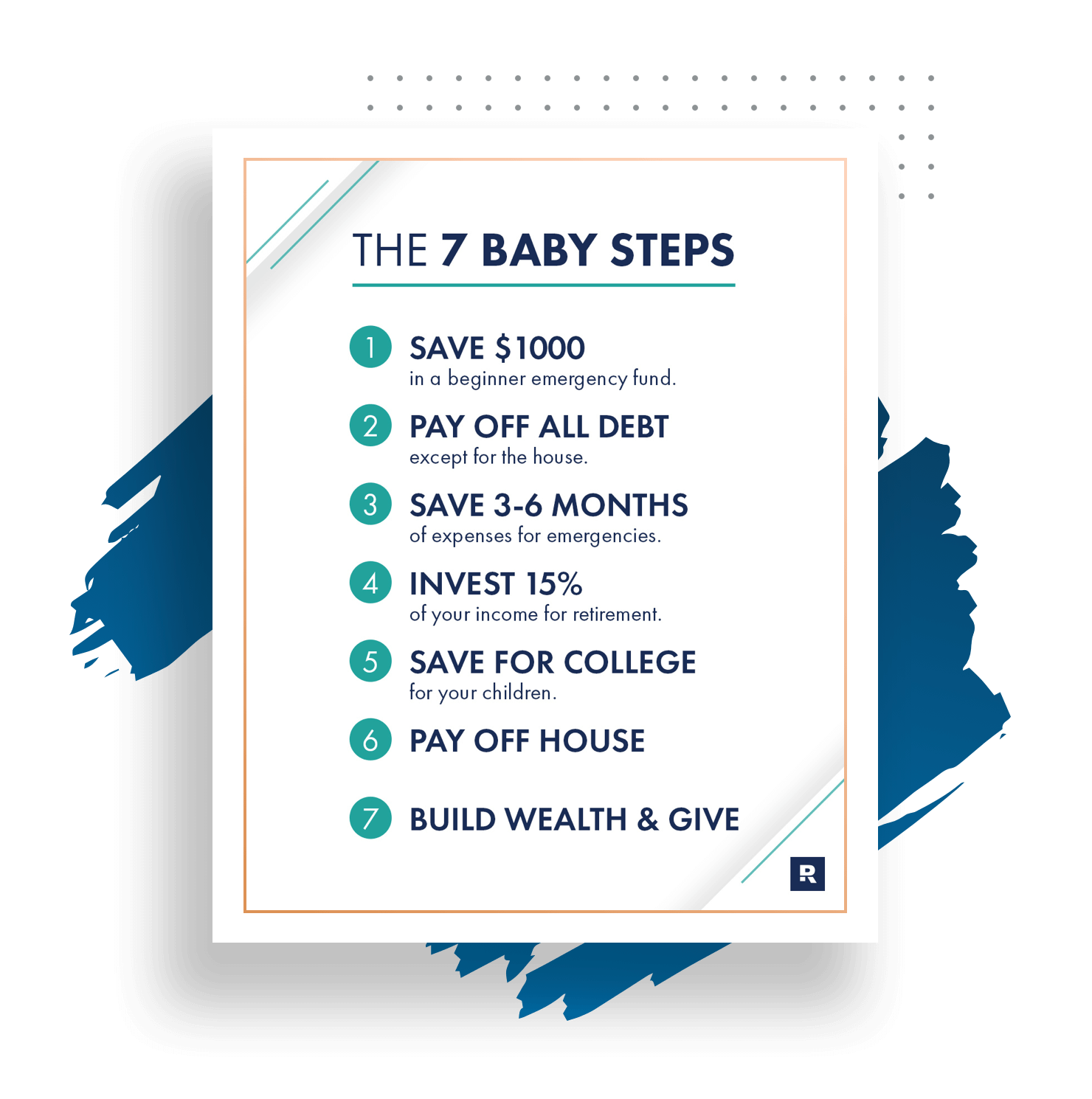
That’s when a lot of people decide they’ve had enough. They’re ready to start Ramsey’s proven plan for becoming debt-free and building wealth: the 7 Baby Steps.
What are the 7 Baby Steps?
The 7 Baby Steps are a step-by-step plan for getting out of debt, building wealth, and creating lasting financial peace. It starts with saving a $1,000 starter emergency fund and leads you all the way to living and giving like no one else.
Maybe you’re a recent college graduate, a single parent or someone who’s quickly approaching retirement. No matter your life stage, paying off your consumer debt puts you knee-deep in the hardest of the Baby Steps—Baby Step 2—where you pay off your debt using the debt snowball method.
Why Is Baby Step 2 the Hardest Part of the Plan?
Baby Step 2 is the hardest because it requires the biggest lifestyle changes and usually takes the longest to finish.
Some days it feels like climbing a mountain in 100-degree heat with a backpack full of bowling balls. And if you’ve got kids yelling from the backseat while you’re saying no to the drive-thru for the hundredth time, you know exactly what I mean.
But going through this step will teach you so much about yourself. You’ll become more disciplined and patient than you ever imagined. You’ll learn you’re actually capable of saying no if it means sticking to your goals. And most of all, you’ll realize you’re resilient.
Yes, Baby Step 2 requires some sacrifices—especially if you’re not used to turning down vacations and bougie dinners. In Baby Step 2, you’re working more hours than you ever thought you could handle. You’re eating rice and beans. You haven’t gone to the movies or stepped foot in a restaurant in months.
But you’re gazelle intense, so it’s easy at first. In fact, one of the great things about the debt snowball is that you see progress from the beginning. You’re paying off the smallest bills and winning left and right. You’re motivated! You’re on fire! (Cue Alicia Keys.)
But what happens when the snowball starts to slow down—and your motivation pauses with it? This is when Baby Step 2 becomes harder than all the sacrifices and extra hours worked.
This is the point when you have to dig your heels in and say, “I’m in it for the long haul.”
How Do You Stay Motivated When Getting Out of Debt?
The truth is, you won’t wake up every day feeling excited about saying no to restaurants or throwing every extra dollar at your debt. That’s normal. The key is knowing the difference between what gets you started and what keeps you going.
|
Motivation |
Discipline |
|
Gets you started |
Gets you to the finish line |
|
Feels like a rush after you pay off a debt |
Shows up even when you don’t feel like it |
|
Fades when the debt snowball slows down |
Doesn’t care how you feel—it just does the next right thing |
|
Sparked by a big win or an “I’ve had it!” moment |
Built through small habits, like checking your budget every week |
You need both. Motivation gets you off the couch, and discipline gets you across the finish line.
1. Why do I need an “I’ve had it!” moment?
You need an “I’ve had it!” moment because until debt makes you mad enough to act, you won’t stay gazelle intense long enough to finish Baby Step 2.
Does debt make you mad? It should!
Think about what debt is keeping you from doing and how those monthly payments make you feel. If you’re going to fully commit to Baby Step 2, you’ve got to see debt for what it is—the enemy. You need to say, “I’ve had it!”
When you’re down to your last few debts, the big ones—or even the final one—and you aren’t seeing those small wins anymore, it’s easy to feel like you’re running on fumes and getting no traction.
But you guys, this is your defining moment. Quitting is normal, and so is debt—but if you’re following the Ramsey Baby Steps, you’re done with normal. Your money mindset is laser-focused. How badly do you want to be debt-free?
2. How do I find my why?
You find your why by getting brutally specific about the life you want once you’re debt-free—then keeping that picture in front of you every single day.
Before you got here, you probably had a really good reason to start the Baby Steps. You might not even be aware of what it was other than needing to make a change with your money.
But let’s dig deeper. What’s your why? What are the reasons you want to kick debt to the curb for good?
Maybe your dream is to build a legacy—to create a home where your children will never watch their parents stress out about paying for groceries or the minimum payment on their credit card bill. Maybe you want to pursue a passion or start a business. Or maybe you want to build wealth, live and give like no one else . . . but you have to get out of debt first.
Get specific with whatever your why is and keep it at the forefront of your mind by creating a vision board on paper or on Pinterest. When you’re feeling discouraged, those images will remind you of how you’re going to feel once you’re debt-free. Every sacrifice you make today gets you closer to the kind of future you want to live.
To learn more about how to stay connected to your why, check out my book: Know Yourself, Know Your Money.
3. How do I break down my debt payoff goals?
You break down your goals by splitting your total debt into smaller milestones—like every $5,000 or every $500—so each win feels doable instead of overwhelming.
Instead of looking at $50,000 of debt and screaming like Kevin McCallister in Home Alone (you know the face), break it into smaller chunks then celebrate each milestone along the way.
Those small wins are exactly why the debt snowball works so well. Every debt you pay off is like tossing another bowling ball out of your backpack—you suddenly feel a lot lighter, and the climb doesn’t seem as impossible as it did before. That’s the momentum that keeps you going.
4. How do I track my debt payoff progress visually?
You track your progress visually with something you’ll see every day. Put a sticky note on your bathroom mirror to remind yourself how much debt you have left. Or draw a mountain on poster board and color it in as you pay off your debt until you reach the summit. Or fill up a jar full of marbles (or coins) where you move one marble for every milestone. The more often you see how far you’ve come, the more motivated you’ll be to keep going.
If you want an even faster gut check, our Debt Snowball Calculator can show you exactly when you’ll be debt-free based on your numbers.
5. Can I reward myself while paying off debt?
Yes—small, budgeted rewards can actually help you stay motivated, as long as they don’t slow down your snowball.
You could treat yourself to something as small as a latte from your favorite coffee shop, or a Chick-fil-A run on a Friday. Better yet, add those rewards to your visual tracker to have something to look forward to when you reach a goal!
Here's a Tip
I’m a spender at heart, so I get it—walking past a sale and not buying anything feels almost painful. But I’ve learned that a $10 reward I planned for hits different than a $100 impulse buy I didn’t. Budget the fun, and it stops feeling like cheating.
Ron in our Facebook community has a great system in place to reward himself with little treats any time he hits a milestone: “Pay off a tire account? Budget a dinner out next month. Pay off a credit card? Budget a day out of the house and have some fun or add $25 to each other’s pocket money for the month. You’ve got to have things like that or you’ll resent the journey.”
6. How does comparison affect your debt payoff?
Comparison kills your motivation by making you feel like you’re losing just because someone else is winning. And too often, it leads to overspending to keep up appearances.
Scrolling Instagram and seeing everyone’s new car, remodeled kitchen or vacation photos can make your rice-and-beans season feel unbearable. But you’re not seeing their debt, their money fights or their maxed-out credit cards. You’re just seeing the highlight reel.
It’s great to get inspired by other people’s stories, but don’t compare your story to theirs. Everyone is on a different journey.
If you’re a one-income family of four making $45,000 a year, your progress is probably going to look a little different than a DINK (dual income, no kids) couple pulling in $120,000 a year. Or let’s say you have $3,000 in credit card debt and that’s it. You’re going to plow through your debt snowball pretty fast compared to someone who’s working to pay off $90,000 of debt. And that’s all okay! We’re all climbing that mountain, but it’s definitely not a race. When we start comparing ourselves to other people, we’re playing a game we’ll never win.
7. Why do I need a support system while getting out of debt?
You need a support system because staying gazelle intense is a whole lot easier when you’ve got people cheering you on and holding you accountable. That support might come from your spouse, a trusted friend, a mentor or other people who are working the Baby Steps too. Having someone to celebrate your wins and encourage you when things get hard can make all the difference.
If you’re looking for people who get it, I’d recommend joining THE Ramsey Baby Steps Community on Facebook. It’s a great place to ask questions and connect with others who are working toward the same goal.
And, of course, one of the best ways to stay motivated and keep your gazelle intensity is to take Financial Peace University. This nine-lesson course teaches you the step-by-step plan for paying off debt fast so you can start saving more money for the future.
What Should I Do to Stay Motivated if I Lose My Gazelle Intensity?
If you lose your gazelle intensity, the best thing to do is revisit your budget, celebrate the progress you’ve already made, and find a new way to make the journey fun again.
Every gazelle gets tired. If you’ve hit a wall—the motivation’s gone, the excitement’s worn off, and Baby Step 2 just feels like a slog—take a breath and refocus before you give up.
Here’s what actually works: Open EveryDollar and reset your budget for the month you’re in, not the month you wish you were in. Look at every category with fresh eyes. Then scroll back through your debt payoff history and look at every balance you’ve already knocked out. That’s proof you can finish this.
Finally, find a new way to make the journey fun again. Try a no-spend weekend challenge with your spouse, a debt-free scream video night with friends, or a small budgeted reward.
The finish line is still there. Reset, refocus, and keep moving forward.
Why Do Your Sacrifices in Baby Step 2 Matter?
Your sacrifices matter because every dollar you throw at debt today is changing your future. You’re proving that debt doesn’t get to call the shots anymore.
When it gets hard, remember why you started. Every extra shift, every meal at home, every “no” to something you can’t afford is bringing you one step closer to becoming debt-free.
And the impact goes far beyond your bank account. You’re rewriting the future of your children, and their children too. You’re transforming your family tree. You’re paving the way to leave a legacy.
Making sacrifices to get out of debt is weird, but don’t settle for normal. Look at what’s at stake if you quit. Don’t give up now—you’ve got this!
Next Steps
- Download EveryDollar and build a budget for this month.
- Build your debt snowball by listing every nonmortgage debt you owe, from smallest to largest.
- Join THE Ramsey Baby Steps Community on Facebook or take Financial Peace University to stay motivated and accountable.
-
How long does it usually take to finish Baby Step 2?
-
It varies, but the average person finishes Baby Step 2 in about 18 to 24 months. Intensity—not income—is the biggest factor in how quickly you reach the finish line. Two people with the same paycheck can finish years apart depending on how gazelle intense they get.
-
Is it okay to take a break from the debt snowball?
-
You should only pause your debt snowball for a real emergency, like a job loss, a medical crisis or a baby on the way. Outside of those situations, keep your momentum going. Pausing “just because” is how people lose their gazelle intensity and end up stuck in Baby Step 2 for years instead of months.
-
Can I spend money on fun things while paying off debt?
-
Yes—as long as it’s small and budgeted. Think cookies on the bottom shelf: a little fun you can actually afford, not a splurge that knocks you off track. A Chick-fil-A run or a $10 Target find can help you stay motivated without slowing down your debt snowball.
-
What’s the best way to track my debt payoff progress?
-
EveryDollar makes it easy to track your debt payoff progress in real time. Watching those balances shrink—and eventually hit zero—is a great reminder that every payment is getting you closer to becoming debt-free.
Get Weekly Insights Delivered Straight to Your Inbox
Did you find this article helpful? Share it!

About the author
Rachel Cruze

Get proven Ramsey answers fast.