
How to Estimate Your Homeowners Insurance (Without a Calculator)
 By

Key Takeaways
- Calculate your home’s replacement cost by multiplying your home’s square footage by your local cost to rebuild per square foot.
- Create a home inventory so you know how much personal property coverage you need and have a record of your belongings if you ever file a claim.
- Add up the assets you’d risk in a lawsuit to make sure you have enough liability coverage—and consider umbrella insurance if your net worth is over $500,000.
- The average homeowners insurance policy costs $2,490 a year for $400,000 in dwelling coverage, but your cost depends on your rebuild cost, location and deductible.
- Insure your home for replacement cost, not market value.
Let’s be real: Most home insurance cost calculators give you vague estimates based on generic info—and that’s the last thing you want when it comes to protecting your biggest investment. The right way to size your coverage is to answer three questions: What would it cost to rebuild your home? What would it cost to replace your stuff? And what could a lawsuit take from you?
Quick Answer
You can estimate how much homeowners insurance you need by calculating your home’s total rebuild cost, the value of your personal belongings, and the value of your total at-risk assets. Insure for replacement cost, not market value. Then take those three numbers to a RamseyTrusted® insurance pro to shop rates.Before you run your own numbers, here’s your baseline: The average homeowners insurance policy costs $2,490 a year—about $208 a month—for $400,000 in dwelling coverage, according to 2026 data from Quadrant Information Services, as reported by NerdWallet. Rates swing by state, so check the average in yours. But even then, an average can’t see your rebuild cost, your belongings, or the assets you need to protect—and neither can a generic calculator running on big data. That’s why you need your own numbers. Don’t sweat the math though. If you can multiply, you can do this.
How Do Insurance Companies Calculate Your Premium?
Insurance companies calculate premiums by balancing the “pure premium” (the expected cost of claims for homes like yours) with their “expense ratio” (how much it costs for them to run their business). The homeowners insurance secret sauce is complex, but it’s not impossible to understand.
Insurance companies are ultimately in the business of making money (duh). No matter how noble their other intentions might be, no company can lose money for long and stay in business. This means the price they charge is a balancing act.
Charging too little could put them out of business. Charging too much will potentially push customers away.
So, what do they do? Well, in the era of Big Data, they turn to the numbers. When analyzing risk, insurers focus on two main factors: 1) where you live and 2) how risky you are. They look at how likely you are to file claims and how much those claims will cost them.
Here’s how insurers generally figure out what to charge for homeowners insurance premiums.
1. Pure Premium
The pure premium is one of the first numbers insurance companies calculate for groups of similar homeowners (for instance, homeowners in Los Angeles). One of the factors that goes into the pure premium math is dividing the group’s total property losses by their total property value. To get a realistic idea of risk, companies typically consider data from at least the past five years for the group.1 So if the properties were valued at $200 million and the losses totaled $10 million, their losses would be 5%, or five cents for every dollar of property value.
2. Expense Ratio
Once they have the pure premium, insurers find the expense ratio (basically the insurance company’s operating expenses plus desired profit). This is usually a percentage and includes things like taxes, underwriting, administrative costs, marketing and commissions.
3. Premium Price
Insurers then take the pure premium and the expense ratio, plug them into their fancy insurance calculators—and out pops what’s called the gross premium. (We have to agree with the name.) This is what you end up paying.
But wait, there’s more . . .
Interested in learning more about homeowners insurance?
Sign up to receive helpful guidance and tools.
Here's a Tip
Check if your provider offers a discount for safety enhancements. Installing a burglar alarm and deadbolt locks would boost your security and could lower your premium too.
Level of Coverage and Deductible
Your premium is also based on how much coverage you choose and the size of your deductible. A higher deductible will mean a lower monthly rate because you’ll pay more out of pocket before the insurance company has to cover a claim. But before you raise your deductible, be sure you’ve passed Baby Step 3 with a full emergency fund to cover the new amount.
Construction Type
We’re talking about what your house is made of—brick, wood, etc. A home built with more durable materials is less likely to be damaged—so insurers often offer lower premiums to reflect that reduced risk.
Personal Claims History
If you have a long history of filing claims for every little thing, an insurer is going to take that into account. Filing claims on small repairs will only cost you more in the long run. In fact, it could increase your premium even if your neighbors file a lot of claims. (That might not seem fair, but it’s a factor.)
Your Home’s Square Footage
The larger the home, the more expensive it is to insure. Keep that in mind before you add that epic kitchen bump-out or expand the laundry room!
How Many Live There
If you, your spouse, your children, and your entire extended family are all living under the same roof . . . we hope you’ve got a huge refrigerator! But seriously, with that many people sharing space, you’ll pay more for liability coverage because there’s a higher likelihood of incidents.
Insurance companies will also look at things like the type of roof you have, how close you are to resources like fire and police stations, whether you have dogs (including the breed), your credit score, and the kind of security and fire alarm systems you have.
How Do You Estimate How Much Homeowners Insurance You Need?
To estimate coverage type and limits, break it into three parts:
- How much would it cost to totally rebuild my home at current construction costs?
- How much would it cost to replace my personal belongings?
- If someone sued me for liability and won, what personal assets would be at risk?
While we can’t help you calculate your exact premium (since insurance math is a closely guarded secret), these questions still help you estimate how much coverage you need. You should also consider whether you live in an area that’s at higher risk for extreme weather. Think about natural disasters like floods, earthquakes and hurricanes. While a standard homeowners policy covers a lot of different events, flooding and hurricanes are two things it generally won’t cover.
Here's a Tip
Live in an area prone to hurricanes, floods or earthquakes? You may need extra policies, since standard homeowners insurance won’t cover those disasters. Ask your agent about adding separate flood, earthquake or hurricane coverage.
Insurance Can Be Confusing. We Have Someone Who Can Help.
RamseyTrusted® insurance pros are independent and vetted—and they help you fill the gaps in your policies. They make getting insurance (like home, auto and umbrella) one less thing to stress about. Plug in your zip code to connect with an agent who understands the coverage needs in your area.
How Do You Calculate Your Home’s Replacement Cost?
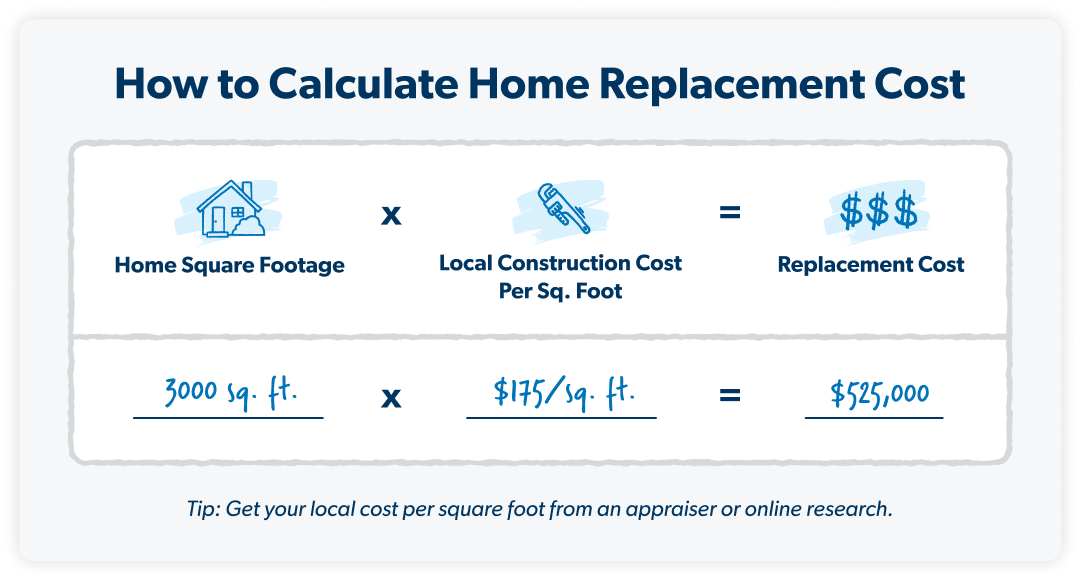
Multiply your home’s square footage by your local area’s average cost to rebuild per square foot and that number will tell you how much dwelling coverage to get.
|
Square Footage x Local Rebuild Cost per Square Foot = Dwelling Coverage Needed |
Let’s say your house is 3,000 square feet, and the average construction cost in your area is $175 per square foot. So, you multiply 3,000 by $175 and get $525,000. That’s the amount of dwelling coverage you should get.
You can find the average construction cost in your area by working with a RamseyTrusted pro or getting a quote from a local contractor or appraiser. You can also work with an insurance agent to get this number. And remember that your replacement cost is different from your home’s market value or how much you paid for it. You’re looking for how much it would be to rebuild.
How Do the Four Types of Dwelling Coverage Pay Out?
The four types are actual cash value, replacement cost, extended replacement cost, and guaranteed replacement cost. We recommend replacement cost coverage or better—not actual cash value.
Actual Cash Value
An actual cash value (ACV) policy will cover your house and belongings minus depreciation. So if you experience a house fire, your insurer will only pay for what the buildings on your property were worth when they burned down—not when you first bought them. That leaves you underinsured after depreciation, which is why ACV is a pitfall to avoid.
Replacement Cost
Replacement cost value (RCV) is an extra layer of protection. It doesn’t factor in depreciation. RCV pays to repair or replace your house up to its current value or the limit set by the policy. For instance, let’s say you have a $525,000 dwelling coverage limit and the rebuild costs $575,000. You’ll have to pay $50,000 plus your deductible. But if the rebuild only costs $500,000, your insurance will cover it—minus your deductible.
Extended Replacement Cost
Another option is extended replacement cost coverage. This will pay for the replacement value of your home (up to the coverage limit) but with an extra percentage of the coverage limit thrown in. It’s more expensive than basic replacement cost coverage but can come in handy if you live in an area where construction costs are rising quickly.
Guaranteed Replacement Cost
Guaranteed replacement cost gives you even more coverage, but you’ll pay more for it. It pays for the full replacement cost of your home and doesn’t factor in depreciation or dwelling coverage limits. So, if it costs $350,000, $400,000 or $500,000 to rebuild your home, that’s what the insurer will pay. No ifs, ands or buts about it.
How Do You Calculate the Replacement Cost of Your Personal Property?
To figure out how much personal property coverage you need, add up what it would cost to replace everything you own at today’s prices. The best way to do this is by creating an inventory of everything you own. This might sound hard, but we’ll give you a few tips on how to quickly check this off your list.
- Write it all down. Pick a weekend when you’ll have some larger blocks of time (in other words, Thanksgiving isn’t a good time to bite this off). Then go through your house and garage and write down everything you own and what it would cost to replace. Create a spreadsheet where you can total everything up. Estimate how much it would cost to buy each item new today—not what you paid for it 20 years ago.
- Make a digital record. Take photos and videos so you have an even more thorough record. And note more expensive items you’d get appraised like jewelry, guns or art, since there is a limit to what the insurance company will pay on those. You might need extra coverage for pricier items.
- Keep it safe. Finally, keep the spreadsheet and documents in a place where they won’t be lost if there’s a house fire.
Most people undervalue their belongings, so creating this inventory is crucial. When you actually add everything up, you might be surprised how much it’s all worth (and how much you still need to organize or get rid of!).
It’s also a good idea to send your inventory to your insurance company so they have the proof on file. This will help a lot when it comes time to file a claim. And don’t forget to set a reminder to update your inventory every year to make sure it’s current.
Now that you know how much your belongings are worth, you can figure out how much coverage to get. Usually, your policy limit for personal property replacement is around 50% to 70% of your dwelling coverage. But you can increase this limit if you need to.
How Do You Calculate Your At-Risk Assets?
To calculate your at-risk assets, add up everything a court could go after if you lost a lawsuit, like savings, vehicles, future wages and unprotected investments, then carry enough liability coverage to match it. If you don’t have personal liability insurance, many of your assets would be at risk in a legal battle. These assets include:
- Your vehicles (if they’re titled in your name)
- Future wages
- Savings
- Some investments, including real estate
- Personal belongings
- Boats
- Business assets
Depending on where you live, some assets may be protected and won’t be subject to seizure in a lawsuit. These include things like:
- IRA accounts
- Annuities
- Social Security benefits
- Equity in your home
- Employer-sponsored 401(k)s
Create a separate inventory of assets that would be at risk in a lawsuit. Once you have this number, you’ll have a better idea of how much liability coverage you need. You can purchase liability starting from $100,000 all the way up to $1 million—but we always recommend getting at least $500,000. If you have a higher net worth, you may want to look into getting umbrella insurance for an even stronger defense.
Why Is My Homeowners Insurance So Expensive?
Your homeowners insurance costs so much because of where you live, what it would cost to rebuild your home and the size of your deductible, plus industry-wide pressure from severe weather and rising claims costs. In 2024, all states saw double-digit rate hikes, while in 2025, disasters cooled a little but rates still increased by 4.6%.2, 3
You can’t change the weather, but you do still have some control: Check your declarations page, raise your deductible, and shop rates. Your insurance declaration page is just a fancy term for a summary of your insurance policy—you can see your deductible and how much coverage you’re paying for. If you have a fully funded emergency fund, raise your deductible to bring your premium down. And shop rates with a RamseyTrusted pro.
We’re not kidding when we say a pro could bring your premium down. Jamie from Birmingham, AL, left this ecstatic message on Facebook after working with a pro: “A 15-minute call saved over $1,000 a year with auto and over $1,000 a year with homeowners!”
How Do You Get the Right Homeowners Insurance Coverage?
The best way to get the right coverage is to work with a RamseyTrusted independent insurance agent. There’s a lot that goes into how homeowners insurance is calculated. It’s complicated!
If you’re tired of wondering how it all works or how to get the right coverage, let an insurance expert like the independent insurance agents we’ve vetted do the work for you. We trust them to look at your situation to help you find the best coverage at the best price. By working with a RamseyTrusted pro, you’ll have peace of mind knowing that your home and belongings are actually covered if something ever happens.
Next Steps
- Calculate your home’s rebuild cost by multiplying its square footage by your local cost to rebuild per square foot.
- Create a home inventory to find the replacement cost of your personal property.
- Total your at-risk assets to decide how much liability coverage you need.
- Connect with a RamseyTrusted insurance pro who can do the heavy lifting for you and shop rates on the right coverage for your home.
-
How much is the average homeowners insurance policy?
-
The national average is $2,490 a year—about $208 a month—for $400,000 in dwelling coverage, according to data by Quadrant Information Services, as reported by NerdWallet. But your cost will vary based on where you live, your home’s age, and how much it would cost to rebuild. It’s a good idea to calculate your own replacement cost instead of relying on an average.
-
Does homeowners insurance cover the market value of my home?
-
No. Homeowners insurance covers the cost to rebuild your home, not what you could sell it for on the open market. Those two numbers are often very different, since market value includes the land and local demand. So, you should base your dwelling coverage on your home’s replacement cost.
-
How can I lower my homeowners insurance premium?
-
Raise your deductible, but only if your emergency fund is fully funded to cover the higher amount. You can also bundle your home and auto insurance and install safety features like a security system or deadbolt locks. Then work with a RamseyTrusted pro to shop rates, since prices vary a lot between companies.
-
How much liability coverage do I need?
-
You need enough liability coverage to cover your total at-risk assets, including savings, investments and, depending on your state, home equity. We recommend at least $500,000—for the value you get, liability is one of the best insurance buys out there. If your net worth is higher than that, look into umbrella insurance for extra protection.
-
What is a homeowners insurance calculator?
-
A homeowners insurance calculator is an online tool that estimates coverage from generic data like square footage and zip code. You don’t need one. Multiply your home’s square footage by your local rebuild cost, add up what it would cost to replace your belongings, and total your at-risk assets.
Get Weekly Insights Delivered Straight to Your Inbox
Did you find this article helpful? Share it!

About the author
Ramsey Solutions

Get proven Ramsey answers fast.