
How to Track Your Monthly Expenses
 By
Key Takeaways
- To track expenses, create a monthly budget, record every dollar you earn and spend, and check your remaining balances regularly so you know how much you have left.
- You can track expenses with pencil and paper, the envelope system, a spreadsheet or a budgeting app.
- A budgeting app makes tracking expenses easier by doing the math for you. Some apps, like EveryDollar premium, can even connect to your bank and automatically import transactions.
You might have every dollar planned out at the beginning of the month. But if you're swiping your debit card without keeping track, that budget won't do you much good.
Quick Answer
To track your expenses, start by creating a monthly budget that includes your income and expenses. Then, record every dollar you earn and spend so you know how much money you have left. You can track with pencil and paper, envelopes, a spreadsheet or a budgeting app like EveryDollar that does the math for you.When you record what you spend throughout the month, you know exactly how much money you have left—and when it's time to pump the brakes on spending.
And don't worry, tracking your expenses doesn't have to take over your life. Let's walk through how to do it and find a method you'll actually stick with.
How to Track Expenses in 4 Steps
Tracking your expenses means recording every dollar you earn and spend so you know exactly how much money you have left in your budget. And just like other important habits (for example, flossing), it takes repetition to go from trying to remember to do it to doing it regularly.
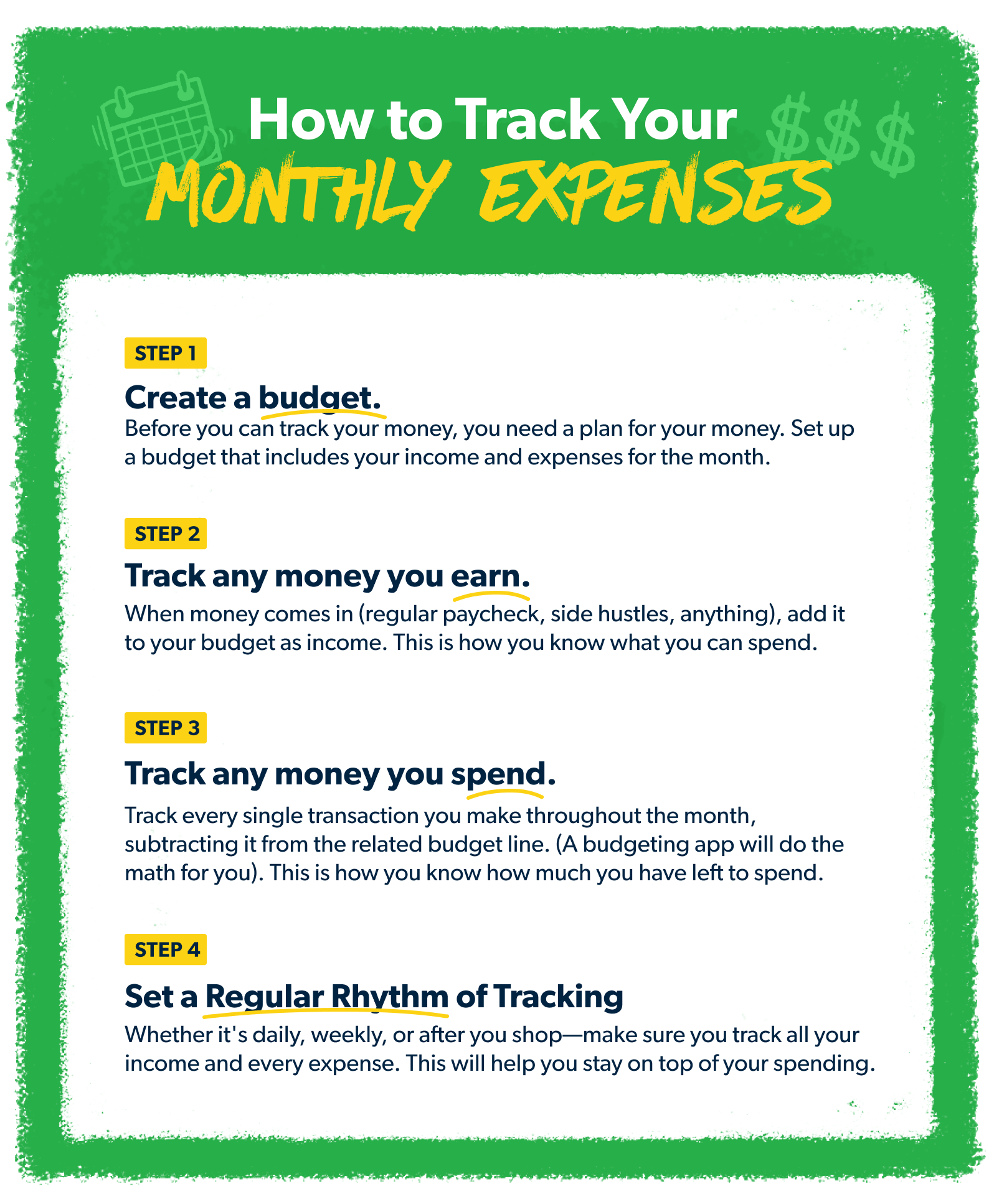
Here are four steps to help you get into the habit of expense tracking:
1. Create a budget.
Before you can track your expenses, you need to create a budget.
A budget is simply a plan for your money that you make every month. And listen, there are a lot of budgeting methods out there. But the best is a zero-based budget, where you give every dollar that comes in during the month a job to do—whether that’s giving, saving or spending.
If budgeting is new to you, you might be a bit confused. So, let’s talk real quick about how to set up your budget.
List your monthly income.
List out all the money you plan on making this month (that means your regular paychecks and any extras, like that side hustle). Add it all up. This is how much money you have to work with this month!
Got an irregular income? Just look back at what you’ve made the last few months. List the lowest amount as this month’s planned income. We’ll talk more about this in a moment.
List your monthly expenses.
Time to plan for everything you’re paying for this month—both your needs and wants. If you don’t know where to start, open up your bank account and take a look at your transactions from the past couple of months. That’ll give you a good idea of what your monthly expenses are.
When you’re ready to create your budget, list your expenses in this order:
- Giving (10% of your income)
- Savings (depends on your Baby Step)
- Four Walls (food, utilities, shelter/housing and transportation)
- Other essentials (insurance, debt, childcare, etc.)
- Extras (entertainment, restaurants, etc.)
You’ll want to break those categories (giving, savings, food, utilities, etc.) down into individual budget lines that accurately reflect your expenses for the month. For example, under Food, you could include a line for groceries and a line for eating out.
As you break those down, think about which expenses are fixed and which are variable. Fixed expenses, like your car payment and insurance, stay the same every month. But variable expenses, like gas and maintenance, can change from month to month. Giving each expense its own budget line makes it easier to track those costs.
Find Margin You Didn’t Know You Had With EveryDollar
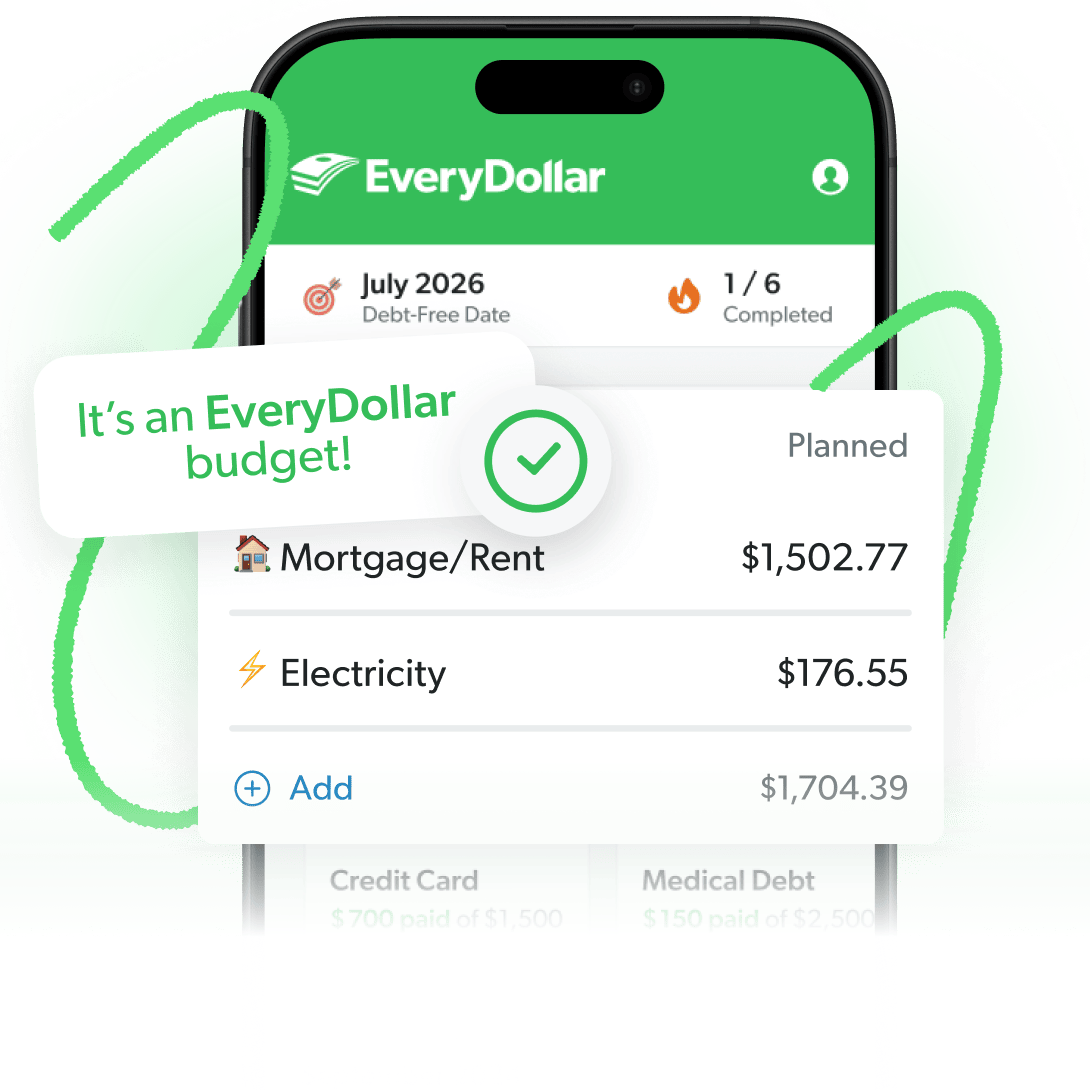
The EveryDollar budgeting app helps you find extra money every month so you can beat debt, build wealth, and make progress. Every. Day.
Subtract your expenses from your income.
A zero-based budget means your income minus your expenses equals zero. Start with your monthly take-home pay, then subtract each expense until you hit zero.
If you’ve got money left over, that’s awesome! Put it toward your current Baby Step (the Baby Steps are the proven, guided path to saving, paying off debt, and building wealth). If you’ve got a negative number, lower your planned totals or cut extras until you get zero.
Like we said before, it’s all about giving every single dollar you make a job to do. That way, your money’s working as hard as you.
Now that you’ve set up your budget, you’ve got to keep up with it. That’s where the tracking comes in!
2. Track any money you earn.
Every time money comes in, record it in the income part of your budget. That includes your regular paychecks, side-hustle money, and anything else you make from doing something like selling stuff you no longer need.
This step is super important if you have an irregular income. Remember, you planned low when you listed your income. So if your income turns out to be more than you planned, this is when you’ll adjust the number. Then you can put that extra money toward your current money goals.
Even if you’ve got a steady paycheck, you still need to track your income! For one thing, you can make sure nothing’s off with your paycheck. For another, you can create that habit of tracking.
3. Track any money you spend.
Track every single transaction. All month long.
When you fill up the gas tank, subtract that expense from your gas budget line. When you pay the rent, subtract that expense from your housing line. When you buy tickets to see your favorite boy band’s reunion tour, subtract that expense from entertainment (or maybe you’ve got a specific budget line just for concerts).
If you spend it, track it. Whether the money’s coming out of your wallet, bank account, PayPal, cash envelope, coin purse or old-fashioned piggy bank . . . you get the picture.
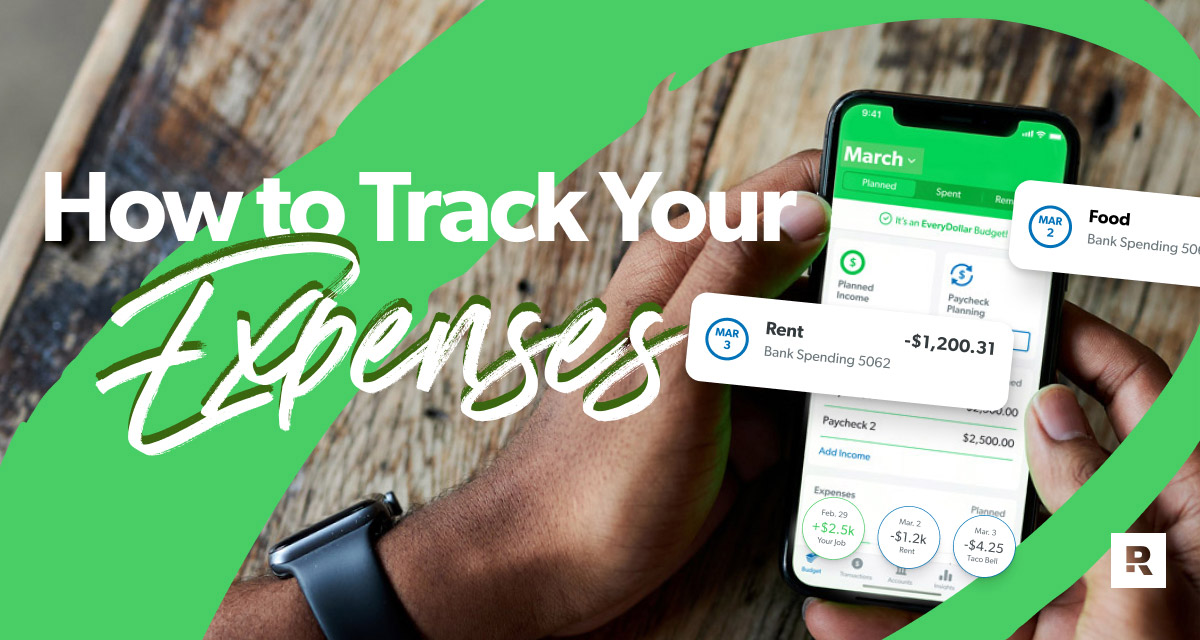
You can track your spending manually by entering each purchase yourself. Or, with EveryDollar premium, you can connect your bank so your transactions automatically stream into the app for you to review and categorize. Either way, the important thing is to keep up with your spending.
As you track your spending, make sure you’re subtracting too (even better if you’ve got a budgeting app that does the math for you). Then you can see how much you have left in your different budget categories for the month. This is a super important part of tracking because it’s how you keep yourself from overspending!
4. Set a regular rhythm for tracking.
Track your expenses regularly. That might be weekly or daily—or before you leave the grocery store parking lot.
Do whatever works for you and helps you keep up with all your expenses for the month. (If you know those paper receipts are just going to get lost in the bottom of your purse, don’t set yourself up to fail.)
Here's a Tip
Try the grocery store parking lot rule: Record your purchase before you even put the car in gear. That way, you won’t be digging through your purse for the receipt three days later trying to remember how much you spent.
Also, if you’re married, make sure you’re both working from the same budget and tracking expenses. This is great for accountability and communication. That way, neither one of you can say, “I didn’t know you spent most of the entertainment budget on zip-lining tickets. I wanted to sign us up for a couples hip-hop dance class.”
The more you track expenses, the more aware you’ll be of your spending. No more surprise transactions derailing your budget—you’re the one in control.
 What Are the Best Expense-Tracking Methods?
The best expense-tracking method is the one you'll actually stick with. You can use pencil and paper, the envelope system, a spreadsheet or a budgeting app like EveryDollar. They all get the job done, but some make tracking a whole lot easier than others.
|
Method |
Cost |
Effort |
Automatic Calculations |
Best for |
|
Pencil and paper |
Free |
High |
No |
Anyone who wants to start tracking with no setup |
|
Envelope system (cash) |
Free |
Medium |
No |
Tracking cash spending on things like groceries and fun money |
|
Spreadsheet |
Free |
High |
Only if you build the complex formulas |
People who enjoy creating and maintaining their own system |
|
EveryDollar (budgeting app) |
Free version available; optional premium upgrade |
Low |
Yes |
Anyone who wants an easier way to track spending in real-time, including married couples |
Any of these methods can work if you stick with them. But we recommend using a budgeting app because it does the math for you and makes it easier to keep up with your spending throughout the month.
Let's take a closer look at the pros and cons of each one.
Pencil and Paper
You can absolutely track your expenses with good old-fashioned pencil and paper. Whether it’s filling out a budget template or freestyling it on a yellow legal pad, plenty of people love a good paper budget to track expenses.
Pros
- You don’t need access to technology.
- Physically writing things down requires an active brain. (And active brains are really helpful when you’re dealing with money.)
Cons
- It takes a lot of energy to constantly write down and keep up with the math.
- If you misplace receipts, mix up your numbers, or forget to record some spending, that can lead to a busted budget.
Conclusion
Hey, tracking expenses with pencil and paper is way better than not tracking expenses at all. If it’s the way you want to go, then go for it!
Here's a Tip
If you want to start out with a paper budget and then move on to some other method, check out our Quick-Start Budget template.
The Envelope System
The envelope system helps you track your spending by using cash for as many budget expenses as possible. You can still autodraft expenses like retirement contributions, mortgage payments and some utility bills, and you might send checks or make a debit card payment online for other bills. But you’ll use physical cash for all the expenses you pay for in person.
To get started, label some envelopes with the budget lines you want to pay for in cash—like groceries, entertainment and restaurants. (You can also use a special divided wallet.) Then, fill each envelope with the amount of money you budgeted for that particular line.
Pros
- You know exactly when to cut back on spending because you see when the cash in the envelope starts getting low.
- You don’t overspend because when the envelope is empty, you’ve got nothing left to spend. (Your money is essentially tracking itself!)
Cons
- Sometimes paying in cash is inconvenient.
- Paying with cash isn’t always an option.
Conclusion
Physically watching the money leave the envelope inspires a whole new level of responsibility. Even if you go with a different method to track expenses, doing the envelope system with at least some of your budget lines is a great way to manage your money.
Spreadsheets
You can also track your expenses with a spreadsheet. If you love a good formula, this might be right up your alley.
Pros
- Spreadsheet enthusiasts love all the template options.
- You can customize your budget.
- You can set up your spreadsheet so it does the math for you.
Cons
- Spreadsheet enthusiasts aren’t always married to fellow spreadsheet enthusiasts. This can cause some friction in the money and marriage department.
- You can update a spreadsheet on your phone, but scrolling through rows and entering transactions on a tiny screen can be a pain. And if you aren’t regularly entering your expenses, your budget’s not doing you any good—it’s just a spreadsheet full of plans.
Conclusion
If spreadsheets are the only way you (or your spouse) want to budget and handle expense tracking, that’s cool. But know there are more convenient tracking methods out there.
Expense-Tracker Apps (AKA Budgeting Apps)
Budgeting apps make tracking your expenses easier by keeping your budget right on your phone. And since most of us always have our phones on us, that means we can always have our budgets on us! Brilliant.
Pros
- You can log in on your phone and track your expenses immediately, no matter where you are. So convenient!
- You don’t have to do the math—the app does it for you.
- Many budgeting apps have features to help you create your budget and keep up with your money. With EveryDollar premium, you can even connect your bank so your transactions automatically stream into your budget.
- Sharing the same budget with your spouse is super easy.
Cons
- You need access to technology.
- The company who made your app could shut it down (like with the Mint situation), and you could lose your budgeting history.
Conclusion
A budgeting app is our favorite way to track expenses because it makes it way easier to create a budget, keep up with your spending, and stay on the same page with your spouse if you’re married. Win, win and win!
What’s the Best Expense Tracker for You?
We recommend EveryDollar! It's a free budgeting app that makes it easy to track your spending and stay on top of your money throughout the month.
EveryDollar helps you find extra margin every month so you can start making real money progress, really fast. Just download the app, answer a few questions, and we’ll build you a personalized plan, based on your situation, to free up margin and make the most of every dollar. Every day. (See where we got the name?)
Next Steps
- Download the EveryDollar budgeting app. Create your free account so you can start planning and tracking your money.
- Make your first budget. List your income and expenses, then subtract your expenses from your income until you get zero.
- Track your first transaction. The next time you spend money, record it in your budget. Then keep it up throughout the month!
Frequently Asked Questions
-
How often should I track my expenses?
-
You should track your expenses every time you spend money, or at least once a day. The sooner you record a transaction, the easier it is to remember what you bought and how much you spent. Plus, you'll know exactly how much money you have left in each budget line before you make another purchase.
-
Is EveryDollar free to use?
-
Yes! EveryDollar has a completely free version that lets you create a custom budget and manually track your expenses. If you'd rather have your bank transactions automatically stream into your budget, you can upgrade to EveryDollar premium for even more features.
-
What is the best free way to track expenses?
-
The best free way to track expenses is with a method you'll actually stick with. Pencil and paper and the envelope system are both free options. Or you can use a free budgeting app like EveryDollar to track your spending right from your phone without having to do the math yourself.
-
Should I track my income too?
-
Absolutely! You should track every dollar you earn, not just what you spend. That way, you know exactly how much money you have to work with each month. This is especially important if you have an irregular income. And if you earn more than you planned, you can give that extra money a job in your budget.
-
How do married couples track expenses together?
-
Married couples should work from one shared budget and both take responsibility for tracking expenses. With a budgeting app like EveryDollar, you and your spouse can log in and see the same budget, so you're both working with the same numbers. That means fewer surprises when one of you checks how much money is left for groceries!
Get Weekly Insights Delivered Straight to Your Inbox
Did you find this article helpful? Share it!

About the author
Ramsey Solutions

Get proven Ramsey answers fast.