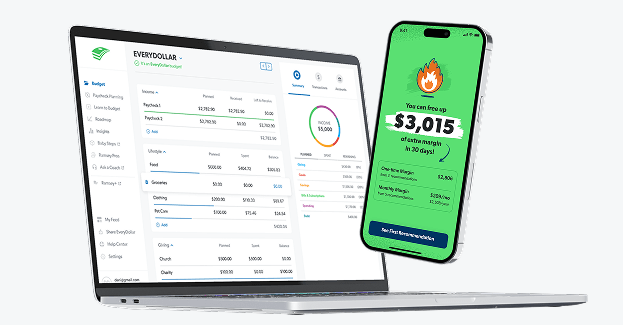
EveryDollar Budget App
With EveryDollar, you’ll find extra margin every month and get a personalized plan to make the most of it. Every day.
Guide Contents

If you're wondering how to start a budget—and actually stick to it—you're in the right place.
When you make a budget every month, you give every single dollar coming in (income) and going out (expenses) a purpose. Instead of wondering where your money went, you’re telling it where to go. You’re taking control.





Let’s put some breathing room in your budget. With EveryDollar, you’ll keep tabs on your spending and you could uncover an extra $395 on average in your first month.
That’s real money you can put toward beating debt and building wealth. You’ll feel like you got a raise!
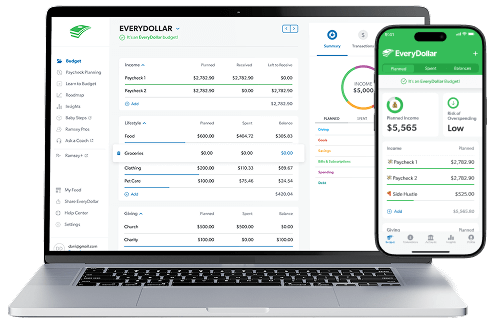

You can make (and keep) a budget no matter your income, your money goals or whether you’ve ever budgeted before. And these five steps will show you exactly how to do it.
But first: Open up your online bank account or pull out those hard copy bank statements from the past couple months. Trust us—it makes the process way easier when you can look back at your numbers.
Income is any money you plan to get during that month.
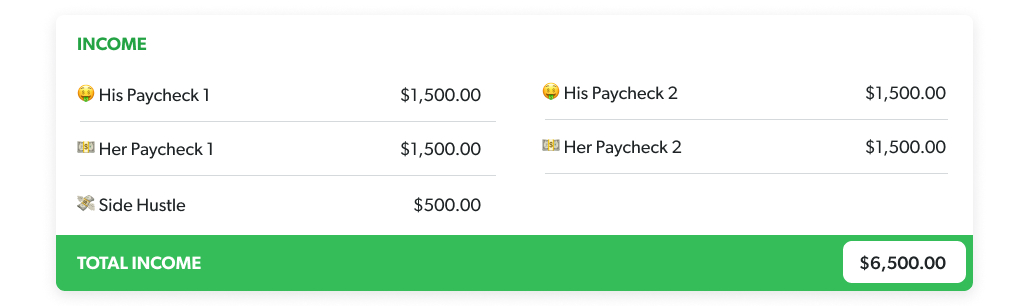
Create separate income budget lines for every paycheck you (and your spouse, if you’re married) make, plus anything extra coming in (like a side hustle).
Next, it’s time to list everything you plan to spend that month and give each expense a dollar amount. (Yep, this is when that bank account or statement gets super helpful.)
Make budget categories, and then create budget lines underneath each category.
Think of a budget category like a folder and the budget lines like the files inside it. For example, Food is a budget category, and Groceries and Eating Out are budget lines that go under it.
With all these different expenses to keep up with, you might think you need multiple bank accounts to keep everything organized. You don’t—that’s what your budget is for. And for bigger expenses you need to save up for over time, sinking funds can help you set aside money little by little without opening a new account for every single one.
Think through these main areas as you’re jotting down expenses:
Before you put the things you pay for every month into your budget, set aside money for giving. We believe in putting 10% of your income here and always having a spirit of generosity!
Also, if you don’t have an emergency fund yet, you need to make saving one of your priorities— starting with Baby Step 1. We talk about this more in the How to Make a Budget for Your Money Goals section.
Next, cover your Four Walls: food, utilities, shelter and transportation.
By the way, that Grocery budget line is super hard to guess at first, so just start with your best estimate based on your past spending. You’ll learn what you actually need to budget after a few months.
Next up, list all other monthly expenses:
Okay, that was a lot. Let’s do a quick recap. We’ve covered some expenses that might not apply to you, but this list should give you a good idea of what your budget categories could look like:

Now that you’ve organized every expense and given each budget line a dollar amount, subtract all your planned expenses from your income. This number should equal zero. We call this a zero-based budget.
Now, a zero-based budget doesn’t mean you let your bank account reach zero. Leave a little buffer in there of about $100–300. It also doesn’t mean you blow all your money.
Zero-based budgeting just means you give every dollar a job to do—giving, saving, spending. It’s all accounted for and has a purpose.
Don’t leave it there. You’ll end up mindlessly spending it on dollar bin items and one-click wonders. Put those dollars to work by putting any “extra” money toward your current money goal.
Cut expenses until your income minus your expenses equals zero. (Hint: Start with those Eating Out and Entertainment budget lines.)
You can also get a side hustle or work overtime. Just remember—if you increase your income, don’t increase your spending! Use that extra cash to cover your budgeted expenses and get your numbers back to zero.

Track every dollar you earn and spend throughout the month. That’s how you keep your budget up to date and know exactly where your money is going.
When you make money, track it in your budget. When you buy absolutely anything, track it too. Keeping your eyes on your spending helps you know how much you have left so you don’t overspend.
Tracking transactions is such a huge key to winning with budgeting (and money) that we have a whole section below about how to do it and why it’s important.
Ready to make tracking easier? With EveryDollar, you can connect your bank so your transactions stream right into your budget.
Make a new budget every single month before the month begins. No two months are exactly the same, so your budget needs to change right along with your life.
Start by copying over this month’s budget to the next. Then make changes for anything new that’s coming.
If you’re struggling to find money for those categories, cut back spending somewhere else and move that money over or crank up your income for the month. (Time for an extra freelance gig!)
P.S. Having an accountability partner really helps during those first months of budgeting (and during the whole journey). We’ll cover that below.
If you’re new to budgeting, this calculator gives you a quick example of what your monthly budget could look like. Just type in your monthly take-home pay to get a solid starting point.
This calculator gives you a quick snapshot. But the EveryDollar budget app helps you turn those numbers into an actual monthly budget you can personalize, track and adjust as life happens.
Plus, you’ll find extra margin you can put toward beating debt and building lasting wealth.
With EveryDollar, you’ll find extra margin every month and get a personalized plan to make the most of it. Every day.

Use our envelope system to pay cash for those hard-to-wrangle budget lines (like Groceries, Restaurants and Entertainment).

With six colors to choose from, this leather wallet is the most stylish way to organize your spending.
Want to try the pen and paper method first? Download our budgeting forms to help you get started—including our free and easy starter budget template.
If your income changes from month to month, build your budget around the lowest amount you’ve made in the past few months. Then, if more money comes in, adjust your budget and put those extra dollars to work.
That’s the whole trick: Budget for the floor, not the ceiling. If you get a bigger paycheck, don’t let that money slip through the cracks. Send it toward your current money goal or another budget line that needs it.
As your income changes throughout the month, so does your budget. EveryDollar makes it easy to adjust your numbers as income comes in so an irregular paycheck doesn’t have to mean an irregular plan.
Check out our Irregular Income Budget Planning form for more help!
Tracking your transactions means recording every dollar you earn and spend so you always know where your money stands. And yep, we mean every single one.
It’s the fourth step in our five-step budgeting breakdown. And now, we’ll dive into exactly how to do it:
Pro tip: With EveryDollar, tracking is a breeze. You can connect your bank to your budget so transactions stream right in. You just drag and drop them to the right budget line. Boom.
Tracking your transactions keeps your budget accurate, helps prevent overspending, and shows you where your money is actually going.
That means you can:
To budget for your money goals, decide what you’re working toward and make it a line item in your monthly budget. A budget is how you tell your money where to go—and if you want that money going toward paying off debt, saving for vacation, or prepping for emergencies . . . well . . . you need to budget for it.
Here are some tips for budgeting for your money goals:
If you don’t know which money goal to go after first, check out the 7 Baby Steps (aka the proven plan to save money, get out of debt, and build wealth).
Pro tip: If your goal is to pay off debt (Baby Step 2) or save for emergencies (Baby Steps 1 and 3), it’s best to work on those one at a time. After you free up your income and have the security of that stacked emergency fund, you’ll have margin to multitask on other goals like investing, saving for your kids’ college, or paying off your house.
If you’re trying to save money for a big expense, create a sinking fund. This is a way to save up by setting aside money each month. You just divide the amount of money you need by the months you’ve got to save. Voilà. Now you know how much to put in your monthly budget for this money goal. So, if you need $1,200 for a summer vacation in four months, you’d need to save $300 a month.
If you want to pay off debt, we recommend using the snowball method:
Want to see how soon you can be debt-free? Check out our Debt Snowball Calculator.
And finally, if you want to save up an emergency fund, you only need two things: a budget line for emergency fund savings and the mindset that this is a priority with your money!
Okay, but where do you get that extra money for your vacation savings or debt snowball or emergency fund? Good question. Here are a few ways to get more money to put toward your goal:
Some money goals take longer than others. Don’t. Give. Up. You have what it takes to pay off your debt, save for the future, build legit financial security . . . the list goes on. Keep budgeting. Keep working. You’ve got this!

A budget helps you spend and save on purpose—from groceries to summer vacations and everything in between. These tips will help you stick with your budget and keep making progress.
One of our top budget tips is to pick the best method out there: zero-based budgeting.
Zero-based budgeting is how you get intentional with your money. All of it. Any “extra” money left after you list out your expenses doesn’t stay extra—it’s given a purpose and a job. Put it into a budget line so it doesn’t get spent accidentally.
And it doesn’t matter if you get paid weekly, biweekly or monthly. Zero-based budgeting will work for you.
Remember, you work hard for your money. Every single dollar should work hard for you. That’s the power of the zero-based budget!
Have you ever made a goal that was totally setting you up for failure? Like saying you’ll read 10 books a month when you barely have any free time? If you want to succeed, you have to push yourself—but you also have to be realistic.
The same is true with your budget. Push yourself to spend better and save more, but be realistic for your life. When you keep it real, you can really win.
You may want to break some of your budget lines into weekly portions to help you spread out your spending. This is super helpful if you get paid more than once a month—but it’s a great trick for any budgeter.
For example, if you give yourself $200 for Personal Spending, think of it as $50 a week. If you plan for $600 on groceries, that’s like spending about $150 a week.
Sometimes thinking in these bite-size amounts makes it easier to stick to your budget.
We mentioned this before, but you need a little space for anything that pops up or that you forget (like school photos or your anniversary—wait, don’t forget that!). A Miscellaneous budget line helps you cover these expenses without busting your budget or running to the credit card. Speaking of which . . .
We’ve got about a million reasons (at least) to stop using your credit cards, but here are just two.
First: If you’re using credit cards to pay for normal monthly expenses and making a bulk payment at the end of the month—that’s a bad money management system.
Paying that lump sum means you don’t see how often you buy breakfast biscuits on the way to work. What if you’re literally eating away at what could be a healthy retirement fund? When you track every expense, your expenses can’t hide from you.
Second: If you get behind on payments, you rack up interest and get stuck in the cycle of paying off last month’s expenses this month.
You can never get ahead that way. Budget this month’s money to pay for this month’s expenses—and to save for the future! That’s how you take control of your money.
The decisions you made yesterday don’t have to determine today. When you make mistakes with your money (and you will—everyone does) don’t throw a pity party. Keep. Moving. Forward.
Don’t worry about what everyone on social media appears to have. Some of them are lying. Some are in debt up to their designer sunglasses. And a few really do have their lives together. But those people worked hard for it—and that’s what you’ll do too.
Work hard defending your budget and say no or not now when you need to. Being true to yourself, your budget and your money goals is more valuable than anything you could ever buy.
It usually takes three months to get a handle on this whole budgeting thing. It won’t be perfect the first time or the second time. But you’ll get there! Give yourself grace as you go.
Budgeting isn’t a sprint. It’s a marathon, a commitment, a lifestyle! Keep all these tips for staying motivated in your back pocket and pull them out whenever things get hard.
And when it does get tough, remember: You’re tougher.
An accountability partner can help you stick with your budget and keep you moving toward your money goals.
When you’re in the thick of making any goal happen, knowing you’ve got someone checking in makes all the difference. And budgeting regularly is not only a great goal—it’s also the foundation for hitting all your other money goals!
Listen, there’s no shame in asking someone to help you keep your eye on the goal. Just the opposite. There’s incredible strength in seeking accountability.
Here's some info to help when you're looking for and working with your accountability partner.
Pick an accountability partner who’ll cheer you on, keep you honest, and call you out when you need it. You want someone who’s in your corner—but won’t let you make excuses.
Got a spouse? Boom. You’ve got a built-in accountability partner, which brings its own challenges (we’ll get to that in a second).
But if you need to handpick your accountability partner—or want to find another couple to check in with—look for these characteristics:
Check in with your accountability partner every month and use that time to set up next month’s budget. Married couples can do this together at a monthly budget meeting. If you’re working with a friend or family member, you can build the budget on your own—but don’t skip the check-in.
If you aren’t sure what to actually do in these meetings, grab yourself a copy of our budget meeting guides (we’ve got a classic and couples edition).
To get on the same page with your spouse, you guys need to sit down and talk about your money. Rachel Cruze recommends four rules to help you do money conversations well: Be honest, listen, stay calm, and show grace.
Your spouse is your built-in accountability partner, so bring the same encouraging, honest and present qualities to your money conversations—especially the hard ones.
1. Be honest.
Be honest about what you believe and how you feel about money, dreams and your life together. Then let your spouse do the same. These vulnerable conversations can strengthen your relationship and help you understand where the other person is coming from.
2. Listen.
Really listen. Don’t just wait for your turn to talk. Ask questions—before you share your own thoughts—so you actually understand why your spouse feels the way they do.
3. Stay calm.
Keep your cool, even when the conversation gets hard. Raising your voice usually turns up the temperature instead of solving the issue. So, stay calm, ask questions, and focus on understanding each other.
4. Show grace.
Being too hard on yourself or your spouse won’t help. Bring grace and truth together, and you can work through hard truths instead of around them.
If you want more help with this, take Financial Peace University together. This nine-week class works whether you’ve been married five minutes or 50 years, and you’ll learn how to talk about money, set goals, and budget as a team.
Let’s be honest—sometimes all this budgeting stuff gets . . . well . . . exhausting. It can be tough to maintain that drive to hit your money goals.
Here are eight tips and tricks to keep the motivation going along the way.
If you hang out with senseless spenders, you can be tempted to do the same. Find some friends who won’t pressure you to do stuff outside of your budget.
Okay, not just any app. Our app: EveryDollar. Because you can try to keep up with pencil and paper or spreadsheets, but they aren’t as easy. Budgeting made easy is the whole point of EveryDollar! And let’s face it, an easier budget is one you’re way more likely to stick to.
Dig deep and be honest about the reasons you want to take control of your money once and for all. That’s your why. And when things get tough or boring, remember your why!
Hang up images around the house that represent your goals. Paying off that car? Put a picture of it on your fridge to remember why you’re cooking at home instead of ordering that delivery pizza.
Lower the risk of budgeting burnout by budgeting for fun. Now, if you’re saving for an emergency fund or paying off debt, that fun money will be a small amount. But it’s just for a season. You’ve got this!
When you reach a goal—even a small one—celebrate! After you budget three months straight, pay off a debt, or cut extra spending for 30 days, treat yourself to a free or budget-friendly reward.
If you respond to stress by impulse buying, replace that habit with a better one. A relaxing bath, a walk or run outside, a card game with your family, a cup of chamomile tea—these are all great (and inexpensive) ideas.
Hey, burnout happens to us all. Go ahead and decide now what you’ll do when it comes. Just don’t give up on budgeting. It’s how you’ll make your money goals happen, and that’s worth fighting for!
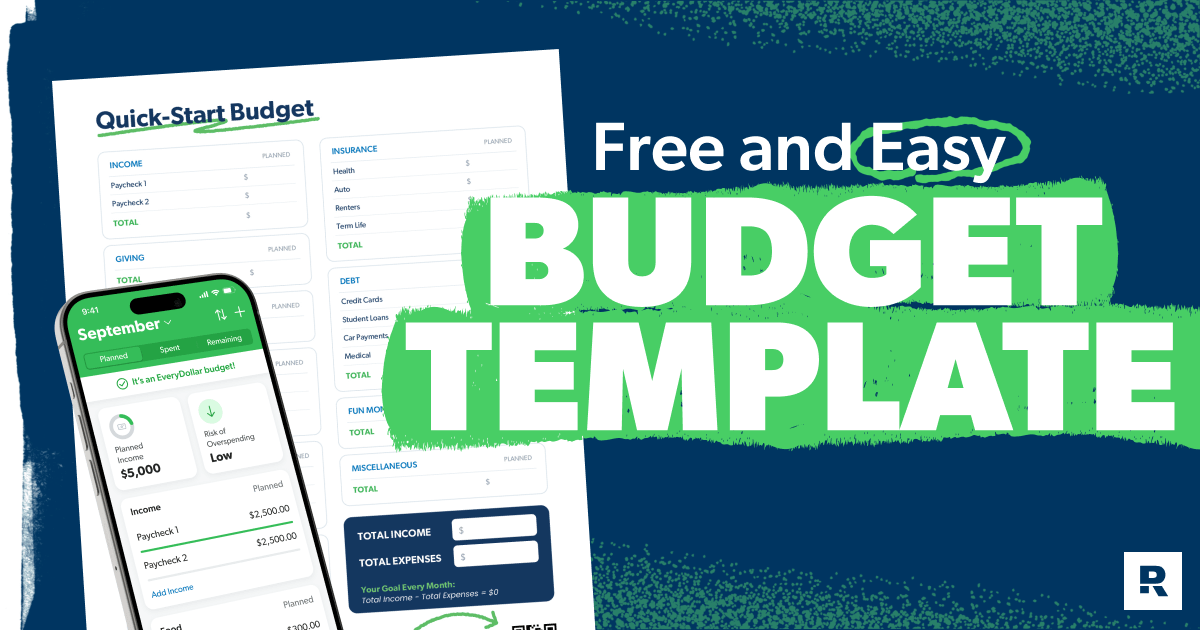
If you’ve never budgeted before (or it’s been a while) jumping in can be challenging. You know what'll help you feel confident as you start? A budget template!
 Ramsey Solutions
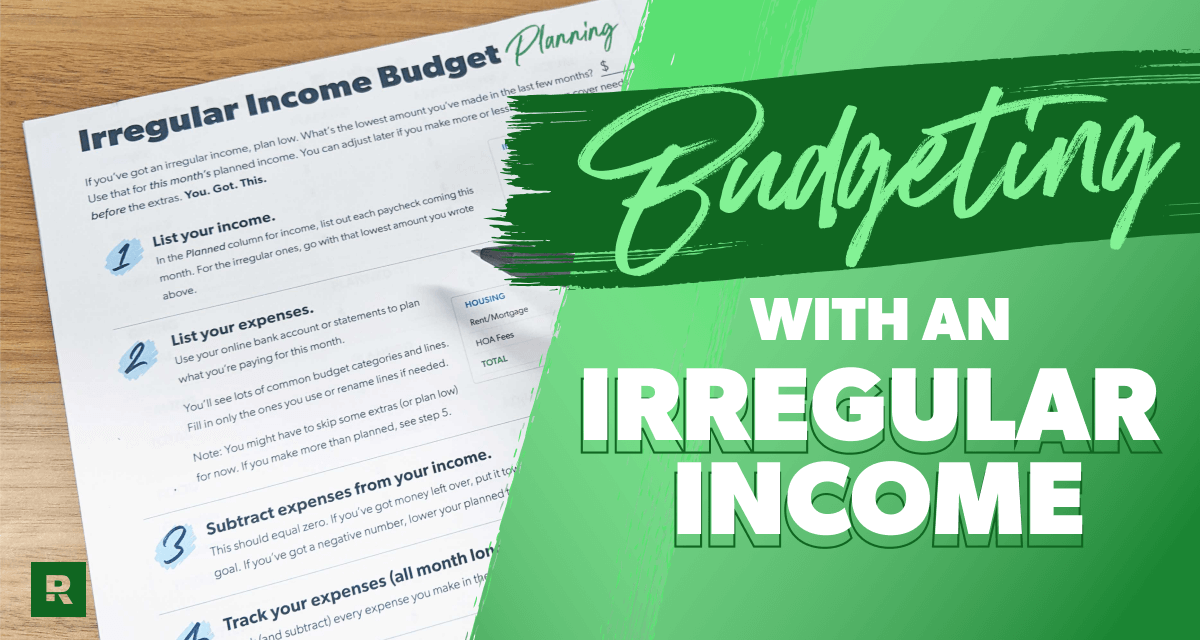
Is your paycheck different from month to month? Learn how to manage irregular income and create a budget that keeps you in control—no matter how much you earn.
Ramsey Solutions

Whether you're new to budgeting or looking to improve, these budgeting tips will help you take control, stay on track, and feel confident with your money.
 Rachel Cruze
A budget is a plan for your money—every single dollar that’s coming in (income) and going out (expenses). It helps you decide where your money will go before you spend it so you can stay in control of your money and work toward your money goals.
Budget for your Four Walls—food, utilities, shelter and transportation—before other expenses. These are the basics you need to keep yourself and your family fed, housed and moving. Once those are covered, you can work your other expenses and goals into your budget.
How much you save each month depends on what Baby Step you’re on (aka the proven path to saving money, ditching debt, and building wealth). Your current Baby Step helps you know which savings goal gets priority, whether that’s building an emergency fund, investing for retirement or saving for another goal.
Once you’re debt-free and have a fully funded emergency fund, start investing 15% of your gross household income in retirement accounts. That’s Baby Step 4. And yep, that’s 15% of your income before taxes—not your take-home pay. Make that investing amount part of your monthly budget so you stay consistent.
Keep up with your budget wherever you’ll actually use it consistently. You can budget with pencil and paper, a spreadsheet or a budgeting app. Just make sure you’re budgeting every dollar, every month. If you want an easy way to plan and track your budget in one place, check out our EveryDollar budget app!
We recommend zero-based budgeting because it gives every dollar you make a job to do. Your income minus your planned expenses equals zero, so there’s no “extra” money floating around waiting to get accidentally spent. Other budgeting methods exist, but zero-based budgeting puts you in control of every dollar.
Beginners can make a budget in five steps: List your income, list your expenses, subtract your expenses from your income, track your transactions all month long, and make a new budget before the next month begins. The real trick is sticking with it. Give yourself grace while you learn, and keep going.
Give yourself about three months to get the hang of budgeting. Your first budget probably won’t be perfect—and neither will your second. That’s completely normal. Keep making a new budget every month, tracking your spending, and adjusting your numbers based on what you learn. You’ll get there!
Absolutely! You can budget with an irregular income by looking at what you’ve made over the past few months and using the lowest amount as this month’s planned income. Then, if you make more during the month, adjust your budget and put those extra dollars toward your current money goal or another budget line.
Budgeting is making a plan for your money before you spend it—so you’re telling your money where to go instead of wondering where it went. At Ramsey, we use a zero-based budget, where your income minus your expenses equals zero because you’ve intentionally given every single dollar a job to do.
A budget should include every category where your money will go that month. Your exact categories will depend on your life, but here are some common ones:
Create a personal budget by listing your income and expenses then customizing your categories around your actual life and money goals. The goal is to give every dollar a job without getting too in the weeds. Maybe you don't need to specifically budget for plant seeds, but your gardening hobby overall might get its own budget line.
Make a new budget every month before the month begins. Each month will look a little different, so your budget should flex with it.
If you get paid weekly, biweekly or monthly, just plan your expenses around each paycheck and adjust as needed.
If your income changes every month, look at what you’ve made over the past few months and use the lowest amount as your planned income. That gives you a conservative starting point for your budget. Then, if more money comes in during the month, adjust your budget and put those extra dollars to work.
Stick to your budget by planning your spending before the month begins, tracking your transactions as you go, and adjusting when life happens. It’s also important to remember your why—the reason you’re budgeting in the first place—whether that’s getting out of debt, saving for a vacation, buying a house, or reaching another money goal.
Before you jump into the bills and other expenses, set aside money for giving. We believe in putting 10% of your income here. And if you don’t have an emergency fund yet, make savings one of your priorities. Next is the Four Walls: food, utilities, shelter and transportation. Create a budget category for each of these. Do the same with your remaining essentials like insurance, childcare and debt (if any). Finish with nonessentials like personal spending, entertainment, dining out, subscriptions and miscellaneous.
If you go over budget in one line, move money from another line to cover it and keep your overall budget balanced. Don’t panic or give up on the whole budget because one number was off. Then use what you learned to plan that line more accurately when you make next month’s budget.
Yes. It doesn’t matter how much you make—budgeting is about what you do with what you make. Some people making six figures a year living paycheck to paycheck because they don’t manage their money well. A budget gives you clarity, direction and peace with your money, no matter your income.
The easiest way to start budgeting is to follow five simple steps: List your income, list your expenses, subtract your expenses from your income, track your transactions all month long, and make a new budget before the next month begins. Don’t worry about getting everything perfect your first month—just start.
The best tool is the one you’ll actually use and stick with. Look for something that makes it easy to plan your spending, track your transactions, and adjust your budget throughout the month. You can use pencil and paper, a spreadsheet, a template or a budgeting app like EveryDollar.
The 50/30/20 rule is a budgeting method that splits your take-home pay into three buckets: 50% for needs, 30% for wants, and 20% for savings and debt payoff. At Ramsey, we recommend zero-based budgeting instead because it gives every single dollar a job based on your actual needs and goals.
If you get paid weekly or biweekly, you can still make a monthly budget! But it can be helpful to plan out your spending weekly to make sure you're not overspending between paychecks. Plan around when your major bills hit, and break your other expenses into weekly amounts.