
How to Invest in Mutual Funds
 By
Key Takeaways
- Mutual funds are a solid choice for long-term investors thanks to their lower costs, instant diversification and active professional fund management.
- To start investing, calculate your budget, open a tax-advantaged account, then split your choices evenly across four fund types—growth and income, growth, aggressive growth and international.
- A financial advisor can help you choose the right mutual funds for your retirement portfolio, keep tabs on the market, and help manage your investments for long-term success.
We’ve all been there. You know you want to start investing in mutual funds. The problem is all the things you don’t know. How much should you invest? What type of accounts should you use? What does researching mutual funds even involve?
Before you know it, the whole process feels trickier than folding a fitted bedsheet. Relax, we’ve got you covered.
Quick Answer
To invest in mutual funds, you should first be debt-free (except the mortgage) with a 3–6-month emergency fund. Then, invest 15% of your gross income in a mix of four types of mutual funds—growth and income (large-cap), growth (mid-cap), aggressive growth (small-cap), and international—using tax-advantaged accounts like a 401(k) or Roth IRA.Let’s get you up to speed on everything you need to know about what mutual funds are and how to invest in them with confidence. We’ll walk through it together step by step and in plain English.
What Are Mutual Funds and How Do They Work?
A mutual fund is a type of investment that pools money from lots of different investors to buy a diversified portfolio of stocks, bonds or other assets. Each investor’s initial investment rises or falls by the same percentage as the value of the portfolio.

Here’s a good way to visualize how mutual funds work: Imagine a group of people standing around an empty bowl. They each take out a $100 bill and place it in the bowl. These people just mutually funded that bowl.
It’s a mutual fund. Makes sense, right?
Now, imagine that a mutual fund manager takes the money and uses it to buy a collection of investments on the group’s behalf. The result is a portfolio that all the investors share and the fund manager . . . well, manages.
The value of each group member’s investment goes up or down in value at the same rate as the total value of all the investments in the portfolio. That’s why investing in mutual funds makes it easy to gain exposure to lots of different investments without trading single stocks.
How Do You Invest in Mutual Funds?
Now it’s time to get down to business! If you’re ready to start investing in mutual funds, just follow these five steps and you’ll be well on your way:
1. Calculate your mutual fund investing budget.
Ramsey recommends investing 15% of your gross income in tax-advantaged retirement accounts. That’s Baby Step 4, and it comes after you’ve paid off all debt (except the mortgage) and saved 3–6 months of expenses in an emergency fund.
Why invest 15% of your gross income? Why not more or less? Because at Ramsey, we’ve seen millions of Americans become Baby Steps Millionaires by investing 15% consistently over time while still having enough money for other important financial goals—like saving for their kids’ college and paying off their house early. If they could do it, so can you.
For example, imagine you make $65,000 a year. You do a little math and determine that 15% of your gross income is $9,750 per year. To find out what that looks like monthly, you divide $9,750 by 12 and come up with $812.50 a month.
To keep it simple, we’ll say your goal is to invest about $800 every month. Depending on how your mutual funds perform, here’s what could happen if you invest that amount from age 35–65:
|
Monthly Investment |
Years Invested |
Assumed Annual Return |
Estimated Value at 65 |
|
$800 |
30 |
10% |
$1.8 million |
|
$800 |
30 |
11% |
$2.2 million |
|
$800 |
30 |
12% |
$2.8 million |
We used 10–12% because that’s the historical average annual return of the S&P 500 over a 30-year period.1 The goal of a good growth stock mutual fund is to beat the performance of the market, so your returns could be even higher.
These numbers assume a $65,000 annual household income from age 35–65. This means that even if you never get a raise, never switch to a higher-paying job, and never receive an employer match throughout your career, you can still retire as a millionaire. A freaking millionaire!
Building wealth takes discipline, and it doesn’t happen overnight. If you want to invest for your future, you need to plan on investing consistently—no matter what the market is doing.
2. Open tax-advantaged retirement accounts.
A tax-advantaged retirement account, like a workplace 401(k) or a Roth IRA, is a great place to start investing in mutual funds.
And if you get a company match on your 401(k) contributions, even better. That’s free money and an instant return on your investment! But don’t count the match as part of your 15% goal. It’s nice to have, but it’s just the icing on the cake of your own contributions.
If you ever get confused about where to start investing, just remember: Match beats Roth beats traditional.
Here’s what that looks like: If you have a traditional 401(k) at work with a match, invest up to the match. Then, open a Roth IRA. With a Roth IRA, the money you invest in mutual funds goes further because you use after-tax dollars—which means you won’t have to pay taxes on that money when you withdraw it in retirement. It’s all yours!
The only downside to a Roth IRA is that it has lower contribution limits than a 401(k). It’s possible to max out your Roth IRA without reaching your 15% goal. That’s okay. Just go back to your 401(k) and invest the rest of your 15% there.
Have a Roth 401(k) with good mutual fund options? Even better. You can simply invest your whole 15% in that account and boom—you’re done!
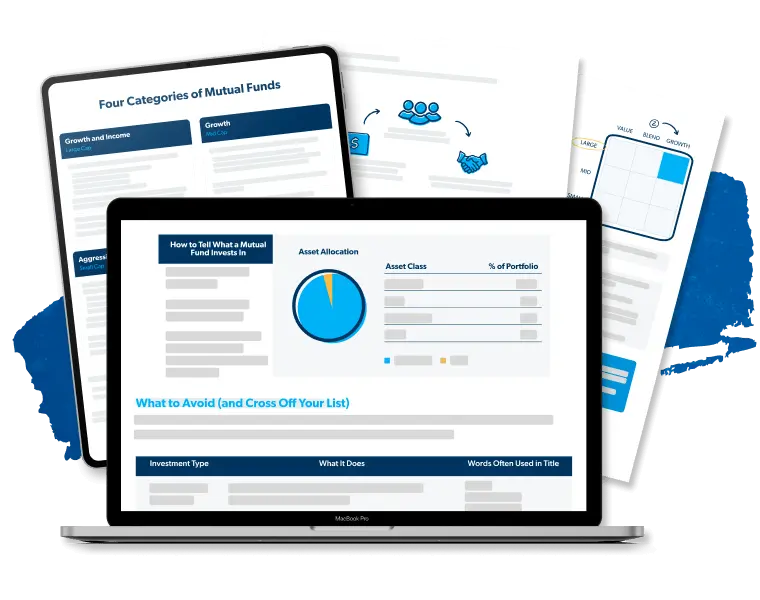
Decode Your Retirement Plan Options
Get a free, interactive guide that takes the mystery out of choosing investments for your 401(k), 403(b), or any other employer-sponsored plan.
3. Research and narrow down your mutual fund choices.
Researching mutual funds largely comes down to knowing what information to look for—and where to find it on mutual fund fact sheets.
Also known as a fund summary or fund overview, a fund fact sheet breaks down the key details you need to know to decide if an investment is right for you. For a deeper dive, you can also check out a fund’s prospectus, which is a legally required disclosure document with even more detail.
Let’s break down which sections of a fund fact sheet to focus on and what to look for in each:
- Objective: This is simply a summary of the mutual fund’s goal and how the fund’s management team plans to achieve that goal. This section can also help you figure out what type of mutual fund an investment is. We recommend sticking to growth stock mutual funds—funds that invest primarily in stocks and have a history of outperforming the market.
- Asset allocation: If the objective doesn’t reveal the type of mutual fund, check out the asset allocation section. It’ll break down what type of investments (stocks, bonds, cash, etc.) are in the fund’s portfolio.
- Performance (rate of return): Again, you want a history of strong returns for any fund you choose to invest in. Focus on long-term results—10 years or longer if possible. You’re not looking for a specific rate of return, but you do want a fund that consistently outperforms most funds in its category.
- Expense ratio: A mutual fund expense ratio is an annual percentage of your investment that a fund deducts to cover its operating expenses. Think of it as annual dues for keeping the fund up and running. If a fund’s expense ratio is higher than 1%, it’s generally considered expensive.
- Cost: Look for the sales charge, or load, in the fee table. If a fund charges one, we recommend front-end load funds. That means you pay up front when you invest, with no charge when you sell and no higher yearly fees eating into your growth.
- Sectors: Sectors refer to the types of businesses the fund invests in, like financial services or health care. A fund is well-diversified if it invests in a good mix of sectors.
- Turnover ratio: Turnover ratio tells you what percentage of a fund’s investments have been bought or sold over the course of a year. For example, a 20% turnover ratio means 20% of the fund’s investments are different than they were a year ago. A lower turnover ratio can be a good sign that the fund’s managers are confident in its investments and aren’t trying to time the market.
- Fund manager experience: You want a seasoned manager with at least 5–10 solid years of experience under their belt. Many managers mentor their successors for several years, though. So don’t write off a new manager too quickly if the fund has consistently performed well.
Getting familiar with fund fact sheets and how to read them can help you feel a little more comfortable as you make decisions with your investment professional.
Here's a Tip
When it comes to expense ratios, even a small percentage difference can go a long way. If you’ve got $100,000 invested in a fund, a 0.5% fee comes out to $500 a year, while a 1.5% fee will cost you $1,500 annually.
4. Choose your mutual funds.
To build a balanced portfolio, spread your investments equally across four types of stock mutual funds: growth and income (large-cap), growth (mid-cap), aggressive growth (small-cap), and international.
What’s with all the “caps”? Market capitalization or market cap is a term investors use to describe the size and value of a company. Many stock mutual funds focus on investing in companies that share the same market cap because they tend to share a set of qualities that make their performance easier to predict.
Let’s take a closer look at the four types of stock mutual funds we recommend and what you can expect from them:
- Growth and income (large-cap): These funds create a stable foundation for your portfolio. They invest in large, well-known (big and boring) American companies that have been around for a long time and offer goods and services people use regardless of the economy.
- Growth (mid-cap): This category features medium or large U.S. companies that are experiencing growth. Unlike growth and income funds, these are more likely to ebb and flow with the economy. For instance, you might find the company that makes the latest “it” gadget or luxury item in your growth fund mix.
- Aggressive growth (small-cap): Think of this category as the wild child of your portfolio. When these funds are up, they’re up. And when they’re down, they’re down. Aggressive growth funds usually invest in smaller companies with lots of potential.
- International: International funds are great because they spread your risk beyond U.S. soil and invest in big non-U.S. companies you know and love, like Toyota, Samsung and Nestlé. You may see these referred to as foreign or overseas funds. Just don’t get them confused with world or global funds, which group U.S. and foreign stocks together.
Here’s a quick cheat sheet on those four types of stock mutual funds:
|
Fund Type |
Market Cap / Focus |
Risk/Reward Profile |
|
Growth and income |
Large-cap |
Lower risk: slow but steady growth |
|
Growth |
Mid-cap |
Moderate risk: growth that rises and falls with the economy |
|
Aggressive growth |
Small-cap |
Higher risk: greater growth potential, bigger price swings |
|
International |
Non-U.S. companies |
Risk varies by fund: global diversification |
Investing evenly across each of the four categories above keeps your portfolio balanced and helps you minimize your risks through diversification.
Diversification just means you’re spreading your money out across different types of investments. Because the last thing you want to do is treat your retirement portfolio like the Kentucky Derby and bet it all on one horse.
Sometimes, it can be tempting to get tunnel vision and focus only on funds or sectors that brought stellar returns in recent years. Just remember, nobody can time the market or predict the future (unless you happen to have a time-traveling DeLorean parked in your driveway).
Before committing to a fund, take a step back and consider the big picture. How has it performed over the past five years? What about the past 10 or 20 years? Choose mutual funds that stand the test of time and continue to deliver strong returns over the long haul.
5. Work with a pro to manage your investments.
A good investment professional can help you manage your investments in two ways. First, they can help you choose which mutual funds to include in your retirement portfolio. Be clear about your goals up front so you and your pro are on the same page before you make any decisions.
Second, they can help you stay engaged with your investment strategy. Every once in a while—maybe once a year or once every quarter—it’s a good idea to set up a meeting or a phone call with your financial advisor to see how your mutual funds are performing and whether you need to make any changes to your portfolio.
After all, there’s a reason why most millionaires we talked to for The National Study of Millionaires said they worked with a financial advisor to achieve their net worth.
And remember: The key to successful investing is patience, so don’t obsess too much over your portfolio. There’s no reason to panic when the stock market is down. No matter how bad things have gotten, the market has recovered every single time. So put your phone down, turn the news off, and take a deep breath. Don’t give in to fear. Trust the proven process.

Make an Investment Plan With a Pro
Find an investment professional who knows Ramsey values and leads with the heart of a teacher. Get connected today through the SmartVestor program.
What Are the Main Benefits of Mutual Funds?
As we’ve touched on, mutual funds come with awesome benefits built in—all of which can help make them a solid investment choice for folks trying to save for retirement. Here are three big ones:
Lower Costs
One big advantage of mutual funds is that you often don’t need a lot of money to get started—some funds don’t even have a minimum investment requirement.
Instant Diversification
We’ve all heard it many times before: “Don’t put all your eggs in one basket.” That’s diversification in a nutshell—spreading your investments across many different companies, which reduces your overall risk.
Mutual funds can come prepackaged with exposure to hundreds of different companies, making it easy for investors—especially those starting out—to diversify from the beginning.
Active Management
Index funds and index exchange-traded funds (ETFs) have a sort of “set it and forget it” approach to investing. The goal of these investments is to match the performance of a specific index, like the S&P 500.
Actively managed mutual funds, on the other hand, are run by a team of investment experts who set out to beat the stock market’s returns. They set the fund’s strategy, do their research, monitor the fund’s performance, and make adjustments as needed.
That said, some fund managers pull off this goal a lot better than others. That’s why it’s so important to do your research before handing over your money! Look for actively managed growth stock mutual funds with a long track record (at least 10 years) of outperforming the market, not just matching it.
If you’re weighing ETFs against mutual funds specifically, see our full comparison of ETFs versus mutual funds.
Next Steps
- Ask your HR representative whether your company offers a tax-advantaged retirement plan with an employer match. (That’s free money!)
- Take our free Retirement Assessment to get a better understanding of how much money you may need to retire.
- Work with an investment professional so you can make informed decisions when it comes to your investing goals. Connect with up to five pros for free using our SmartVestor program.
This article provides general guidelines about investing topics. Your situation may be unique. To discuss a plan for your situation, connect with a SmartVestor Pro. Ramsey Solutions is a paid, non-client promoter of participating Pros.
-
How do mutual funds make money?
-
Mutual funds can make you money through capital gains, dividends and interest. Here’s a quick breakdown of each and how they work:
- Capital gains: Capital gains are the profit you get when you sell an investment for more than you paid for it. As a mutual fund investor, you can earn capital gains in two ways. The first is by selling your shares of the fund once they’ve risen in value. The second happens when a fund sells some of the investments in its portfolio for a profit. Those profits are then passed along to investors as capital gains.
- Dividends: Dividends are payments that some companies make to their shareholders, usually as a form of profit sharing. If a mutual fund is invested in a company that makes a dividend payment, it gets passed along to the fund’s investors.
- Interest: Interest is money you earn for lending money to someone else. That’s why bond mutual funds invest mostly in debt, like government or company bonds. The downside is that bond funds only tend to generate a profit of around 5–6%, which is barely enough to keep up with inflation.1,2 That’s why we recommend sticking to mutual funds that invest in stocks.
-
Can I invest in mutual funds on my own?
-
Yes, you can invest in mutual funds through an employer-sponsored retirement plan, like a 401(k), or through an IRA or brokerage account.
We recommend working with an investment pro who can help you choose the right account for your situation. A pro can also help you choose from thousands of different mutual fund options, create a personalized investment plan, and help you stay on track over time.
-
What is the minimum investment for mutual funds?
-
The minimum investment for mutual funds depends on the fund. Some have no minimum, letting you start with just a few bucks, while others can require $1,000 or more to get started. Most employer-sponsored retirement plans let you start right away by contributing a portion of each paycheck.
-
What is the difference between index funds and mutual funds?
-
An index fund is a passively managed mutual fund that mirrors the performance of a market index, like the S&P 500. Actively managed mutual funds are run by a team of professionals whose goal is to pick stocks that will outperform the market.
For a full breakdown, see our comparison of index funds versus mutual funds.
-
Are mutual funds a safe investment?
-
All investments come with some level of risk. But mutual funds are considered less risky than investments like stocks because they come with built-in diversification. While the success of a stock depends 100% on a single company, a mutual fund’s return depends on the collective performance of all the investments in the fund’s portfolio.
Stock mutual funds also tend to earn higher returns over time than investments like money market funds, which can struggle to keep up with inflation.
Get Weekly Insights Delivered Straight to Your Inbox
Did you find this article helpful? Share it!

About the author
Ramsey Solutions

Get proven Ramsey answers fast.