
Monthly Expenses to Include in Your Budget
 By Rachel Cruze
Key Takeaways
- Budget for every expected expense, including bills, food and costs that only come around once in a while.
- Fund budget categories in order: giving, saving or debt payoff, the Four Walls, then everything else.
- Use sinking funds to save a little each month for irregular expenses before they surprise you.
- Give every dollar a job with a zero-based budget so you stay in control of your money.
If you regularly make a monthly budget (or you’re ready to start), that’s awesome. I mean it! Budgeting is the first step to taking control of your money, and you’re taking that step.
Quick Answer
Your monthly budget should include all the expenses you expect to pay, from regular bills like groceries and utilities to costs that only come around every so often. Exactly what you include will depend on your lifestyle.But where do you start? A blank budget looks like a test you didn’t study for. Rent goes . . . somewhere. Groceries go . . . somewhere. But what about the $40 for your kid’s soccer cleats, or the birthday gift you know you’ll need to buy in October?
The best way to build a budget is to start with broad budget categories and then break them down into individual expenses (or what we call line items).
What Are Budget Categories?
Budget categories are the buckets (like giving, housing and groceries) where you put your expenses so every dollar in your budget has a clear, planned purpose before the month begins. They’re what turn a list of numbers into an actual plan—one that gives you permission to spend.
Budget Categories vs. Budget Lines
Budget categories are the broad groupings that organize your spending. Budget lines are the specific expenses inside each category. Think of a category like a folder and the budget lines like the files inside it. You make your budget categories and then create budget lines underneath each category.
For example, Transportation can be broken up into several budget lines like Gas and Car Repairs.
What Budget Categories and Expenses Should You Include in Your Budget?
Your budget should include every expense you plan to pay, from the bills that hit every month to the ones that only come around once or twice a year. Of course, exactly what you include will depend on your family, your lifestyle and what you’ve got going on that month.
Plan before the month begins to catch the expenses that don’t show up every month. Divide your budget into different categories, and then add expenses to each category. Fund your budget categories in this order: giving, saving (or paying off debt if you have any), the Four Walls (food, utilities, housing and transportation) and then everything else.
You may not need every single one of these budget lines, but this list will help you spot what’s missing!
Giving
I always start my family’s budget with giving (including tithing 10% of our income). It’s the best way to get my head (and heart) straight before I start working through the rest of my budget. Generosity takes the focus off me and shifts it onto thinking about others. And honestly, it helps me start each month feeling way more grateful for what I have.
- Tithing
- Charitable giving
Savings or Debt Payoff
Savings and debt payoff are grouped together because where your dollars go depends on where you are in the 7 Baby Steps—the tried-and-true plan for financial peace. In Baby Step 1, that’s your $1,000 starter emergency fund. In Baby Step 2, it’s your debt snowball—where you throw as much money as you can at your smallest debt while every other debt gets its minimum payment. In Baby Step 3, you’ll go back and fully fund your emergency fund until you have 3–6 months of expenses saved.
And if you’ve got a big purchase coming up (like a car or a vacation), use a sinking fund to save up for it a little at a time. (More on that later!)
- Emergency fund
- Debt payoff
- Retirement savings
- Large purchases
Food
Cover groceries first, then give restaurants their own budget line if you’ve got room for eating out. You have to eat—but you don’t have to eat out.
Groceries are part of the Four Walls, but restaurants aren’t an essential expense. They’re a want, not a need. So if you have to free up cash for one of the Baby Steps or get more margin in your budget, this is a great place to cut spending and save money!
- Groceries
- Eating out
Here's a Tip
If you’re having trouble taming your food budget, check out my free meal planner to help you get that number down.
Utilities
Include all the services that keep your house running in your utilities budget category. Remember, these bills might change from month to month, so think about that as you plan. Heating and cooling bills can jump in the coldest and hottest months. Plan for those spikes.
To be safe, budget on the higher side in each of these budget lines—and if you don’t end up needing the money, throw the extra at your current money goal!
- Electricity
- Water and sewer
- Natural gas or propane
- Trash services
- Internet
- Phone bill
Housing
Your housing budget includes more than just your rent or mortgage payment. Don’t forget property taxes and HOA fees (if those apply to you), as well as maintenance like lawn care, gutter cleaning and HVAC inspections.
You can also include household items like laundry detergent, toilet paper, paper towels and light bulbs in this category. Household items are a part of life—and they need to be in the budget.
- Mortgage or rent
- Property taxes and HOA fees
- Home maintenance
- Household items
- Lawn care
- Pest control
Transportation
Your transportation budget should cover whatever it costs to get where you need to go. That might include gas, public transportation costs (including Uber or Lyft rides), oil changes or other routine car maintenance. And don’t forget the costs that only come around once in a while, like vehicle registration, new tires and any yearly inspections.
If you’re still paying off a car loan, that’s lumped under your debt payments, not your Transportation category.
Of course, the amount you budget each month for transportation costs might change. Think about any special occasions like a trip to Grandma’s or an out-of-town soccer tournament for the kids. You’ll need to budget more for gas in a month that has more driving!
- Gas or public transportation
- Car maintenance
- Licenses and taxes
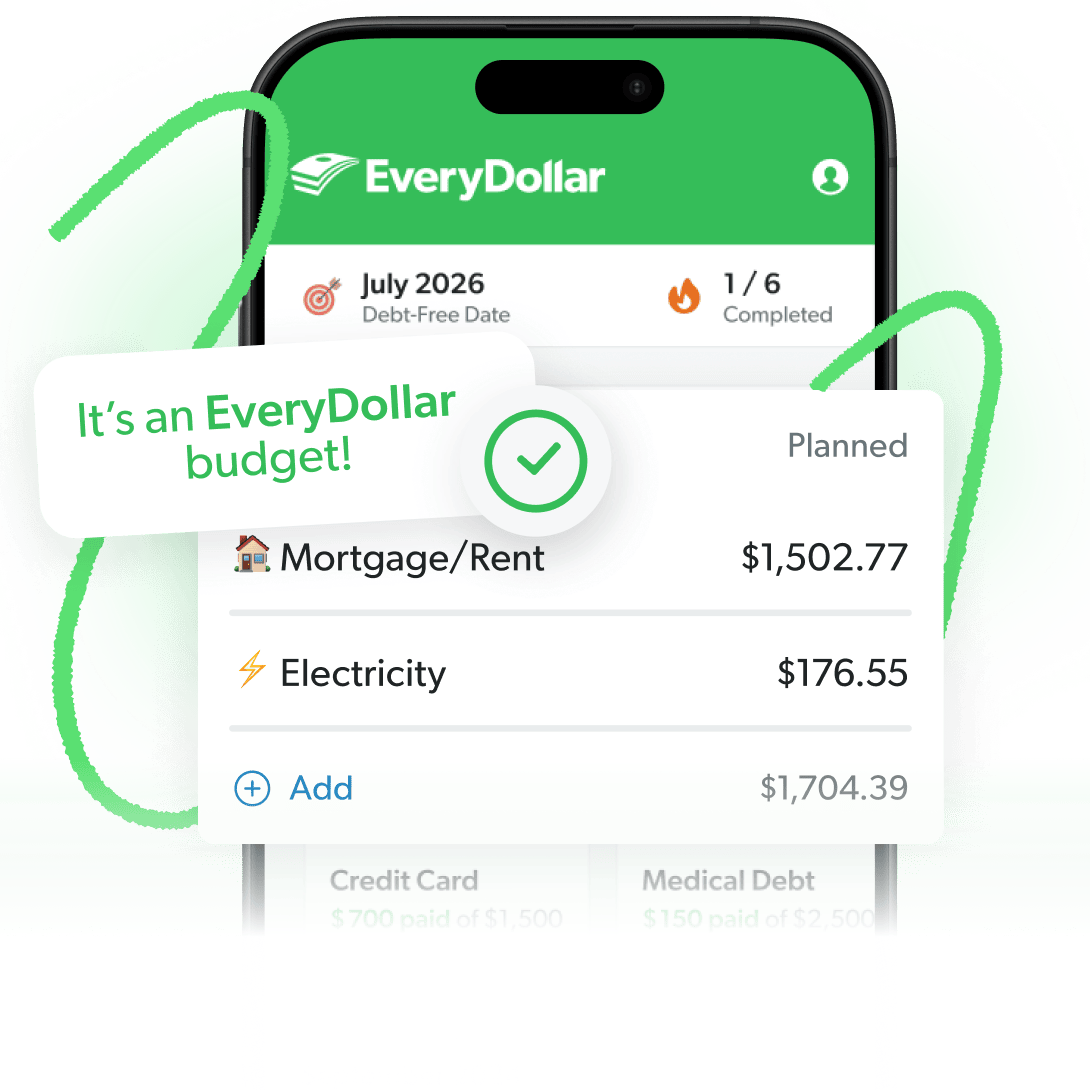
Put More Breathing Room in Your Budget
Money feeling tight? Not anymore. The EveryDollar budgeting app helps you free up thousands of dollars you didn’t know you had—in minutes.
Insurance
Insurance premiums belong in your budget every month—even if you pay some of them only once or twice a year. Yeah, I know insurance isn’t the most fun thing to spend your money on, but don’t skip this. Insurance helps protect the people and things you love.
When you’re budgeting for insurance, make sure you include the types of insurance you can’t do without, including:
- Health insurance
- Auto insurance
- Homeowners or renters insurance
- Term life insurance
- Identity theft protection
If you pay a premium once or twice a year, set aside a little each month so the money is there when the bill comes. A $1,200 annual premium, for example, comes out to $100 a month.
Health
Medicine, vitamins, supplements, gym memberships, workout apps, therapy—it all counts here. And think beyond what you pay every month. Dental cleanings, eye exams, checkups and other appointments may only come around a few times a year, but they still need a spot in the budget.
Make sure you’re taking care of yourself. But at the same time, remember: You can be fit and healthy on a budget.
- Gym memberships and fitness classes
- Therapy appointments
- Copays for doctor visits
- Medications
Personal
Your personal budget category covers things like clothing, personal care, pets and fun money. Think toothpaste, makeup, haircuts, getting your nails done, dog food—and a little money to spend on whatever you want.
My husband, Winston, and I each have our own fun money lines—and you should too if you’re married. I don’t have to check in when I see something I want in the $5 Target bin, as long as there’s still $5 left in my line! It keeps us accountable to our budget and to each other—but it also gives us freedom to spend. And really, that’s what budgeting is all about!
Now, if you’re trying to build up your savings or pay off debt, you’ll want to trim this category down to help you reach your goal faster. But it’s okay to reward yourself in little ways!
- Clothing
- Personal care
- Pet care
- Gifts
- Fun money
Kids
Kids’ expenses could go in the personal category, but I put them in their own category because they’re a big part of the budget for most parents. Think childcare, school tuition, school supplies, field trips, dance or karate classes, and even the group snack you forgot you signed up to bring. Include as many of these expenses as you can in your budget to keep from stressing as much.
- Childcare
- School expenses
- Sports and extracurriculars
Debt
If you’ve got debt, you need to include your minimum payments in your budget every month. That means your car payment, student loans, credit cards and any other debt you’re still paying off.
Then, use any extra money you can squeeze out of your budget and throw it at your smallest debt. That’s how you work the debt snowball and start knocking those payments out one by one!
- Car payment
- Student loans
- Credit cards
Lifestyle and Entertainment
You guys, it’s great to spend money on things you enjoy—if they’re in the budget! Tickets to a concert, a ball game with your kids, bowling with friends. (You can also have plenty of fun without spending a single dollar.)
And if you pay for any TV or music streaming services, be sure to put those in the budget too! Some are regular monthly expenses, so they need a budget line every month. Others you pay for once a year, so you’ll need to know which month to expect the charge.
- Streaming services or cable
- Subscriptions (monthly and yearly)
- Event tickets
- Travel expenses
Miscellaneous
A miscellaneous category, or budget buffer, is a small amount—typically $50–100 for minor, unpredictable costs like a parking meter or last-minute school supplies—so tiny expenses don’t force you to rework your whole budget.
No matter how carefully you plan your budget, little expenses pop up that you didn’t see coming. Just don’t let the miscellaneous category become a catchall for expenses you actually can plan for. A buffer that grows to $300 or $400 isn’t a buffer anymore. It’s a category you haven’t named yet.
- Miscellaneous
What’s the Right Order to Fund Your Budget Categories?
Bottom line: Giving, saving and the Four Walls stay funded no matter what. If money runs short before the month is over, cut spending from other categories.
The only exception to this rule would be if your Four Walls are at risk. They take priority over everything. So if you’re in a financial emergency or bare-bones budget situation, food, utilities, shelter and transportation come before any debt payment, any savings contribution, and any other expense until you can get yourself into a more stable financial situation.
Why Do Giving, Saving and Debt Payoff Come First?
When you sit down to build your budget, list giving and saving (or debt payoff) first so they’re treated as nonnegotiable, not as “whatever’s left over.” If you filled in the Four Walls first, then fun money and other spending . . . well, giving and saving (or debt payoff) would almost always get squeezed out at the end. Decide the amount before the month begins and treat it like a bill, not a maybe.
How Do You Budget for Expenses That Don’t Happen Every Month?
A sinking fund is a savings category where you set aside a small amount each month for a larger, planned expense (like Christmas gifts, trips or a big home project) and irregular expenses (like annual subscriptions or car repairs) so the full amount is ready when the bill arrives.
Take the total cost, divide it by the number of months until it’s due, and set that amount aside each month. In EveryDollar, you can add a month-specific line item to include expenses tied to a certain month.
Say your car tag renewal is $96 and it’s due in eight months. Divide $96 by 8, and you need to set aside $12 a month. Got a $150 annual subscription due in 10 months? That’s $15 a month. Give each one its own line in your zero-based budget, and the money will be sitting there when the bill shows up.
Here are some examples of expenses that could be sinking funds:
|
Expense |
Annual Cost |
Months to Save |
Monthly Contribution |
|
Christmas gifts |
$600 |
12 |
$50 |
|
Car repairs and maintenance |
$1,200 |
12 |
$100 |
|
Vacation |
$2,400 |
12 |
$200 |
|
New outdoor deck |
$4,300 |
24 |
$179 |
And that’s exactly how people in THE Ramsey Baby Steps Community are using sinking funds. Jessica shared:
“I use sinking funds for car insurance. I put aside the amount of the monthly payment each month and pay in full every six months.”
“I use sinking funds for car insurance. I put aside the amount of the monthly payment each month and pay in full every six months.” – Jessica
Your calendar can help you catch these expenses before they sneak up on you too. Add renewal dates, appointments and other upcoming costs, then check your calendar when you make your budget each month. You can also look back at past budgets in EveryDollar to see what expenses came up around the same time last year. (Oh, and don’t forget to budget for taxes if those don’t automatically come out of your paycheck.)
What Monthly Expenses Do People Forget to Budget For?
The expenses people forget are the ones that don’t hit your account on a regular schedule. Before you finalize your budget, check it against this list:
|
Expense Type |
Easy-to-Forget Expenses |
|
Fees and renewals |
Car registration, subscriptions, memberships, insurance premiums, property taxes, HOA fees |
|
Seasonal costs |
Holiday spending, back-to-school costs, seasonal utility spikes |
|
Home and car upkeep |
Home repairs, pest control, oil changes, tires |
|
Family and personal |
Birthdays, kids’ activities, school fees, vet visits and pet boarding, dental and medical costs |
How Do You Budget for Your Monthly Expenses?
To create your monthly budget, write down your income, list every expense, and subtract your expenses from your income until you hit zero. Here’s how, step by step.
Step 1: Write down your income. Add up all the money you expect to make that month. (If you have an irregular income, put in your lowest estimate. You can bump it up later if you make more!)
Step 2: List your monthly expenses. Pull up your bank account and look through the last 12 months of transactions—not just last month. This will help you catch those annual and seasonal expenses that are easy to forget.
Step 3: Subtract your expenses from your income. That number should equal zero. This method is called zero-based budgeting.
Now, a zero-based budget doesn’t mean you have zero dollars in your bank account. (Keep a little buffer of $100–300 in there.) It also doesn’t mean you spend everything you make.
Nope. It simply means you’re giving all your money a job to do. It means you plan how you give, save, spend and invest all your income. This way, you never get to the end of the month and wonder where all your money went—because you told it exactly where to go.
When you budget, you are in control of where every single dollar goes. This gives you confidence that you’re spending and saving well.
And EveryDollar makes the process even easier. It makes it super easy to track transactions throughout the month so you always know how much you have left to spend in each category.
Next Steps
- Make sure you’ve covered this month’s expenses. Look through the categories above and add any expenses you may have missed to your budget.
- Plan ahead for irregular expenses. Look back at the last 12 months and check your calendar for upcoming costs, then start a sinking fund for the ones you know are coming.
- Make your budget with EveryDollar. Give every dollar a job before the month begins so you can cover your expenses and work toward your goals.
Frequently Asked Questions About Monthly Budget Expenses
-
What expenses and budget categories should a zero-based budget include?
-
At minimum, include giving, saving or debt payoff, the Four Walls (food, utilities, housing, transportation), insurance, health care and discretionary categories like personal and entertainment.
-
How many budget categories do I need?
-
Most zero-based budgets land somewhere between 10 and 20 categories. Fewer, and you’re probably lumping too much into Miscellaneous. More, and the list gets hard to manage. Start with the essentials, then add only what your spending shows you need.
-
What expenses do people commonly forget to budget for?
-
People often forget expenses that don’t show up every month, like car registration, seasonal utility spikes, home and car maintenance, subscriptions, holiday spending and pest control. Look back through the last 12 months of transactions to find those easy-to-miss expenses before they catch you off guard.
-
How do I budget for expenses that don’t happen every month?
-
Use a sinking fund. Estimate the total cost, divide it by the number of months until it’s due, and set aside that amount each month. For example, if you’ve got a $240 expense coming up in eight months, save $30 a month so the money is ready when you need it.
Get Weekly Insights Delivered Straight to Your Inbox
Did you find this article helpful? Share it!

About the author
Rachel Cruze

Get proven Ramsey answers fast.