
 By
By
Link copied!
Unable to copy link. Please try again.
Key Takeaways
- The 50/30/20 rule splits your monthly after-tax income into three categories: 50% for needs, 30% for wants, and 20% for savings and debt repayment.
- For most American households, needs alone consume about 80% of take-home pay, making the 50% needs cap unrealistic.
- A zero-based budget gives every dollar a job based on your actual expenses and current financial goals, not fixed percentages that don’t fit real life.
Every financial influencer (and most parents) have an opinion on how you should handle your money. It’s your money though, so it’s up to you to find a budgeting method that works. One popular way to budget is the 50/30/20 rule.
Here's A Tip
The 50/30/20 rule is a budgeting method where you divide your monthly after-tax income into three categories: needs (50%), wants (30%) and savings (20%).
But is the 50/30/20 rule a helpful, or even realistic, way to budget? Let’s talk about how this method works—so you can create a budget that best works for you.
What Is the 50/30/20 Budget Rule?
The 50/30/20 rule (sometimes written as the 50-30-20 rule) divides your monthly after-tax income into three spending categories: 50% for needs (housing, groceries, utilities, insurance, minimum debt payments), 30% for wants (dining out, entertainment, travel), and 20% for savings and extra debt repayment.
The 50/30/20 rule is designed to simplify budgeting by using fixed percentages instead of detailed planning. But simple doesn’t always mean effective.
Let’s take a closer look at each category.
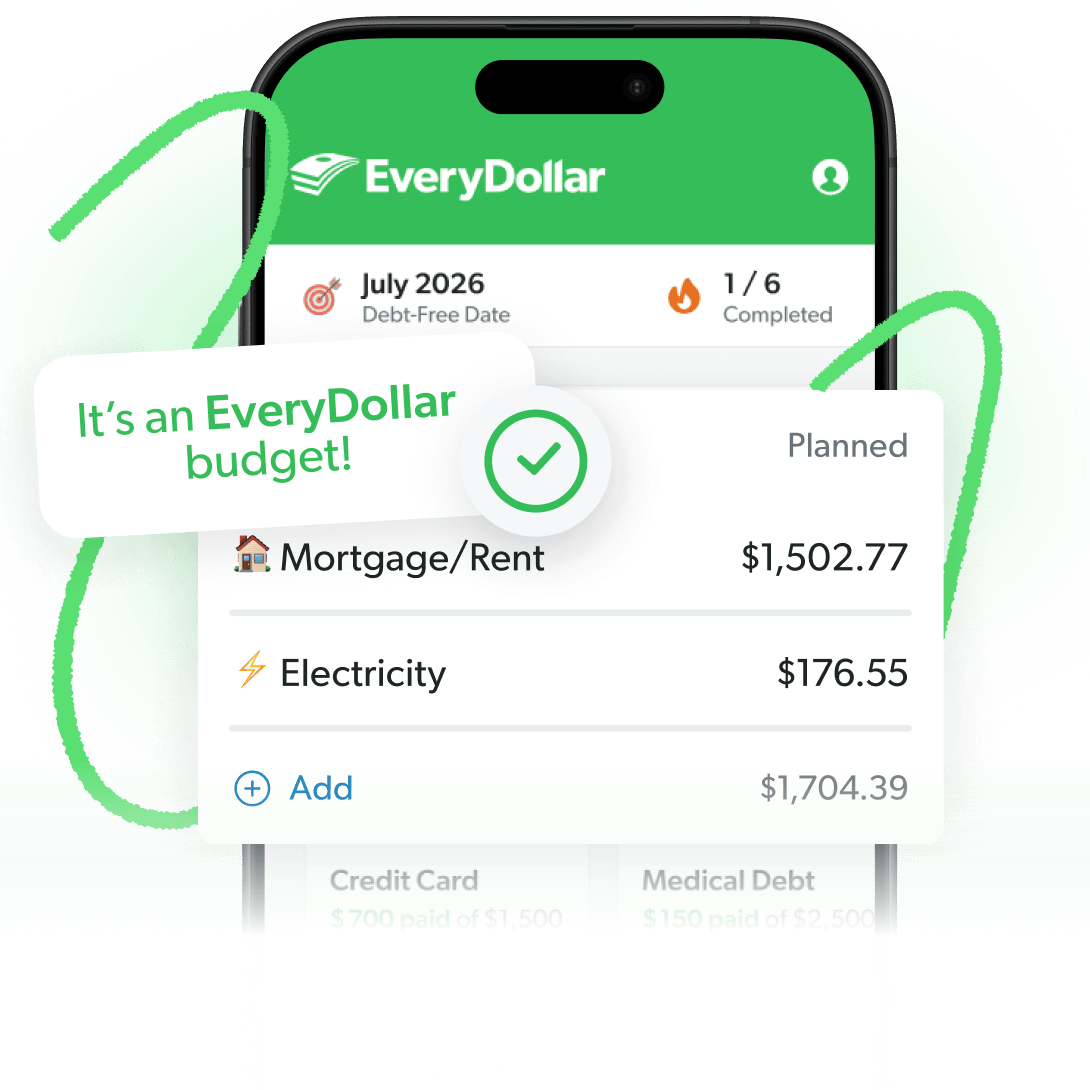
Find Margin You Didn’t Know You Had With EveryDollar
The EveryDollar budgeting app helps you find extra money every month so you can beat debt, build wealth, and make progress. Every. Day.
What Counts as “Needs” in the 50/30/20 Budget?
Needs are all the expenses that are necessary for you to get by in life. They are the bills and other monthly expenses you pretty much have to pay. We call the most basic needs the Four Walls:
- Food
- Utilities (electricity, water, natural gas)
- Shelter (rent or mortgage payments)
- Transportation (car expenses and gas)
These are the things you really can’t live without. But there are some other important expenses that fall into the needs category:
- Insurance
- Health care
- Childcare
- Debt payments
Under the 50/30/20 rule, your needs should total no more than half of your take-home pay.
What Counts as “Wants” in the 50/30/20 Rule?
Wants are the expenses that improve the quality of your life. They aren’t essential for survival, but they make life more fun. (Looking at you, Jonas Brothers concert tickets!)
Some examples of wants include:
- Restaurants
- New clothes or accessories
- Sporting events
- Concert tickets
- Streaming services
- Self-care services (like massages or getting your nails done)
- Vacations or nonessential travel
- New tech
The 50/30/20 rule says to spend 30% of your take-home pay on your wants.
But hear me when I say this: Wants are not needs. Yes, we all know this . . . in theory. But when you start dividing all your expenses into categories, the lines between needs vs. wants can get blurred.
Wants are all expenses you can technically do without (even if it’s uncomfortable). Because you don’t have to go out to eat when you’ve got groceries in the fridge. And unless your kid outgrew their jacket and school shoes, you don’t need to buy new clothes every month.
What Goes Into the 20% Savings Category?
The savings category covers all the money you’re setting aside for the future or putting toward debt. Examples include:
- Emergency fund savings
- Retirement investments
- Down payment for a house
- Sinking funds for car repairs, trips, Christmas, etc.
- Extra debt payments above minimum payments
With the 50/30/20 rule, the goal is to put 20% of your monthly income toward savings.
That’s just 20% of your income to get you feeling safe and secure with money for today, tomorrow and down the line in retirement. And with this rule, you’re somehow supposed to save for all of that at once.
Who created the 50/30/20 rule?
Sen. Elizabeth Warren and her daughter, Amelia Warren Tyagi, popularized the 50/30/20 rule in their 2005 book, All Your Worth: The Ultimate Lifetime Money Plan.
The book was aimed at families struggling to make ends meet because their spending was out of whack. The idea was to make budgeting simple. And simple is great—as long as it actually works. But when you use the 50/30/20 rule with real numbers, it doesn’t work because most families spend way more than 50% of their income on needs. And when a budget method isn’t realistic, most people get frustrated and stop budgeting!
How Do You Calculate a 50/30/20 Budget?
What does it look like to apply the 50/30/20 rule to an actual budget? Well, first, you’ll probably need a calculator (unless you were a mathlete in high school). Here’s a step-by-step process for creating a 50/30/20 budget:
- Calculate your monthly take-home pay (after taxes and health-insurance premiums).
- Multiply your take-home pay by 0.50 for your needs budget.
- Multiply your take-home pay by 0.30. That’s your budget for wants.
- Multiply your take-home pay by 0.20 to find your savings and extra debt payment budget.
- Categorize every expense into needs, wants, or savings and check whether your actual spending fits these percentages.
Let’s say your gross monthly income is $6,360. But after taxes and benefit deductions, you take home about $5,000 each month. If you use the 50/30/20 method, you’d have $2,500 for needs, $1,500 for wants, and $1,000 for savings.
|
Category |
Percentage |
What It Covers |
Example Dollar Amount ($5,000 Take-Home Pay) |
|
Needs |
50% |
Housing, groceries, utilities, insurance, etc. |
$2,500 |
|
Wants |
30% |
Dining out, streaming, travel, etc. |
$1,500 |
|
Savings |
20% |
Emergency fund, retirement, extra debt |
$1,000 |
Here’s what your budget would look like if your monthly take-home pay was $3,500 (which is roughly $50,000 in gross annual income).
- Needs: $1,750
- Wants: $1,050
- Savings: $700
That might look great on paper, but it’s not realistic to only have 50% of your income for needs. For many of us, housing alone is 25% or more of take-home pay. That leaves just 25% to pay for essentials like food, transportation and utilities. That’s going to be pretty tough—especially if you have some extra mouths to feed.
You can probably tell by now that I have some problems with this rule.
Here's A Tip
Use our free budget calculator and see how much it really takes to cover all your monthly expenses.
Does the 50/30/20 Rule Actually Work?
The 50/30/20 rule doesn’t work for most Americans. The median household spends over 80% of take-home pay on needs alone, according to U.S. Census Bureau income data and average expense figures. That leaves just 20% for wants or savings.
Seriously, look at the math:
- Median household annual income: $83,7301
- Average monthly take-home pay: $5,6452
- 50% of take-home means $2,823 for needs
- Average monthly spending for needs: $4,6633
- That’s over 80% of income on needs alone
Here’s where it gets worse. Debt payments count as “needs” under the 50/30/20 framework. So if you’re paying $400 a month on student loans and $350 a month on a car payment, that’s $750 in minimum debt payments alone—on top of your housing, food and utilities.
If you’ve got a car loan, credit cards or student loans to pay off, then you probably don’t have 30% left for wants and 20% for savings. When you put the 50/30/20 rule to the test, well . . . that math doesn’t add up! Literally.
Also, the 50/30/20 budget rule requires you to fit your money into those same budget percentages every single month. And I don’t know about you, but my budget is never the same each month. A budget isn’t a slow cooker. You can’t set it once and walk away. Forcing yourself to stick to exactly these percentages isn’t helpful. You need a budget that works with you—not against you.
What Are the Pros and Cons of the 50/30/20 Budget Rule?
The big benefit of the 50/30/20 budget rule is that it gets you thinking about your money in categories (needs, wants, and savings), which is a simple way to start thinking about budgeting. For someone new to budgeting, that’s huge. It also prioritizes needs over wants and encourages saving, which everyone should do! But the fixed percentages just don’t work.
Pros
- It helps you make a plan for your money. Any kind of spending plan—even an imperfect one—is better than no plan at all.
- It prioritizes needs before wants. Putting essentials first is just good money management.
- It encourages you to save money. We all want to save more money, so including savings in your budget is a good habit to build.
Cons
While recommended budget percentages can be a good starting point, the 50/30/20 rule ultimately falls short. Here are a few reasons why.
It’s not realistic for most budgeters.
The math just doesn’t work with the 50/30/20 budget rule. Just about everyone spends more than 50% of their income on needs. And even if you’re a unicorn and the rule works once, your budget percentages will likely change from month to month.
It doesn’t prioritize saving over wants.
Savings should be a priority—not an afterthought. Especially if you’re saving up for your emergency fund or for a big goal, like a down payment on a house. The 50/30/20 rule makes it easy to put savings on the back burner, when it should be one of the very first things you budget for each month.
With the 50/30/20 rule, you budget 30% for your wants and put 20% toward savings. Yes, saving 20% is better than saving nothing at all. But that’s not the best (or fastest) way to build your savings.
It doesn’t help you pay off debt faster.
With the 50/30/20 rule, you’re paying off your debt . . . but slowly. It combines both saving and extra debt payments to make up only 20% of your overall budget. That’s not enough if you really want to make a dent in your debt!
And if you’ve got debt, you shouldn’t be spending 30% of your money on things you don’t need anyway. You should be focusing on knocking out your debt as fast as you can. That means cutting back on extra costs (aka the wants) so you can throw more at your debt and take back control of your income.
Plus, trying to hit too many major money goals at once can actually keep you from making progress. You’re much better off if you line up your big money goals in order of priority (using the 7 Baby Steps to guide you) and knock them down one by one. You’ll be able to really focus as you save for emergencies, pay off debt, and build your retirement savings—in that order.
And when your budget is set up to help you take those steps one at a time, you know what happens? You make progress faster. And that’s what I want for you—to make progress with your money!
Your budget should live and breathe with you. It should adapt to your stage of life and to your money goals. The 50/30/20 rule just doesn’t do that.

How Does the 50/30/20 Rule Compare to Other Budgeting Methods?
There are all kinds of budgeting methods, including more that use set percentages, such as the 60/30/10 rule and the 70/20/10 rule. These other budget rules get closer to realistic percentages for needs, but they’re still a one-size-fits-all approach.
|
Method |
How It Works |
Ramsey’s Take |
|
50/30/20 rule |
50% needs, 30% wants, 20% savings |
It’s too rigid and doesn’t match real expenses. |
|
70/20/10 rule |
70% living expenses, 20% savings, 10% giving or debt |
Better emphasis on needs, but it still uses fixed percentages that don’t flex. |
|
Zero-based budget |
Every dollar assigned a job. Income minus expenses equals zero. |
It’s customizable, goal-driven, and built for real life. |
A zero-based budget is the only budgeting method that adapts to your actual income, your actual expenses, and your current Baby Step, which is why we recommend it.
What Is a Zero-Based Budget and Why Is It Better Than the 50/30/20 Rule?
A zero-based budget is when your income minus your expenses equals zero. You give every dollar a job and make every part of your paycheck work for you and your goals! It’s better than the 50/30/20 rule because it’s built around your actual expenses and your current financial goals, not fixed percentages that don’t flex with real life. It shows you where you need to cut back on your spending so you can make faster progress toward your goals.
Plus, a zero-based budget is way more flexible! As things change in your life, so does your budget.
|
50/30/20 Budget |
Zero-Based Budget |
|
|
|
|
|
|
|
|
The 50/30/20 rule boxes you in. But your budget should reflect your reality. It should reflect where you are right now and where you want to be with your money—not force your expenses into some blanket percentage category.
When you create a zero-based budget, start with giving, next saving, and then needs (what I call the Four Walls—food, utilities, shelter and transportation—and then other essentials). After that, you prioritize everything else in the budget based on your income, your situation and your Baby Step.
What Budgeting Method Actually Works?
A zero-based budget is the budgeting method that actually works. Stop trying to cram your life and your goals into percentages that don’t make sense. Go all in with the zero-based method and create a budget that gets you closer to your money goals.
If you don’t tell your money where to go, you’ll always wonder where it went. With a zero-based budget, nothing gets wasted and nothing gets lumped into a vague category. You tell every single dollar where to go on purpose. That means your money lines up with your priorities—not some formula.
So now that you know a zero-based budget is the way to go, let me tell you about my favorite zero-based budgeting app—EveryDollar.
EveryDollar does more than just help you track your spending and manage your money—it actually helps you find more margin every month! Just download the app, answer a few questions, and we’ll build you a plan to free up thousands in margin to put toward your goals.
Next Steps
- Calculate your actual monthly take-home pay.
- List every monthly expense and sort it into needs, wants, and savings to see where your money is really going.
- Check whether your needs already exceed 50% of your income (for most people, they do).
- Switch to a zero-based budget. Give every dollar a job based on your current Baby Step, not fixed percentages.
- Download EveryDollar for free and build your first zero-based budget in under 10 minutes.
50/30/20 Budget FAQ
-
How is money divided using the 50/30/20 method?
-
When using the 50/30/20 budget method, monthly expenses are divided into three categories: 50% to needs, 30% to wants and 20% to savings.
-
Is the 50/30/20 rule after taxes?
-
Yes, you use your monthly after-tax income (take-home pay) when budgeting with the 50/30/20 rule.
-
When might the 50/30/20 rule not be the best saving strategy to use?
-
If you’ve got a specific savings goal (like building an emergency fund or saving for a home down payment), the 50/30/20 rule won’t help you make progress as fast as the zero-based budget method.
-
When using the 50/30/20 rule to budget, what category are loan payments in?
-
When using the 50/30/20 rule, minimum debt payments are budgeted under needs (50%) and any debt payments above the minimum are budgeted under savings (20%).
-
Does the 50/30/20 rule include 401(k) contributions?
-
Yes, the 50/30/20 rule includes 401(k) contributions in the savings category (20%). But if your employer automatically deducts your 401(k) contributions from your paycheck, you’d need to factor that in when budgeting your take-home pay.
-
Can I modify the percentages in the 50/30/20 rule to fit my circumstances?
-
You can technically adjust the percentages in the 50/30/20 budget to fit your specific situation. But at that point, you’re not really budgeting with the 50/30/20 rule—you’re doing your own thing. That said, you’re better off using another method, like the zero-based budget, to create a budget that works for your specific expenses and current money goals.
-
Who created the 50/30/20 rule?
-
Senator Elizabeth Warren and her daughter, Amelia Warren Tyagi, introduced the 50/30/20 budgeting framework in their 2005 book, All Your Worth: The Ultimate Lifetime Money Plan. The rule was designed as a simplified approach to budgeting for middle-class American families.
-
What is the 70/20/10 budget rule?
-
The 70/20/10 rule allocates 70% of after-tax income to needs, 20% to savings, and 10% to giving or debt repayment.
-
What happens if my needs exceed 50% of my income?
-
If your needs exceed 50% of your take-home pay (and for most Americans, they do), the 50/30/20 rule breaks down immediately. You’re forced to either cut essential expenses or steal from the wants and savings categories.
Get Weekly Insights Delivered Straight to Your Inbox
Did you find this article helpful? Share it!

About the author
Rachel Cruze

Get proven Ramsey answers fast.