
Passive Income Streams to Build in 2026: 15 Realistic Options Ranked by Effort
23 MIN READ | JUN 9, 2026
 By
By
Link copied!
Unable to copy link. Please try again.
Key Takeaways
- Passive income is money you earn with limited day-to-day effort after some up-front work.
- The best passive income streams in 2026 fall into three buckets: real estate and rentals, creative and digital products, and investments.
- Where you are financially determines which streams are smart for you.
- Never go into debt to chase passive income. Any “opportunity” that requires a loan or promises fast returns is a trap.
- Start with one stream that fits your current life, finances and skills.
You’ve probably seen the promises: “Earn $5,000 a month in your sleep!” “Quit your job with passive income!”
Here's A Tip
Passive income streams are ways to earn money regularly without putting in much time or effort. The right stream depends on your debt, your Baby Step and how much up-front work you’re willing to put in.
Look, we get it . . . but most of what you’ll read online about passive income is hype. The truth is, passive income is real, but it’s not 100% passive in most cases. It takes time to build a reliable passive income stream, and it works best when you have a solid financial foundation. The right stream for you depends entirely on where you are in your financial journey.
We’re going to cover 15 realistic passive income streams across three categories—plus exactly which ones make sense at your current Baby Step.
What Is Passive Income and How Does It Actually Work?
The IRS defines passive income as income from rental activity or a trade or business in which you don’t materially participate.1 In plain English: It’s money that keeps coming in after the initial setup—whether that’s a rental property, an online course you built last year, or dividends from investments you made a decade ago.
Here’s a quick breakdown:
- Active income means you work, then you get paid. Stop working, stop earning.
- A side hustle is active income from an extra job on top of your primary full-time job.
- Passive income is when you do the up-front work (building it, funding it, setting it up) once, and the income continues with minimal ongoing effort.
That said, no passive income stream is completely hands-off. Every option requires some level of effort, risk or maintenance—especially at the beginning.
Where Does Passive Income Fit in the Baby Steps?
Not every passive income stream makes sense at every stage of your financial journey. If you follow the Ramsey Baby Steps (the path to true financial peace), you can have a stream at each level that won’t interfere with your overall money goals.
Here’s where each type fits within the Baby Steps—and what to skip until you’re ready.
- Baby Steps 1–2 (saving a starter emergency fund and paying off debt): Your focus right now is the debt snowball, not passive income. But if you’re itching to start, zero-cost options are okay: renting out a spare room, selling a digital product using skills you already have, or selling unused items. Don’t invest anything. Don’t take on debt. Keep it simple and free.
- Baby Step 3 (building your emergency fund): A high-yield savings account (HSYA) is the one passive income stream that makes complete sense here. Park your emergency fund in one. Earn 3% interest or more while you build your safety net.
- Baby Steps 4–6 (investing 15% for retirement, saving for your kids’ college, paying off the house): Your retirement contributions come first. After that, modest digital products and a HYSA are fine. Hold off on rental properties. Focus your energy on paying off your house.
- Baby Step 7 (building wealth and giving generously): Now you’re playing offense. Rental properties, REITs, taxable brokerage accounts with low-turnover index funds—this is where those big passive income strategies belong. You’ve earned it.
What Are the Best Passive Income Streams to Build in 2026?
Here are 15 realistic passive income stream options across three categories. Some will be better than others depending on where you are financially.
- Real estate and rental income: Use what you already own to earn.
- Creative and digital products: Build something once, sell it repeatedly.
- Investments and savings: Let your money work while you sleep.
What Are the Best Real Estate and Rental Passive Income Streams?
The best real estate and rental passive income streams include buying rental property, renting out a spare room, storing people’s stuff, renting out items you own, and renting your vehicle.
All of these work, but many of them are only wise when you’re financially stable. They also take more responsibility and up-front effort, but they can provide steady income over time when managed wisely.
1. Buy real estate.
Buying real estate and renting it out is one of the most common ways to build passive income over time. But before you take this step, pay off your own home first and purchase your investment property with cash. Don’t ever go into debt to buy rental property.
Rental properties come in a few different forms:
- Residential rentals: Single-family homes, duplexes or small apartment buildings are the most common and usually the easiest place to start.
- Commercial properties: Retail spaces, offices, warehouses or storage units can bring in more rent but often come with more regular effort and complexity.
- Specialty rentals: This includes vacation properties or mixed-use buildings.
No matter the type, rental income isn’t truly passive, especially at the start. You’ll need to find tenants, handle maintenance, and take care of occasional repairs. Or you’ll need to hire a property manager to do all those things for you, which will eat into your profit. But once those systems are in place, the day-to-day effort can be minimal—especially if you keep the property well-maintained. Rental property becomes a more passive income stream over time, not instantly.
We suggest buying a property (in cash—no second mortgage here) somewhere that’s convenient for you to visit so you can personally keep an eye on it. And find a local RamseyTrusted® real estate agent who knows your area and what will attract renters.
Earning potential: The median rent for a three-bedroom single-family home is about $2,100 a month.2 That sounds like a lot of consistent monthly income, but keep in mind, that’s before any expenses like repairs, upkeep and property taxes. And just think how much a monthly mortgage would eat out of that—which is why we say don’t even think about this until you can buy a property in cash.
Vacation rentals on sites like Airbnb have the potential to make around $15,000 in annual supplemental income.3 But this depends on factors like location, season and demand. High-demand markets like tourist regions and coastal areas can earn more.
You should also know that vacation rentals come with their own set of responsibilities—including managing the website bookings, cleaning after every guest stay, etc. So it’s like being a landlord and a hotel manager—more work and less passive, especially after a messy guest stay!
2. Rent out a part of your house.
If you still have some debt to pay off or can’t afford to take on a whole rental property, consider renting out a spare room. Having a roommate or the occasional Airbnb guest is a great way to add extra money to your budget—if you don’t mind sacrificing some privacy.
How passive this income feels depends on how you do it. A long-term renter usually requires less day-to-day effort, while short-term rentals on Airbnb can take more hands-on management, especially if you’re hosting frequently. Cleaning, coordinating check-ins, and handling minor repairs all come with the territory.
You also might need to add extra layers of coverage to your existing homeowners insurance policy or get a new type of coverage altogether . . . and that can get really pricey. So talk to your insurance agent before listing your extra room on Airbnb! But with the right setup—and realistic expectations—renting out part of your home can be a flexible way to earn extra income without taking on a whole new property.
Earning potential: Long-term roommates typically pay anywhere from $600–$1,400 per month depending on your market.4 Short-term Airbnb room rentals can earn an average of $89 per night.5
3. Store people’s stuff.
People have a lot of stuff—and they’re always looking for affordable ways to store it. If you have extra space in the basement or the garage, what could be easier than having people pay you to store their stuff? You’ll just need to make sure their items are safe and secure.
Check out websites like Neighbor or StoreAtMyHouse to get started. These services can put your indoor or outdoor space to work. And if you have a barn, garage or even just carport space to store vehicles, boats, campers and other high-dollar toys, people will pay even more to keep them safe and protected from weather.
Just know that you’re on the hook if anything gets lost, stolen or damaged. Some services offer liability protection, but others require you secure your own.
Earning potential: Storage rentals via Neighbor or StoreAtMyHouse typically earn $20–450 per month.6
4. Rent out useful items.
Do you have any items you don’t use all the time that others would like to borrow? Things like a trailer, trampoline, kayak or even your own yard or backyard pool could earn you passive income as rental items.
With rental websites like Hygglo, all you have to do is upload pictures of your items, set a price, and tell the world they’re ready for rent.
If you’re not quite ready to tell the world, consider starting with just your neighborhood. Got a chainsaw, pressure washer or lawn aerator? Hop on your community’s social media sites and start posting, or distribute flyers the old-fashioned way. Hit it during the right season, and your flyers could get a premium spot on your neighbors’ refrigerator doors—and that leads to phone calls.
Before you start renting out tools or equipment, it’s important to think through the details. Setting clear rules helps protect your gear—but it also helps protect you. If someone gets hurt using your item, especially things like power tools or recreational equipment, you could be held responsible. That’s why it’s smart to use written agreements when possible and double-check your insurance coverage before listing anything.
Earning potential: Tools and large equipment can rent anywhere from $20–300 (or more) for just a half day at retail stores.7 So there’s a lot of potential cha-ching there. Power tools, lawn equipment and outdoor recreation items are good options.
5. Rent out your vehicles.
Have an extra car or truck sitting in your garage? You can list your car on Turo—which lets folks rent out their vehicles to locals or tourists who need a ride for a few days.
And the boat that’s been taking up space in your backyard? Check out Boatsetter to make some extra passive income with your pontoon on a weekend when you won’t be on the water.
But renting out your vehicle to complete strangers could require additional insurance coverages and lots of maintenance costs. So consider yourself warned!
Earning potential: Turo hosts earn an average of $634 per month per vehicle, depending on the car, location and how frequently it’s rented.8 Boatsetter claims boat owners can earn an average of $20,000 a year.9
What Are the Best Digital and Creative Passive Income Streams?
Creative and digital income streams focus on using your skills or ideas to create something once and earn from it repeatedly. These options usually cost less to start, but they require patience and realistic expectations. They can sometimes take a while to get going and there’s no guarantee of a high return.
6. Start a blog or YouTube channel.
If you have a brilliant idea that appeals to a specific audience, you could create something like an educational blog or a YouTube teaching series that doesn’t require constant new material to generate online traffic.
If your content is engaging and gets enough daily traffic, you could sell ad space on your blog or ad spots on your channel. After you put in the heavy lifting, you can sit back, relax and enjoy streams of passive income for every set of eyeballs that watches your content. Not bad!
Just keep in mind, this is a crowded space. To earn meaningful income, your content has to be genuinely helpful and noticeably different from what’s already out there—and it usually takes time to build enough traffic for the income to add up.
Most blogs and YouTube channels take 6–18 months of consistent posting before ad revenue becomes meaningful.10 This is a long game, not a quick win. The good news is, content you create today can keep earning for years.
7. Write an e-book or digital guide.
If you’ve figured out how to create content that gets enough traffic to host ads, think about how you can turn that content into a product. It could be anything from a simple e-book or meal-prep guide to a complete online course or an app.
And writers: You can find self-publishing options everywhere, like Kindle Direct Publishing (KDP), which has several packages for editing, publishing and even book cover designs. If you have some marketing skills and good pals who’ll spread the word—plus (sorry, but this just needs to be said) if your books are actually a decent read—then go for it! You could still see royalties trickle in years down the road.
8. Create an online course.
With learning sites like Udemy, you can use your know-how to create a course on their platform. Once it’s published, it doesn’t require any additional maintenance from you, and you get paid when people take your class. It’s a low-output way of making some extra cash and helping people. That’s a win-win!
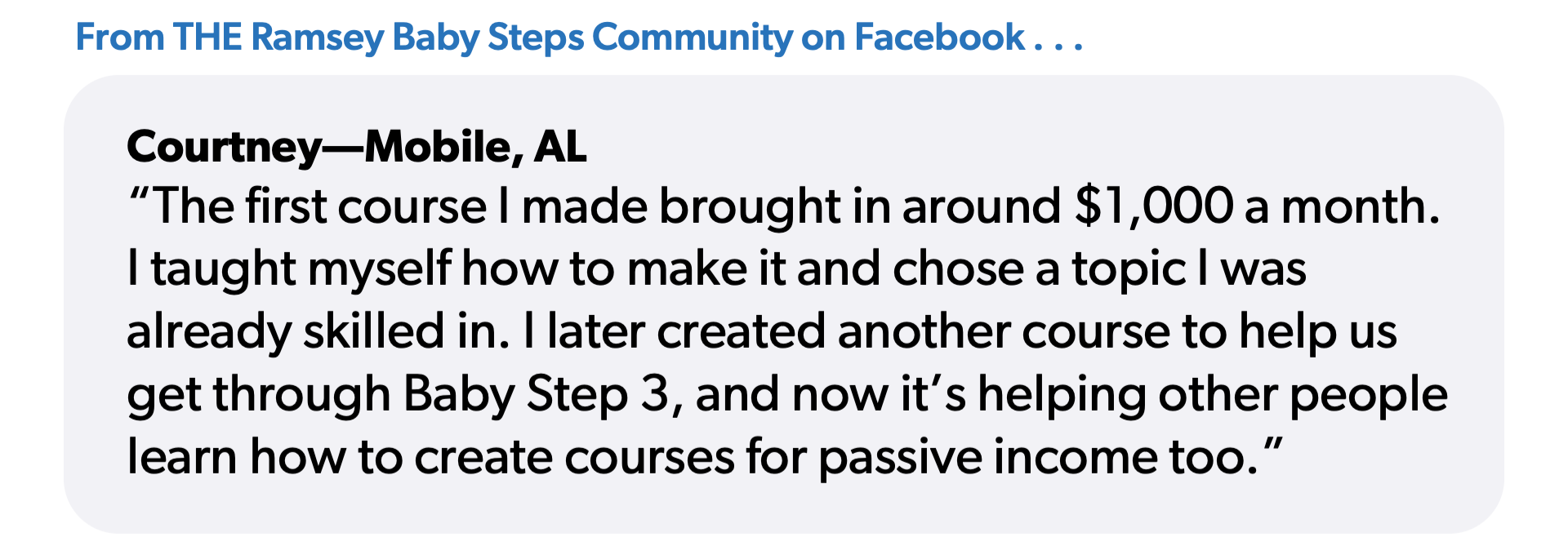
Courtney, a member of THE Ramsey Baby Steps Community on Facebook, shared that she taught herself how to create an online course on a topic she was already skilled in. Her first course brought in around $1,000 a month. She later created another course to help her family through Baby Step 3—and now that course is helping other people learn how to create courses for passive income too.
Like most passive income streams, creating an online course takes work up front—learning the platform, building the content, and choosing a topic people actually need. But once it’s set up, a course can continue earning over time without starting from scratch each month.
9. Sell stock photos or music.
You could also sell something that taps into your creative skills. For instance, if you’re a good photographer, sell stock photos on sites like Foap or create preset photo-editing filters for people to download. If you dabble in music production, license your tunes and sell them to YouTubers and podcasters to use in their content.
10. Design custom products.
Do you have some artwork that might look awesome on a T-shirt? Or a funny slogan you’d like to slap on a coffee mug? You might want to think about uploading your original designs to print-on-demand websites like Redbubble, Teespring Marketplace and Zazzle.
Most of these services are free to join and make it easy to showcase all your original designs. You still need to promote and advertise your designs, but each time someone orders a shirt, sticker or bucket hat with your design on it, you make money. And the best part is, the website will handle all the logistics—including the production, storage and shipping of your products—so you don’t have to. It’s that simple!
11. Become an affiliate marketer.
Have you ever bought something really awesome and gushed about it to your friends, family, coworkers and the store cashier? You think to yourself, Man, I should get paid for all this advertising. Well, that’s a thing! And it’s called affiliate marketing.
To put it simply, affiliate marketing is when a company pays you money to publicly brag about their products. If you’re on social media, you’ve probably seen hundreds of people doing this by posting a special link or discount code under a photo of them using a certain product.
Now this doesn’t mean you can just hashtag your favorite running shoes on Instagram and expect to get paid. The companies you know and love have to have an affiliate marketing program for you to get paid for it, and you’d need to apply to become part of it.
Programs like Rakuten LinkShare can help you find and connect with those affiliate marketing programs. Amazon, eBay and Target are just a few of the hundreds of companies that offer affiliate marketing programs.
While you don’t have to be an influencer with thousands of followers to be an affiliate marketer (although that would help you make more money), there are criteria for you to get into the programs. For example, to become a Target affiliate, you have to be a “website owner, blogger or influencer that runs a family-friendly website and has mainly U.S.-based viewership.”
12. Advertise on your car.
Getting paid to drive your own car? It doesn’t get any easier than that! If you don’t mind slapping a giant logo on your car (or maybe wrapping the entire car or riding with one of those big cans of soda on the top), sites like Wrapify will set you up to get paid for using your car as a mobile billboard.
Sure, you might lose some cool points for driving a car with a lawyer’s face plastered all over it, but you’ll win easy money—without sacrificing time, effort or investment.
Car-wrapping pro tip: If you live in a subdivision, check to see if it’s okay with your homeowners association (HOA). Getting fined might outweigh the potential profit. Bonkers, but true.
Earning Potential: The average person who does a full wrap on their car makes about $260–450 a month for driving to places they already need to go.11 That’s not half bad!
What Are the Best Investment and Savings-Based Passive Income Streams?
Investing and savings play different roles at different stages. High-yield savings accounts are great early on—for emergency funds and short-term goals—while index funds, REITs and other investments make more sense after you’ve built a solid emergency fund, paid off consumer debt and your house, and are consistently investing for retirement.
In short: Use savings for safety first, then move to long-term investments for growth.

Make an Investment Plan With a Pro
SmartVestor shows you up to five investing professionals in your area for free. No commitments, no hidden fees.
13. Take advantage of high-yield savings accounts.
High-yield savings accounts and money market accounts are two of the easiest ways to create a passive income stream and help you reach short-term financial goals like building an emergency fund or saving for a vacation.
You can find plenty of online banks and financial institutions out there offering online savings accounts and money market accounts with annual percentage yields (APYs) between 3–4%. That yield is much higher than the national average for savings accounts, which is only 0.38%.12 And since online banks and credit unions have lower overhead costs than typical brick-and-mortar banks, they can offer better rates for their customers.
Let’s say you have a fully funded emergency fund with $25,000, and that money is in a high-yield savings account with a 4% APY. That account will make $1,000 in interest over the next year—and you didn’t have to lift a finger or save an extra penny! And of course, the more you save, the more interest you’ll earn.
14. Invest in low-turnover funds.
When some people hear passive income, they tend to think of investing because it can produce the largest results with the least amount of work. And that’s true! Compared to the other options on this list, investing may be the easiest way to kick back, relax and earn.
But we want to be clear about one thing: Investing is a long-term strategy—and investing for retirement is way more important than investing for passive income.
That means your first priority is to invest 15% of your gross income for retirement in good growth stock mutual funds through tax-advantaged retirement accounts, like 401(k)s and Roth IRAs. (And don’t even think about touching that money until retirement. If you take money from those accounts before age 59 1/2, you’ll get smacked with early withdrawal penalties.)
Now, if you've maxed out all your retirement accounts and still haven't gotten to 15% (or if you're in Baby Step 7 and want to invest beyond 15%), then you can start thinking about investing in low-turnover mutual funds. A good way to do that is to invest in an index fund—a type of mutual fund with a low turnover rate—through a taxable brokerage account.
Why a low-turnover fund? Because that means the fund holds on to the stocks for longer, so there are less taxes for you to worry about. And why a brokerage account? Those accounts let you access your money at any point without an early withdrawal penalty (and they also have no limits on how much money you can invest per year).
If you’re out of debt and want to start investing, work with an investment professional.
What about dividend mutual funds?
Dividends happen when a company shares part of its profits with investors. When you own dividend-paying mutual funds in a brokerage account, you can get regular payments just for leaving your money invested. Sounds great, right?
A lot of dividend funds have payouts around 1%. Over the long haul, that isn’t a great source of passive income unless you have lots of money to invest. Think about it: If you invested $100,000 in dividend-paying mutual funds that earned 1.25%, you’d only get about $1,250 per year ($104 per month) of passive income before taxes.
But keep in mind that you should only invest in dividend-paying funds with a brokerage account after you’ve maxed out your tax-advantaged retirement accounts.
What about ETFs?
Exchange-traded funds (ETFs) also distribute a portion of company profits to shareholders on a regular basis—typically quarterly. While we don’t recommend ETFs for long-term retirement investing, they can generate some passive income through dividends. But most ETFs are passive themselves. They passively track an index to match the market, not beat it.
So ETFs are okay after you’ve reached Baby Step 4 and have maxed out your retirement accounts, but there are better, less volatile ways to earn passive income. Just know that the money does compound, but you’re not going to earn anything big. Instead, stick to good growth stock mutual funds with a long track record for actual retirement investing.
What about CDs?
ETFs might have some okay qualities, but certificates of deposit (CDs) are never a good way to earn passive income. A CD locks your money in for a set period—anywhere from a few months to five years—and pays a fixed interest rate. While the rates are typically higher than a regular savings account, once you factor in inflation and taxes on the interest earned, you're barely breaking even. And because the money is locked away, any early withdrawals mean penalties. So there’s zero flexibility and liquidity.
15. Invest in real estate investment trusts (REITs).
There’s also a type of mutual fund that buys real estate instead of stocks, called a real estate investment trust. A REIT (pronounced “reet”) pools your money with other investors’ money to buy properties. But you should only consider investing in REITs once you’re on Baby Step 7 and maxing out all your tax-advantaged retirement accounts.
And be careful. While there are some good REITs out there, some use debt to purchase properties—which means more risk for you as an investor.
Talk with your investment professional before you start investing in REITs (you’ll be glad you did).
How Can You Make $1,000 a Month in Passive Income?
Getting to $1,000 a month in passive income is absolutely doable. But there’s no single hack that gets you there overnight. Here are three examples:
- High-yield savings: Putting $300,000 in a high-yield savings account at 4% APY makes $1,000 a month in interest. Most people won’t start here, but it shows how powerful a fully funded emergency fund plus Baby Step 7 savings can be over time.
- Rental property: One rental property netting $1,000 a month after expenses (taxes, insurance, maintenance) is realistic in most markets, especially if the property is paid for in cash.
- Stacking smaller streams: You could potentially make $300 a month from affiliate income, $400 a month from a digital course, and $300 a month in HYSA interest to make $1,000 a month. This is achievable in earlier Baby Steps with zero debt and minimal up-front cost.
Keep in mind that most people who reach $1,000 a month in passive income got there over years by consistently following the Baby Steps, not by finding a single shortcut. And the best passive income strategy in the world won’t get you far if you’re still carrying debt. Start with the Baby Steps. The passive income will follow.
How to Choose the Right Passive Income Stream
Not every passive income stream is right for every person. Here are five questions you can ask yourself to find the one that fits your life, finances and skills right now:
- Do other people make real money doing this? Look for verifiable income data, not influencer stories. If you can’t find evidence of real people earning real dollars, move on.
- Which strategy would I be best at? Match the stream to your skills, assets and schedule. A rental property is great in theory but not if you can’t deal with needy tenants. A blog will make money eventually but only if you love creating content.
- Does this idea have a positive long-term track record? Established options (real estate, index funds, digital products) have decades of proof. New or trendy options need more scrutiny.
- Has this come back to bite people? Research the downside. Taxes, insurance, hidden fees—every method has a catch. Know it going in.
- How much time will this actually take? “Passive” is a spectrum. A rental property might take five hours a month to manage well. A blog might take 10 hours a week for the first year. Be honest with yourself.
Don’t fall for any passive income ideas that promise a quick return or require huge amounts of money up front—like vending machines or opening a laundromat. Things like that require way too much time and money to be considered passive and could ultimately sabotage your financial goals. Look for opportunities that are steady, profitable and trustworthy. Do your research. And never go into debt!
Putting Passive Income in Perspective
You don’t have to do everything on this list to build passive income. Just choose one or two options that actually fit your life, finances and goals. Some streams take more time up front, others take more patience, and all of them work best when you’re building on a solid financial foundation.
The good news is, you don’t have to figure it all out at once. Start where you are, stay out of debt, and focus on steady progress instead of quick wins. Over time, the right passive income stream can add margin to your budget and confidence to your long-term financial plan
Next Steps
- Choose one passive income idea that fits your current finances and supports your long-term goals.
- List the pros and cons of the stream (time, money, etc.) and be honest if it’s really worth your effort to get going.
- If investing is part of your plan, connect with a SmartVestor Pro who can give guidance that fits your goals and help you invest with confidence.
This article provides general guidelines about investing topics. Your situation may be unique. To discuss a plan for your situation, connect with a SmartVestor Pro. Ramsey Solutions is a paid, non-client promoter of participating Pros.
FAQs About Passive Income Streams
-
Is passive income taxable?
-
Yes, passive income is taxable. The IRS taxes most passive income at your regular income tax rate. Rental income is typically taxed as ordinary income, though you can deduct expenses like repairs, depreciation and property management fees. Investment income (dividends, capital gains) has its own tax treatment depending on whether gains are short term or long term. Talk to a RamseyTrusted tax pro about your specific situation.
-
What is the easiest passive income stream to start?
-
The easiest passive income stream to start depends on where you are financially. If you’re in Baby Steps 1–2, opening a high-yield savings account offers zero risk with no debt. If you have skills to share, creating a digital product (e-book, course, template) has almost no up-front cost. For most people, the easiest option is also the one that uses what they already have.
-
How much money do I need to start earning passive income?
-
You can start earning passive income with very little money. A high-yield savings account earns interest on whatever balance you have. Digital products and affiliate marketing cost almost nothing to start. Rental property requires significant money to start (and you should buy with cash only, no debt). The amount you need depends entirely on which stream you choose. Start with what you have, not what you wish you had.
-
Can I build passive income if I’m still paying off debt?
-
It depends. While on Baby Steps 1–2, focus on the debt snowball first. But zero-cost passive income streams (renting a spare room, selling digital products using skills you already have, opening a high-yield savings account for your starter emergency fund) can contribute to your debt payoff. But don’t take on new debt, invest before paying off debt, or chase time-consuming side gigs that slow down the snowball.
-
How long does it take to build passive income?
-
It depends on the stream. A high-yield savings account starts earning immediately. A blog or YouTube channel typically takes 12–24 months of consistent effort before earning meaningful income. Rental property income starts as soon as you have a tenant, but buying a paid-off rental property takes years of saving. There’s no shortcut that skips the up-front work. The people who actually build lasting passive income are the ones who start early, stay consistent, and treat it as a long-term strategy, not a get-rich-quick scheme.
Get Weekly Insights Delivered Straight to Your Inbox
Did you find this article helpful? Share it!

About the author
Ramsey Solutions