


"I paid off $121,000 in 28
months. I feel strong! The
burden is gone!"


You’re one car repair away from reaching for a credit card. That’s the kind of constant money stress that keeps you up at night. Personal finance is 80% behavior and 20% head knowledge. Baby Step 1 is where you start rewiring the behavior and break the cycle for good. We’ll show you what Baby Step 1 is, why $1,000 is your target, how to build the budget that gets you there, and how to save that first $1,000 fast.
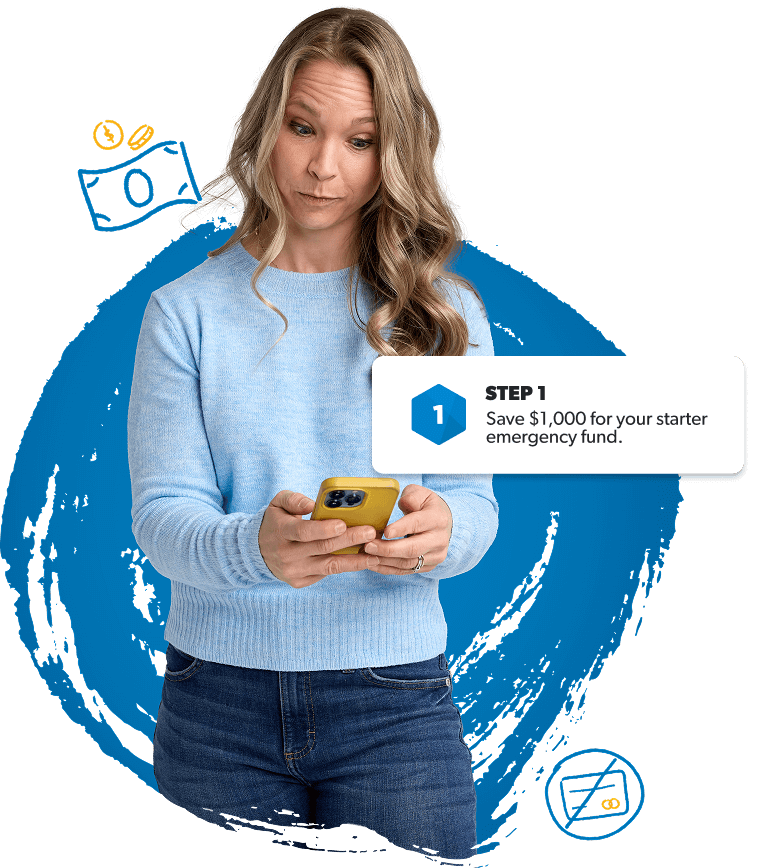
Baby Step 1 is to save $1,000 as a starter emergency fund as fast as possible. It’s the first of Dave Ramsey’s 7 Baby Steps and the foundation of the plan. The goal isn’t to prepare for every emergency. It’s to stop using debt as your backup plan and build momentum before you attack debt in Baby Step 2.


The first Baby Step is to save up $1,000 for a starter emergency fund as quick as you can. That’s enough to cover minor emergencies with cash instead of your credit card. If you’re one of the 37% of Americans living paycheck to paycheck who said they can’t cover a $400 emergency, Baby Step 1 is a game changer.1
This step isn’t about being ready for any possible emergency—it’s about breaking the old habit of relying on debt in an emergency. Your starter emergency fund turns what used to be a financial crisis into a minor inconvenience.
A budget isn’t optional for Baby Step 1. Trying to get ahead without one is like building a house with no foundation. It ain’t happenin’. Once you’ve made your budget, track your spending throughout the month so you know you’re actually sticking to your budget and closing in on your $1,000 goal.
Imagine how you’ll feel when a flat tire doesn’t destroy your bank account or pile on to your credit card balance. You’ll be able to replace it—in cash—and get back on your way. And you’ll ride that momentum into Baby Step 2.
A $1,000 starter emergency fund is enough to cover most of life’s curveballs without adding new debt. No, it’s not enough to get you through a job loss or a major surgery—that’s what the fully funded emergency fund in Baby Step 3 is for. But $1,000 is enough to handle the stuff that’s likely to happen while you’re paying off debt: a car repair, a medical copay or a busted appliance.
It’s true that the $1,000 starter emergency fund has remained the same since Dave started teaching the Baby Steps 30 years ago. But even back then, $1,000 wasn’t meant to cover every life emergency. It’s meant to get you moving. Save it up fast—sell some stuff, pick up an extra shift, and stop eating out. Then you can start paying off debt in Baby Step 2 without worrying about a surprise expense derailing your progress.

The key to this Baby Step is speed. The faster you complete Baby Step 1, the sooner you start paying off debt. Millions of people just like you have done it, even while living paycheck to paycheck. The first step? Look at what’s already happening with your money. Start with a budget.
If you don’t tell your money where to go, you’ll end up wondering where it went. That’s why a budget is a must for Baby Step 1. A zero-based budget gives every dollar you earn a job, whether it’s to pay rent, buy groceries, pay off debt or have a little fun.
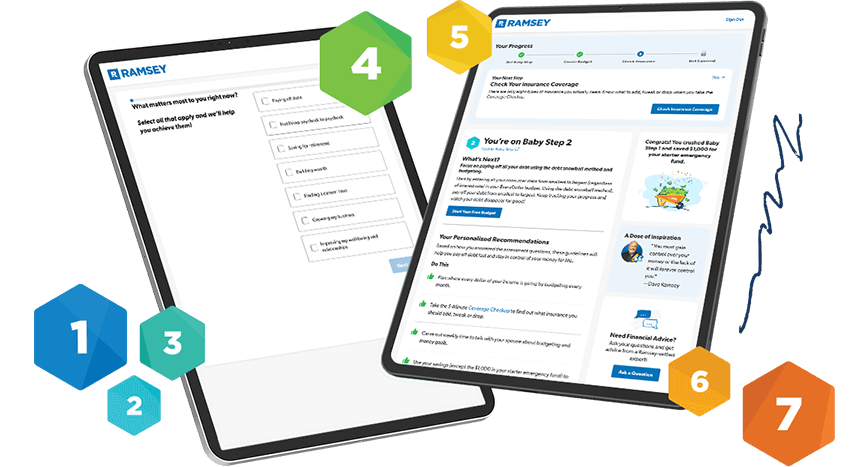
Use EveryDollar, Ramsey’s free budgeting app, to build your first zero-based budget in under 10 minutes and put every extra dollar you can find toward your $1,000 goal.
Write down all your monthly income—paychecks, side hustles, babysitting, everything—and add it up. That’s what you have to work with this month.
Log in to your bank account and look at the past three months. Group each transaction into categories, like giving, rent/mortgage, groceries and gas. Then add up each category and divide by three for a rough monthly average.
Start your budget with giving, even in Baby Step 1. Budget 10% of your gross income to give first—to your church or a charity.
Then budget your emergency fund savings, then your critical expenses (rent, food, minimum debt payments). Anything left? Pile it into your $1,000 savings goal.
Or, skip the math and try our Budget Calculator. Type in your income and expenses, and in about two minutes, it will show you exactly how much you have left toward your $1,000.
Once you see where your money’s going—like $55 a week on Dunkin’—you’ve got to be honest with yourself. You can’t spend like that and get out of debt.
Small sacrifices like that are simple, but not always easy. You’ll be brewing coffee at home for 25 cents a cup for a while. But financial peace is a high that no pumpkin-spice cold brew can top.
You’re building a future you can look forward to. This is your moment to change. You’ve got to do this—for you.
No need to reinvent the wheel—here’s a simple budget calculator to get you started fast.

Drive for Uber, tutor online—there are hundreds of ways to earn more and speed up your Baby Steps. Get creative! What skills could you turn into extra cash? Photography, baking, playing guitar—all these could translate into extra money for your emergency fund.
Pause all investing (even up to the company match) until you complete Baby Steps 1–3.
The truth? People who are broke don’t have time for Netflix. You’ve got time for work, work, family and more work. Remember, this is a season. You’re saving and sacrificing now so that later, you can live like no one else.
Forget those off-site lunches. Pack your lunch and save serious money. Pro tip: Bring snacks too. You’ll skip overpriced vending machines and gas station snacks.
A no-spend challenge means no spending except on the essentials for a month—food, utilities, shelter and transportation. Think: rent, gas, groceries (not restaurants), and internet. No haircuts, treats, presents. You’ll be shocked at the money you’ll save.
Let’s face it—some of the things in your closet could be considered “vintage” by now. But you’re in luck! That’s what all the kids are into these days. Grab anything you haven’t worn in six months—minus seasonal stuff. Post it on Depop, Poshmark or ThredUp.
You could also start a side hustle of finding thrifted items and flipping them online. Every little bit helps.
Stop spending your whole paycheck at Whole Foods. Try Aldi, Trader Joe’s or Walmart instead. Again, this is just a season. You can come back to Publix for their delicious soup bar soon!
This is the time to pull out all the stops—and do it fast. Trim your grocery shopping down to rice and beans if you have to and sell so many things the kids think they’re next. Deliver food or groceries, pet-sit, whatever it takes to start stockpiling money into your emergency fund.
Check your calendar for birthdays, weddings and renewals. Decide how much to set aside each month so nothing sneaks up on you. But keep in mind—this is a new season. Holidays may look different for now.
The goal is to complete Baby Step 1 in 30 days or less, so now’s the time to pull out all the stops. Trim your grocery shopping down to rice and beans if you have to and sell so many things the kids think they’re next. Deliver food or groceries, pet-sit, whatever it takes to start stockpiling money into your emergency fund.
"I paid off $121,000 in 28
months. I feel strong! The
burden is gone!"

“Now, we talk more about our money, we make decisions together, and it’s not stressful anymore.”


“Budgeting gives you a true picture of your finances—of your life—so you can pick what you can do and plan all the good stuff.”


“I cried the first time we finished a month and actually had money left over. That had never happened before.”


“We're not stressed anymore. Our journey's in our hands now. We get to choose what we want to do."


"There’s freedom on the other side of debt. You don’t have to live like everyone else. I wanted something different for my family."

That nervousness you feel about checking your bank account ends today. Baby Step 1 is your first step toward taking control of your money for good. We’ll walk with you from one Baby Step to another so you can finally live with financial peace. For now, get that $1,000 saved up as quick as you can and get on to Baby Step 2: paying off all your nonmortgage debt.
Start by dialing in your budget. Cut anything you don’t need right now, pick up a side hustle, and sell what you can to build momentum.
Just pay the minimums on your debt for now. You’ll attack your debt with full force in Baby Step 2—promise.
Usually about a month. Push hard, no excuses—you got this!
Keep it somewhere safe and easy to access—like a savings account connected to your checking.
First, see if you can cover the cost in your budget. If not, ask:
If you answer yes to all three, it's an emergency.
(No, Black Friday shopping doesn’t count. But an emergency dentist visit? Yep.)
Three words: the Four Walls. That means food, utilities, shelter and transportation. And keep up the minimum payments on your debts. Pause everything else until you hit your $1,000 goal.
If you’ve got a unique question, try our Ask Ramsey tool, powered by Ramsey AI. And to boost your emergency fund savings even more, create your budget in EveryDollar and get personalized recommendations to speed up your progress!