
How to Create a Retirement Budget
 By
Key Takeaways
- Estimating how much money you’ll need in retirement starts with creating a detailed budget based on your income streams, expected expenses and future lifestyle.
- Key costs to budget for include health care, food, transportation and fun.
- Before you retire, eliminate all debt (including the mortgage) to free up as much margin as possible in your monthly budget.
- A crucial part of creating your retirement budget is planning when, how and from which accounts you’ll take distributions.
- Track your spending every month and use sinking funds so irregular costs like travel and property taxes never wreck your budget.
Look, you’ve worked hard, planned ahead, and set aside money over the years to be able to retire. Awesome! Once you’re retired, the goal is to stay retired, which is sometimes easier said than done.
The key to making sure your hard-earned nest egg actually lasts as long as your retirement does is to create a retirement budget—and stick to it!
Quick Answer
To create a retirement budget, add up your monthly income streams (like 401(k) distributions and Social Security) and list your essential and discretionary expenses. Then give every dollar a job so your income minus expenses equals zero (aka a zero-based budget).But you need to do more than just budget if you want your retirement income to last—you need to pay off all your debt so payments aren’t eating into your income.
Despite what most people think, a budget isn’t a killjoy. In fact, it sets you up for success by helping you manage your money. A budget gives you permission to spend and brings you peace of mind. So, to help you get started, here are five steps to creating your retirement budget:
1. Add up your income streams.
List every income stream you’ll rely on in retirement, then add them together to find your total monthly paycheck. Hopefully, you’ve been investing consistently for years and building income streams that will now replace your paycheck.

As you get closer to retirement, sit down with a SmartVestor Pro and make a list of all your income streams, which could include the following:
- Tax-advantaged retirement accounts. These include 401(k)s, 403(b)s and Roth IRAs that hold your investments.
- Social Security benefits. These are the icing on the cake of your retirement fund, not the cake itself. Today, the average Social Security retirement payment is about $2,071 per month, which is not enough to live on for most people.1 It’s up to you to secure your retirement future, not Uncle Sam.
- Pensions. These provide a steady monthly paycheck for your life in retirement, but they’re a thing of the past for many Americans. If you’re on a pension plan with your employer, get the details from HR.
- Part-time earnings. These can give some extra cushion to your budget if you plan to work a little in retirement. Add up how much you think you’ll make each year.
- Taxable investments. These are a great way to save for retirement, especially if you’re a high-income earner. If you’ve got money put away in a brokerage account, you can start to withdraw it during retirement.
- Real estate. This can be a steady source of income—just make sure you don’t carry a single penny of mortgage debt into retirement.
- Annuities. This is an insurance product many people use to fund their retirement years (although we don’t recommend them).
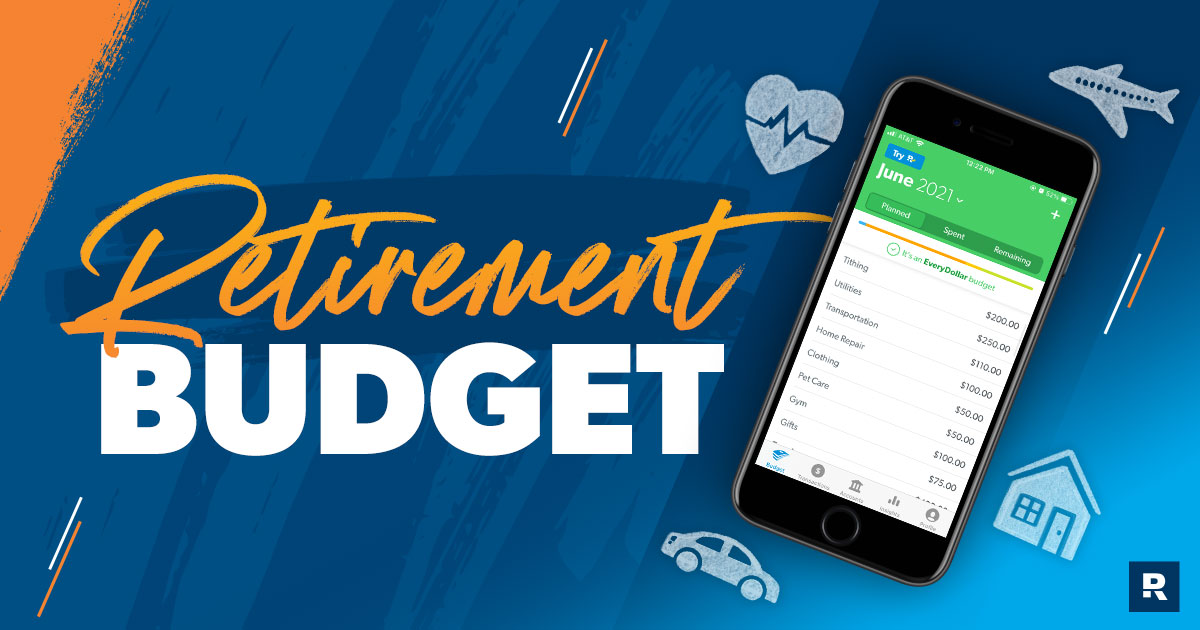
Once you’ve added up every stream, enter that total as income at the top of your EveryDollar budget. Treat it exactly like a paycheck, even though it’s mostly coming from your investments instead of an employer.
Here's a Tip
Set up an automatic transfer from your investment or brokerage account to your checking account on the same day every month—like a payday. That way your retirement income shows up like a regular paycheck and you can budget with confidence instead of guessing when money will land.
To get a rough ballpark number for your annual income, total up your projected income based on all the income streams you plan to pull from, then divide that number by how many years you plan to live in retirement. From there, you can break it down into monthly income.
Expand Your Investing Toolkit
Nobody retires well by accident. Access free calculators, guides and other resources that can help you invest like no one else.
2. List your expenses.
Trying to figure out how your expenses will change once you retire (think health care or travel costs) can be a challenge. List every retirement expense you expect, starting with giving, saving and the Four Walls (food, utilities, shelter and transportation) then add every retirement-specific cost on top, like health care and travel.
But those changes to your monthly and yearly expenses are one of the main reasons why making a retirement budget is so important in the first place!
When you list out your expenses, start with the essential expenses:
- Tithing and charitable giving
- Food (groceries)
- Utilities
- Shelter (no mortgage payment)
- Transportation
Other essential retirement expenses:
- Health care costs
- Personal care (like hygiene)
- Home repair and maintenance
Guess what you don’t see on this list: a mortgage payment. You shouldn’t carry a single penny of debt into retirement—including your mortgage! You need to be 100% debt-free before you retire. No exceptions.
Next, list out your nonessential expenses:
- Travel
- Subscription services
- Gym membership
- Hobbies
- Gift giving
- Pet care
- Clothing
And lastly, list your seasonal expenses:
- Property taxes
- Insurance premiums
- Auto registration
- Christmas, anniversary, birthday and special occasion spending
Here's a Tip
Don’t forget to give yourself a miscellaneous category too so you’ve got a little extra cushion in your retirement spending. That way, anything that pops up unexpectedly isn’t a problem—it’s in the budget.
Once you’ve listed out your expenses, use them as the starting point for your retirement budget. Have a brainstorming session about what you currently spend on each of those line items. Then consider which expenses will likely increase or decrease in retirement.
How do your expenses change after you retire?
Your job status and hair color aren’t the only things that change when you retire—your expenses and priorities will as well. Here are some examples of what we mean:
|
Expense |
While Working |
In Retirement |
|
Commuting and gas |
Higher |
Lower (or shifts to gas for travel) |
|
Work clothes |
Higher |
Lower |
|
Health care |
Lower (employer coverage) |
Higher (Medicare plus supplemental) |
|
Travel |
Lower (limited PTO) |
Higher (more time) |
|
Hobbies |
Lower |
Higher (more time) |
|
Payroll taxes |
Higher |
Lower |
Let’s take a closer look at these expenses and what to watch out for.
What expenses might go up during retirement?
Health care costs may be the biggest expense you can expect to go up in retirement. A recent estimate from a Fidelity study suggests a 65-year-old retiring today will need about $172,500 to cover health care costs throughout retirement.2 That’s because as you age, you’re more likely to have health problems.
Health care costs aren’t the only expense you have to keep in mind. You’ll still have monthly bills that fluctuate. How you budget for these will depend on what you want to do when you have more time and more money. Here are some expenses to think about:
- Utilities. If you plan on sticking close to home, you’ll probably use more electricity, water, heat, cooling, etc.
- Recreation. If you plan to travel the world or visit the grandkids living out of state, this expense will definitely increase.
- Property taxes. Most of the time, these taxes go up as home values rise.
- Hobbies. This could go up, especially if you choose to golf seven days a week or start car collecting! Even budget-friendly hobbies can be costly, so keep an eye on those line items in your budget.

Find a Medicare Plan That Fits You
Get the best plan for your needs and your budget with help from Chapter—the only team of Medicare advisors we recommend.
What expenses might go down (or go away completely)?
The biggest expense you shouldn’t have to worry about in retirement is debt.
Hopefully, you’ve done the Baby Steps and said goodbye to your mortgage, student loans and any other debt that might‘ve been lying around. Why? Because debt is retirement quicksand. It’ll delay your retirement dream by eating up your monthly income and leaving you with little to no margin in your retirement budget.
Make getting out of debt the priority before you retire!
If you kick your mortgage and consumer debt to the curb before you retire, you can focus on spending your income on the things you’ve been looking forward to the most in retirement, like spending more time at the lake house, volunteering at your favorite charity, or traveling through Europe.
And it’s not just your debt payments that might go away—other variable expenses might go down in retirement:
- Entertainment. Lots of movie theaters, sports venues and fun centers offer senior discounts.
- Travel. Some airlines, hotels and rental cars offer a senior rate for those 65 or older—if you ask for it!
- Clothing. If you don’t have to dress professionally for work anymore, you can lower this category in your budget. And as a bonus, some retailers will offer senior discounts on a particular day of the week.
- Groceries. Yep, lots of stores knock down the prices on weekdays, so you can benefit from that!
- Gasoline. If you’re no longer commuting, you can lower this budget amount. But if you plan on lots of trips to see grandkids, your gas budget may actually go up!
- Memberships/subscriptions. Again, some companies offer senior discounts. Ask!
3. Create a zero-based monthly budget.
A zero-based retirement budget means your income minus your expenses equals zero. You’re giving every dollar a job before the month begins.
So, for example, if all your retirement income streams total $5,000 per month, then everything you give, save and spend should add up to $5,000. Every dollar should have a purpose—a job to do for the month.
Retirement isn’t an excuse to stop budgeting. It’s even more of a reason to budget. Finding margin every single month is what protects your peace of mind for the next 20 or 30 years.
If you’re new to zero-based budgeting, it may take a few months to iron out the wrinkles and figure out how much you’re spending and where you’re spending it. But that’s okay! Practically no one gets this right the first time. Don’t be afraid to move things around and make adjustments to your budget throughout the month. The goal is to give every dollar an assignment.
4. Plan your distributions carefully.
Planning when, how much and from which accounts you’ll take distributions (aka withdraw money) is a crucial part of creating your retirement budget.
Most likely, your 401(k) or IRAs will make up the majority of your income stream. Work with a SmartVestor Pro before you touch a single distribution—they’ll help you come up with a withdrawal plan so your retirement budget actually lasts.
The main thing is to make sure you’re not pulling out so much that you stop the growth on what you still have invested. In theory, your portfolio will continue to grow (if you keep your money invested in the right mix of good growth-stock mutual funds).
We can’t emphasize how important it is to work with a SmartVestor Pro as you make these calculations. Don’t risk a big mistake—your future is too important! A SmartVestor Pro will help you navigate all the questions about how much to pull out and when to do it.
Required Minimum Distributions
If you have a tax-deferred retirement account, like a traditional 401(k) or IRA, you need to be aware of required minimum distributions (RMDs). The IRS requires you to start taking RMDs at age 73.3
It’s important to remember that these RMDs will be taxed like regular income, so make sure you’re setting aside money to pay for those taxes!
On the other hand, if you’ve been saving in a Roth account, you don’t need to worry about RMDs because you’ve already paid income taxes on the money you put in. As far as Uncle Sam is concerned, you don’t have to take any money out of a Roth account ever!
If you want to let your Roth account grow and grow, you could theoretically never touch it (if you have other funds to live on) and leave the money to your loved ones once you’re gone.
5. Track your spending.
It’s not enough to set a budget and hope for the best. If you don’t actually stick to it, it won’t do you any good! Remember: You’re in control of your money. Be intentional about the choices you make with it. Budget with your spouse, and if you aren’t married, ask a friend to hold you accountable to the budget.
Tracking your spending will help you stay away from stupid and stay close to your retirement dreams!
How Do You Handle Irregular Retirement Expenses?
Just like in your working life, there will still be expenses that come up that don’t happen every month—travel, taxes, a new roof. Use a sinking fund to save a set amount each month so a big trip or the annual property tax bill never wrecks your regular budget. When the bill arrives, the money’s already there.
Ready to Start Your Retirement Budget?
Two to three years before you retire, we suggest you take an honest look at what you’ll actually need to fund your lifestyle. Create a zero-based budget in EveryDollar and try it out for a while. That way, you’ll know what adjustments to make. We want you to dream big. We also want you to be realistic and have a plan to make those dreams a reality!
Next Steps
- If you want a better understanding of where you are today and how much you need to save each month for the retirement you want, take the R:IQ retirement assessment.
- Need help planning for retirement? You can find an investment pro in your area through the SmartVestor program.
- Ready to start budgeting? Create your retirement budget in EveryDollar today for free and find the margin you need to enjoy your golden years.
Frequently Asked Questions
-
How much should I budget for health care in retirement?
-
Budget for Medicare premiums, supplemental insurance and out-of-pocket costs. Estimates vary, but Fidelity puts the average health care cost for someone retiring today at $172,500.1 A SmartVestor Pro or RamseyTrusted insurance pro can help you nail down a specific monthly number for your state.
-
Can I still use EveryDollar if I don’t have a regular paycheck?
-
Absolutely. Enter your monthly investment distributions or Social Security payments as income at the top of your EveryDollar budget. It works exactly the same as a regular paycheck.
-
Should I keep a mortgage in retirement if the interest rate is low?
-
No. Enter retirement 100% debt-free. A paid-for home is the best inflation hedge you have, and it delivers the biggest raise to your retirement income by wiping out your largest monthly expense.
This article provides general guidelines about investing topics. Your situation may be unique. To discuss a plan for your situation, connect with a SmartVestor Pro. Ramsey Solutions is a paid, non-client promoter of participating Pros.
Get Weekly Insights Delivered Straight to Your Inbox
Did you find this article helpful? Share it!

About the author
Ramsey Solutions

Get proven Ramsey answers fast.