
What Is a High-Yield Savings Account and Do I Need One?
 By George Kamel

Key Takeaways
- High-yield savings accounts (HYSAs) offer much better interest rates than traditional savings accounts—as much as 10 times higher.
- If you’re looking for somewhere to put your emergency fund or to save money for short-term financial goals, HYSAs are a great choice.
- Investing in mutual funds is a better option than HYSAs for long-term financial goals.
All right, here’s the deal with traditional savings accounts: In most cases, they stink as bad as a middle school boys’ locker room. That’s because the money you put into those accounts grows at about the same rate as I did in middle school—not much at all.
Quick Answer
A high-yield savings account (HYSA) pays way more interest than a regular one—often 10 times more. If you’re building your $1,000 starter emergency fund or setting up a sinking fund to save for something big (like a car) in the next few years, open a HYSA. But if you’re investing for retirement or something more than five years out, park that money in mutual funds instead, like your 401(k) or Roth IRA.Traditional savings accounts have an average interest rate of 0.38%.1 Which means, if you put $1,000 into a typical account, over the course of an entire year you would earn . . . $3.80. That’s barely enough money to take someone on a date to the Costco food court (long live the $1.50 hot dog combo).
I love spreading the good news about HYSAs whenever I co-host The Ramsey Show, and even in my book, Breaking Free From Broke. I want to make you a believer too. So let’s get started.
What Is a High-Yield Savings Account?
A HYSA (sometimes called a high-interest savings account) is a type of savings account offered by banks and credit unions that has a higher interest rate than traditional savings accounts. It’s one of several types of bank accounts you can choose from, so it’s worth it to understand their differences.

While traditional savings accounts average a 0.38% interest rate, HYSAs offer rates in the range of 3.5–4.5%.2 If you’re doing the math at home, that’s about 10 times more.
How Does a High-Yield Savings Account Work?
Here’s how HYSAs work: By offering a higher interest rate, the accounts can help you turn up the heat on meeting your money goals. Now, we’re not talking bonfire heat here—maybe more like Easy-Bake Oven heat. But either way, because HYSAs offer higher interest rates than traditional savings accounts, the money you put in can grow faster.
Let’s look at an example: We’ll say Nathan is saving to buy a house, and he puts the $10,000 he’s already saved up into a HYSA at a 3.5% annual percentage yield (APY). If he doesn’t touch the account for a year, he’ll have earned about $350 in interest by the end of the 12 months. If Nathan had put that $10,000 in a traditional savings account earning 0.38%, he only would’ve made $38. Oof.
How are these accounts able to offer such high interest rates? Most HYSAs are available through online banks, which don’t have to pay rent or any of the other expenses involved in operating a brick-and-mortar building, like buying lobby furniture (and making sure the tellers are always fully stocked with Dum-Dums). That means the cost of running their business isn’t as high, and they can pass those savings on to you.
Bank on people we trust.
Get debt-free (and build wealth faster) with a high-yield savings account from FAIRWINDS.
What Are the Pros and Cons of a High-Yield Savings Account?
The pros outweigh the cons, and it’s not close. HYSAs beat traditional accounts almost every time. (The only time you’d want to go with an option besides a HYSA is when you’re investing for the long haul.) Here’s the breakdown:
Pros
- They have a much higher interest rate than traditional savings accounts. Like I mentioned, HYSAs sometimes offer 10 times the interest of traditional savings accounts.
- The money you put in is super safe. HYSAs at legitimate banks—even online banks—are backed by the Federal Deposit Insurance Corporation (FDIC), which insures your deposits up to $250,000 with the backing of the federal government. Legitimate online credit unions are backed by the National Credit Union Administration (NCUA). All those letters simply mean your money’s not going anywhere.
- You can access the money at any time. Unlike some investments where it can be difficult to pull your money out at a moment’s notice, HYSAs allow you to access the money at any time. That makes them a great place for keeping an emergency fund or a down payment fund if you’re saving for a house.
Cons
- They’re not a good long-term investment. Though HYSAs provide a much higher rate of return than traditional savings accounts, they’re still lousy for long-term investing. Even if a bank offers a rate of 4% or more, it doesn’t come close to the 10–12% rate of return that good growth stock mutual funds with long track records of success have historically averaged. That’s where you need to do your long-term investing for retirement or anything else more than five years down the road.
- The interest rate can change at any time. Did you find a great HYSA with an online bank offering a 4.5% interest rate? Well, it may not last long. Banks can change their interest rates for savings accounts whenever they want, which means your rate isn’t a long-term (or even short-term) guarantee.
They’re usually online only. If you’re the kind of person who hates going to the bank in person, then this one doesn’t affect you. If you prefer talking to your bankers face-to-face and making deposits in person, then getting a HYSA through an online bank may not be your cup of tea. But remember, you can still use a local bank for your everyday checking account.
|
Pros |
Cons |
|
Higher interest rates than traditional savings |
Not good for long-term investing |
|
Safe place for money |
Interest rates can change (variable APY) |
|
Easy access to your money |
Often online only (no physical branches) |
|
Good for emergency funds and short-term goals |
Lower returns over time than mutual funds |
How Do You Open a High-Yield Savings Account?
Opening a HYSA is a lot like opening a checking account or traditional savings account—it’s super easy. Here are the three steps:
- Find a bank or credit union. You can find some great options by searching online for FDIC-insured HYSAs.
- Provide identification. You’ll have to send a picture of your passport or driver’s license and give the bank your Social Security number.
- Make a deposit. You can’t have a bank account without money! The final step to opening a HYSA is making a deposit, which you can do by writing a check or transferring funds from another account.
How Do You Find the Best High-Yield Savings Account?
The most important factor is the interest rate, but it’s not the only one. Here’s what to check for before you open a HYSA:
- A competitive interest rate: This is the big one. If most of the HYSAs out there are offering an interest rate around 3%, for example, you don’t want to pick one that only offers 2%. If you want to get super nerdy, you also may want to look into how a bank applies compound interest (aka their compounding method).
- No significant deposit or balance requirements: You don’t want to run into a bunch of fees for falling below a super high balance requirement. Speaking of fees . . .
- No maintenance fees: Getting nickeled-and-dimed by ongoing maintenance fees is a great way to slowly but surely lose money that’s in your account—it’s death by a thousand cuts. You want to pick a HYSA that lets you earn money.
- FDIC or NCUA insurance: Like I said, the FDIC insures your deposits up to $250,000 with the backing of the federal government. Don’t put your money into a bank that doesn’t have FDIC protection, or a credit union without NCUA protection.
Easy access to your money: Accessing the money you put into a savings account shouldn’t be a pain in the neck. Make sure you can easily transfer funds out of the account without a withdrawal penalty. If there’s a limit on the number of withdrawals you can make, that’s okay—you shouldn’t be taking money out of long-term savings that often anyway.
Here's a Tip
To get a good look at all the options out there, just do an online search for “FDIC-insured high-yield savings accounts.” Don’t forget to make sure the bank you choose checks all the above boxes before you pull the trigger. And avoid HYSAs that are offered by credit card companies—they might offer some interest, but they don’t have your best interest at heart. (See what I did there?)
Should You Open a High-Yield Savings Account?
Yes—if you’re saving for something in the next few years or building your emergency fund. But if you’re investing for retirement or any goal more than five years out, a HYSA isn’t the place for that money.
If you’re interested in long-term investing and you want to start making a financial plan for your future, connecting with an investing pro is a great place to start.
But if you’re looking for a place to keep some cash you’ve stockpiled while getting the perk of some extra savings, a HYSA definitely fits the bill. It’s a terrific destination for sinking funds or your emergency fund. That’s exactly why we tell people to keep Baby Step 1’s $1,000 starter emergency fund—and Baby Step 3’s fully funded emergency fund—in a HYSA. It’s safe, it’s easy to get to, and unlike a shoebox in your closet, it actually earns you something while it sits there.
Next Steps
- Set a savings goal and start putting money toward it. For example, if you’re working on Baby Step 1, set aside $1,000 in a HYSA as fast as you can.
- If you’re on Baby Step 3 or higher, make sure that fully funded emergency fund is socked away inside a HYSA. You’ll earn more interest on your money!
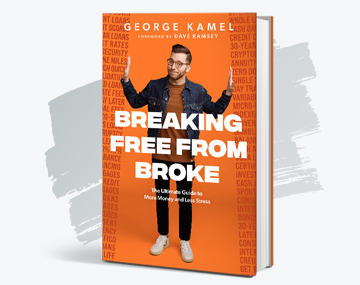
Want more money tips?
A high-yield savings account may not be the only money hack you’re missing out on. I go over plenty of other money tips—as well as some of the biggest traps to avoid—in my book, Breaking Free from Broke. You can read the first chapter for free.
Frequently Asked Questions
-
Are high-yield savings accounts safe?
-
Yes! As long as you choose a high-yield savings account with FDIC protection, your money is totally safe—and guaranteed by the federal government up to $250,000 (per depositor, per institution and per ownership category—if you want to get super nerdy).
-
How much does $1,000 earn in a high-yield savings account?
-
The amount you’ll earn with a $1,000 deposit depends on the interest rate of your individual bank. For example, if your bank has a 4% annual interest rate, you’ll earn $40 in a year. Or if your bank has a 4.5% rate, you’ll earn $45.
-
Are high-yield savings accounts a good investment?
-
HYSAs aren’t good long-term investments, but they’re great places to keep your emergency fund or money you’re setting aside for a short-term savings goal.
-
How often do savings rates change?
-
Savings account interest rates are set by individual banks, meaning they can change at any time without advance notice. While banks decide their own rates, they closely track the Federal Reserve’s target Federal Funds Rate (which is what banks charge each other for overnight loans). When the Fed adjusts its target rate, banks usually adjust their deposit yields too.
Get Weekly Insights Delivered Straight to Your Inbox
Did you find this article helpful? Share it!

About the author
George Kamel

Get proven Ramsey answers fast.