
What Is Recoverable Depreciation in a Home Insurance Policy?
 By
Key Takeaways
- Recoverable depreciation is the gap between what your damaged stuff is worth today (actual cash value—ACV) and what it costs to replace it new (replacement cash value—RCV). Only a replacement cost policy pays it.
- An ACV-only policy leaves you with the depreciated value and a sayonara. RCV (ideally extended or guaranteed RCV) is the only way to truly protect your home.
- With RCV coverage, you get two checks: The first covers the item’s ACV minus your deductible, and the second covers the rest once you’ve replaced or repaired it.
- Keep every invoice and receipt for what you buy or repair because your insurer needs proof before they release the money.
- Policies often give you between six months and two years from the date of the loss to claim recoverable depreciation, so check your policy’s time limit right away.
Imagine you’re trying to cook risotto on your fancy stove to impress your date. Then the pot boils over while you’re trying to convince your neighbor to turn down the bumping hip hop. Your whole stove bursts into flames.
While insurance might not cover the loss of your date, it will pay you $1,000 for the stove. But wait—a new stove costs $2,000! Well, hopefully you have insurance with recoverable depreciation.
Quick Answer
Recoverable depreciation is the difference between an item’s depreciated value (actual cash value, or ACV) and the cost to replace it with a new version (replacement cost value, or RCV). If you have an RCV policy, your insurance company will pay you this difference in a second check after you prove you’ve repaired or replaced the damaged property.People often pick the cheapest coverage, thinking it saves them money. But that’s not actually how homeowners insurance works. Here's why replacement cost coverage, the kind that pays recoverable depreciation, is worth it.

What Is Recoverable Depreciation?
Recoverable depreciation is the difference between an item’s actual cash value (ACV) and its replacement cost, and your insurance company pays it only if you have replacement cost value (RCV) coverage. Recoverable depreciation sounds about as exciting as a saltine cracker. But you’ll be glad you know once you know. The “recoverable” part of that term refers to whether your insurance will pay the difference or not.
How Do RCV and ACV Coverage Affect Recoverable Depreciation?
Only RCV coverage pays recoverable depreciation. ACV coverage doesn’t.
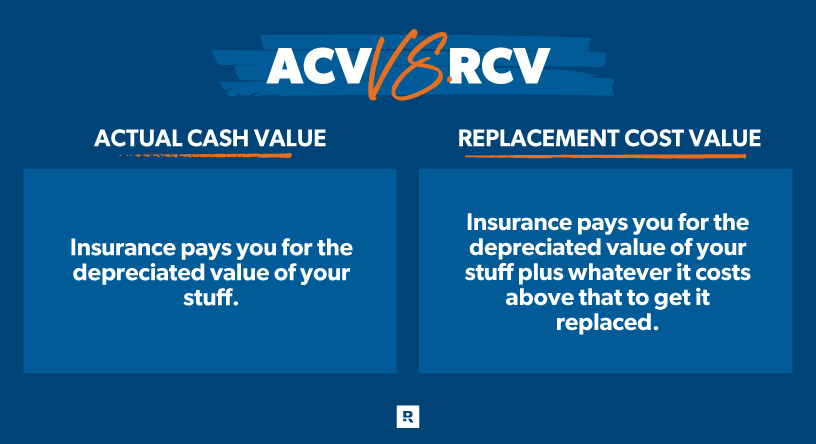
If you have RCV, your insurance carrier will pay you enough to replace the loss—which means the depreciation is covered. You’ll get a check that equals what your damaged property was worth and then another check to cover what it costs to get a new one.
Nonrecoverable Depreciation
If you have an ACV policy, your property will experience nonrecoverable depreciation. Like it sounds, this means when your property loses value, you won’t be able to get that value back through insurance if it gets destroyed. They’ll only pay you what your stove (or other property) was worth when it went up in smoke (aka the item’s loss in value over time is nonrecoverable).
How Is Recoverable Depreciation Calculated?
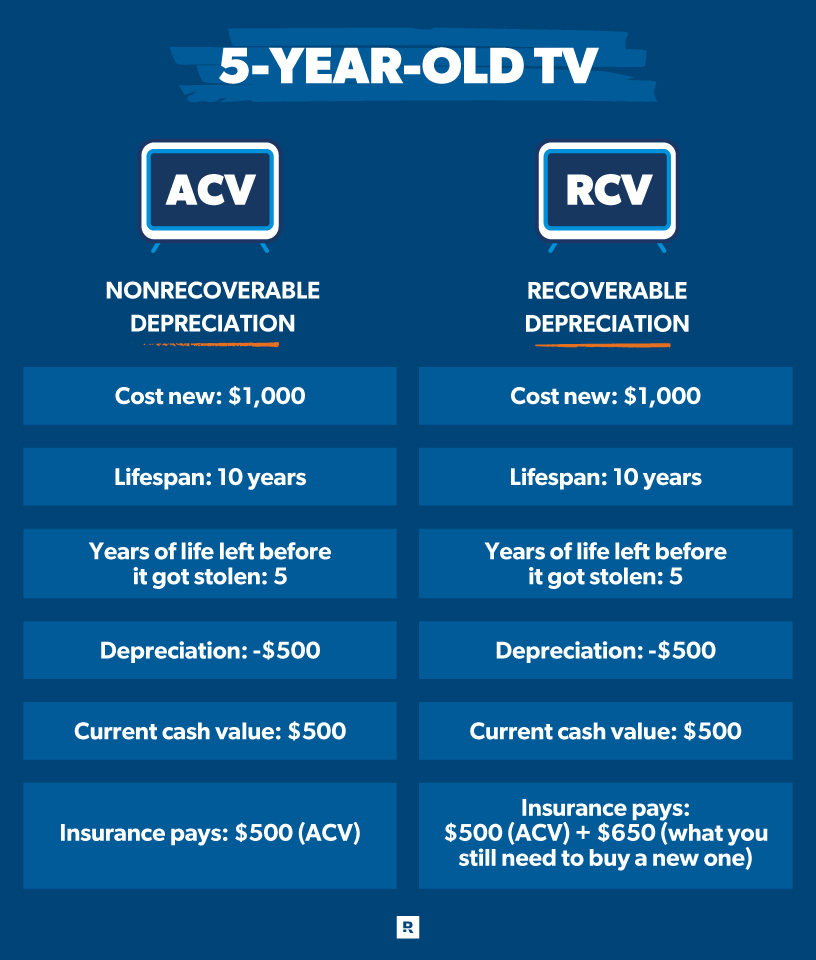
Recoverable depreciation is calculated by subtracting an item’s ACV from what it costs to replace brand-new:
|
Replacement Cost – Actual Cash Value = Recoverable Depreciation Using the stove in our example: $2,000 – $1,000 = $1,000. We’ll show you where that $1,000 comes from next. |
To figure out how much your stuff is worth after depreciation, insurance companies look at the lifespan of your item.
Say your stove is supposed to last 20 years and you’ve had it for 10. The insurance company will take what it’s worth new ($2,000) and divide that by the years in its lifespan (20) to get a depreciation value for each year that passes ($100). So, if you’ve had the stove 10 years, it’s now worth $1,000, according to the insurance company. So much for “investing” in a quality stove!
Another factor insurance companies look at to determine depreciation is obsolescence. If better, badder models of your stove have been made since you bought yours, that’ll make your model worth less. But if no newer models have come out, your stove may hold its value a little longer.
What Determines Your Property’s Depreciation?
|
Factor |
What It Means |
Our Stove Example |
|
Age |
The older an item is, the more value it has lost. |
10 years old = 10 years of lost value |
|
Expected lifespan |
Insurers spread an item’s new cost across its expected lifespan to figure out how much value it loses each year. |
$2,000 ÷ 20 years = $100 per year |
|
Condition |
Wear and tear, damage, and how well the item was maintained all push its value down or up. |
A well-kept stove holds more value than a worn-out one. |
|
Obsolescence |
If newer, better models have come out, your older model is worth less. |
Newer models on the market lower the stove’s value. |
Actual Cash Value (ACV) Repayment
That number ($1,000) we just calculated? That’s the number you’ll see on your ACV check. Your insurance carrier will pay you out according to how much life is left in your item.
Recoverable Depreciation Payment
But if you have RCV, that means that depreciation is recoverable! Which means you’ll be getting more moolah in the mail. Your carrier will cut you a check for $1,000 and a second check for that $1,000 of depreciation your precious stove lost in the 10 years you used it. This is definitely a happier scenario!
How Does Insurance Pay for Recoverable Depreciation?
Your insurance company pays recoverable depreciation in a second check after you replace or repair the damaged property and send proof of what you spent. Recoverable depreciation sounds like a fancy term (it is), but it’s really just explaining how an RCV policy works—you get paid for the replacement value rather than just the actual depreciated value.
Something you may not know about getting your stuff replaced through insurance is you’ll actually get two checks. Even though you have RCV, the first check will only be the ACV of the thing (don’t panic—another one’s coming).
Generally, insurance companies pay out just enough to get you started replacing or repairing your stuff and wait for the final bill to come in so they don’t overpay (or underpay) you. So your second check will be the difference between the ACV of your stuff and what you paid to replace or repair it (up to your policy’s replacement limit). This also helps prevent fraud when someone might bill insurance for the full cost then purchase a cheaper option to make a little money.
Recoverable Depreciation With a Deductible
If you have a deductible (you should!), that first check you get will actually be the ACV minus your deductible. So say your stove is worth $1,000 and your deductible is $500. That means your carrier will cut you a check for $500. Your second check will then be the difference between $1,000 and what you pay for a new stove. In other words, you’ll still be covering $500 worth of your new stove.
|
ACV + Recoverable Depreciation – Deductible = What Your Insurance Company Pays Stove example: $1,000 + $1,000 – $500 = $1,500 |
How Do You File a Recoverable Depreciation Claim?
To file a recoverable depreciation claim, you replace the item first and then submit receipts to your insurer for a second reimbursement check. Let’s break it down:
- Notify your insurer. After the kitchen fire, you’ll want to notify your insurance company and show them the stove damage.
- Receive your ACV payment. They’ll appraise what your stove (with depreciation) was worth before it went up in smoke and send you a check for that amount minus your deductible. In our example, that’s $500: the $1,000 ACV minus a $500 deductible.
- Replace or repair the item. Next, you’ll go out and find a new stove. If you pick one that’s cheaper than the one you had, your insurance company will probably base your recoverable depreciation payment on that cheaper total rather than the value (when brand-new) of the original stove. So, if you want the most bang for your premium buck, go ahead and get a stove that’s as good as your original one.
- Submit your receipts. Here’s where the extra step comes in: Once you’ve bought your beautiful new stove (and before you get carried away making ratatouille), make sure to send invoices and receipts from the purchase to your insurance company to prove you bought it and how much you paid.
- Receive your depreciation check. If everything checks out, your carrier will then send you a second check for the difference between the ACV and how much you paid for the new stove. In our example, that’s $1,000: the $2,000 you paid minus the $1,000 ACV.
How Long Does It Take to Receive Your Recoverable Depreciation Check?
Most homeowners receive their recoverable depreciation check within a few weeks of submitting final repair invoices and replacement receipts to their insurance adjuster, though state laws vary.
Send complete invoices and receipts the same week you finish the work so your adjuster doesn’t have to chase you for anything. If you haven’t heard back in a few weeks, follow up.
Still waiting? Your state sets rules for how quickly insurers have to act on claims. Ask your adjuster for a status update in writing and check your state insurance department’s website for your state’s claim-payment deadline.
Insurance Can Be Confusing. We Have Someone Who Can Help.
RamseyTrusted® insurance pros are independent and vetted—and they help you fill the gaps in your policies. They make getting insurance (like home, auto and umbrella) one less thing to stress about. Plug in your zip code to connect with an agent who understands the coverage needs in your area.
What Does Recoverable Depreciation Cover?
You’ll be able to recover depreciation on anything that’s covered in an RCV policy. This means if your house is destroyed in a storm and you have replacement cost coverage, you’ll get a second check covering depreciation for everything your RCV coverage includes, up to your policy limits.
This could include:
- House structure
- Appliances (washer/dryer, fridge, the three toasters you got for your wedding, etc.)
- Electronics (TV, computers, cameras, etc.)
- Furniture
- Clothes (some of you may be hoping your husband’s clothes blow away)
How Does Recoverable Depreciation Work for Roof Replacements?
Recoverable depreciation on a roof works the same way as it does on a stove: Your insurer pays the depreciated value first, then the rest once the new roof is on and you’ve sent in your receipts.
For most people, their roof is the single biggest item they own that depreciates when it comes to home insurance. While a lot of factors change the price, on average, a new 2,000-square-foot roof in the U.S. costs $29,909.1 To keep the math simple, we’ll go with $30,000 in the example below.
If the heavens open and bestow the gift of hail upon your 15-year-old average roof, pummeling it to destruction, you’ll be getting comfy-cozy with recoverable depreciation—or not, depending on whether you have RCV or ACV coverage.
But let’s say you do have RCV coverage. First, your insurer will calculate the depreciation on your roof. Depending on the type of shingle, most asphalt roofs last 15–30 years.2 Let’s say you’ve got one that’s built to last for 20. You’ve had it for 15, which means it had five years of life left in it. So, according to your carrier, your roof was worth $7,500. That means your carrier will send you a check for seven-and-a-half grand to start with (minus your deductible). After you’ve paid for the new roof, you’ll send them all the invoices and receipts and they’ll pay you the difference ($22,500).
It’s probably pretty obvious by now what will happen if you don’t have RCV coverage and only ACV. You’ll get $7,500 and a buh-bye.
Is There a Time Limit for Claiming Recoverable Depreciation?
Yes, there’s a time limit, and missing it can cost you your entire second check. Stuck between the matte graphite or blue finish for your stove? You can’t wait forever to make your claim on recovering depreciation. Don’t get bogged down for so long while trying to find the perfect replacement that you go past your insurance company’s time limit.
While your policy will set the exact time limit, the window is generally six months to a year from the date your stuff got destroyed.3 If you want to file a claim, notify your insurance company right away and ask them to confirm your deadline in writing.
Interested in learning more about homeowners insurance?
Sign up to receive helpful guidance and tools.
How Do You Fight Insurance Depreciation?
You can fight a depreciation estimate in four steps:
- Read your policy.
- Talk to the adjuster.
- File a complaint with your insurer.
- File with your state department of insurance.
Sometimes what an insurer pays out just doesn’t seem fair. Maybe you think they depreciated your stuff too much or still owe you money. If that’s the case, you can fight it—just be ready to prove why you’re owed more.
First, read your policy carefully. Check the “Conditions” or “Loss Settlement” section for deadlines and coverage details. You might find the insurer is right—maybe you have ACV coverage instead of RCV, or you missed a deadline.
If you still think you’re being underpaid, talk to your adjuster. Make sure they have all the details and ask them to explain how they reached their number. If they deny what you think you’re owed, ask for the denial in writing with the exact policy language they’re relying on.
What if My Insurance Company Refuses to Pay?
If your insurer won’t pay recoverable depreciation, then file a formal appeal. If that fails, file a complaint with your state insurance department (also called the insurance commissioner). Include any receipts, invoices, photos or other evidence that backs up your claim, and keep copies of everything you send.
Do I Need Recoverable Depreciation Insurance?
Yes, it’s more expensive, but buying recoverable depreciation insurance or RCV coverage is the only way to truly protect your home. It might not make sense immediately—it’s so natural to think cheaper coverage saves you money. But that’s a lie. Think about it: If your home went up in flames and your insurance provider only paid you the ACV of what it and everything inside is worth, would you have enough to cover the rest and put your life back together?
In most cases, the answer is no. That’s the reason you should get insurance that will cover the cost to replace everything, including depreciation.
Does RCV feel like too much for your budget? Don’t settle for ACV and hope nothing happens. Open your EveryDollar budget, pause eating out for two months, cancel the streaming services you forgot you’re paying for, and make room for the coverage that actually protects your home. Cutting back on a few extras is a lot cheaper than getting stuck with a too-small check.
How Do You Find Home Insurance With Recoverable Depreciation?
Ask your insurance company for RCV coverage—many offer it as an option. For your home’s dwelling, get guaranteed or extended replacement cost. It’s going to be more expensive, but like we said before, it’s worth it. (It’s a verifiable fact that fancy stoves are the only way to impress a date.)
Just because it costs more, though, doesn’t mean you have to pay through the nose! Going through an independent insurance agent to get a recoverable depreciation policy can save you a stockpot-load of cash. Because they work for you rather than a particular insurance company, they’re motivated to get you the best deal around.
It worked for Jamie from Birmingham, AL, who left this ecstatic comment on Facebook about her experience with a RamseyTrusted agent: “A 15-minute call saved over $1,000 a year with auto and over $1,000 a year with homeowners!”
Protect your future finances from disasters like storms and cooking. With RCV coverage, these calamities become the worst week of your year, not the end of your finances.
Next Steps
- Check your policy for RCV. Find the “loss settlement” section of your homeowners policy and see whether your home and your belongings are covered at RCV or ACV. There can be different coverages for dwelling versus personal property.
- Create a home inventory. Walk through your home with your phone and take a video of every room. Write a list of big-ticket items with purchase dates, model numbers and receipts, and save everything somewhere safe, like the cloud. It makes proving your loss (and what your stuff was worth) a whole lot easier.
- Contact a RamseyTrusted pro. Have an independent, vetted pro review your coverage and help you find RCV that fits your budget.
-
Does the contractor get the recoverable depreciation check?
-
Usually, the check is made out to you, the policyholder. But if you signed a “direction to pay” form, your insurer may send it directly to the contractor. Always verify the payee (aka who’s getting paid) on the check before the contractor leaves the job site. If you have a mortgage, your lender may be on the check too.
-
Is there a time limit to claim recoverable depreciation?
-
Yes. Most policies require you to replace the item and claim the depreciation within six months to a year of the loss.1 If you wait to start a rebuild or replacement and don’t get your claim in before the deadline, you’ll miss out on recouping your full costs, so check the “Conditions” section of your policy right away.
-
Can I keep the money if I don’t replace the item?
-
No. If you don’t replace or repair the item, you only get to keep the first check (the actual cash value). The “recoverable” portion is only paid out once you prove you spent the money to restore what was lost.
Get Weekly Insights Delivered Straight to Your Inbox
Did you find this article helpful? Share it!

About the author
Ramsey Solutions

Get proven Ramsey answers fast.