
How Much of Your Paycheck Should You Save?
 By Jade Warshaw

Key Takeaways
- How much of your paycheck you should save depends on your Baby Step, not a one-size-fits-all savings percentage.
- In Baby Step 1, save $1,000 as fast as you can, and in Baby Step 2, put every extra dollar toward paying off debt.
- Once you’re debt-free, save 3–6 months of expenses in Baby Step 3, then invest 15% of your gross household income for retirement in Baby Step 4.
- Set a specific savings goal with a deadline, then use your take-home pay and payday schedule to figure out how much to save from each paycheck.
- You can find more money to save by getting on a budget, cutting expenses, ditching debt, increasing your income, and adjusting your tax withholdings.
You know that feeling when your paycheck hits your account and somehow it already has 47 places to go? Between bills, groceries and those “surprise” expenses that keep popping up out of nowhere, saving money can feel like one more thing fighting for a piece of your paycheck.
Quick Answer
How much of your paycheck you should save depends entirely on which Baby Step you’re on. In Baby Step 1, save $1,000 fast. In Baby Step 2, save nothing and throw every extra dollar at debt. In Baby Step 3, save 3–6 months of expenses. In Baby Step 4, invest 15% of your gross household income for retirement.So, instead of picking some random savings percentage and hoping it works, I’ll show you how to turn your Baby Step into an exact dollar amount for every paycheck. Plus, I’ve got some ways you can start saving right now.
How Much of My Paycheck Should I Save?
How much of your paycheck you should save depends on which Baby Step you’re on—not a flat percentage. A lot of money experts swear up and down that you should save 20% of your paycheck each month no matter what. But the right amount actually has far more to do with where you are in your financial journey.
Maybe you’ve heard of the 50/30/20 rule, where you divide your money into three categories: needs (50%), wants (30%) and savings (20%). Okay, sure—that could be a great savings goal. But are those percentages even realistic?
According to Ramsey’s State of Personal Finance study, only 45% of Americans are “very confident” they could handle a $1,000 emergency expense, like a car repair. So for a lot of people, building up even $1,000 in savings is a big deal.
If that’s the case, you probably shouldn’t be spending 30% of your income on wants. Or if you’re saving for a down payment on a house, you might need to save more than 20%.
The 50/30/20 rule and similar savings methods sound helpful, but they ultimately fall short. They don’t account for your specific financial situation. It’s one-size-fits-all advice, and if you’re in debt, following it will keep you stuck.
How Do I Figure Out How Much to Save?
Figure out how much to save in three steps: Know your Baby Step, set a specific savings goal, and calculate how much to save per paycheck. Here’s what saving looks like in each Baby Step:
|
Baby Step |
Savings Goal |
How Much to Save |
|
Baby Step 1 |
Starter emergency fund |
$1,000 as fast as you can |
|
Baby Step 2 |
Paying off all debt (except the house) using the debt snowball |
Zero—every extra dollar goes to debt |
|
Baby Step 3 |
Fully funded emergency fund |
3–6 months of expenses |
|
Baby Step 4 |
Retirement |
15% of your gross household income |
|
Baby Step 5 |
Your kids’ college fund |
No set percentage—start after you’re investing 15% |
|
Baby Step 6 |
Paying off your home early |
Extra payments toward your mortgage |
|
Baby Step 7 |
Building wealth and give |
No set percentage—with zero payments, you choose |
1. Know your Baby Step.
First, figure out which Baby Step you’re on. If you’re not sure, look back at the table above to see the goal for each step and find where you are in the plan.
The 7 Baby Steps are the proven plan to help you win with money. Because when you focus on one goal at a time and do it in the right order, you’re more likely to make progress.
And this works! My husband, Sam, and I followed these steps. Not only did we pay off $460,000 in consumer debt, but we also became Baby Steps Millionaires!
What Saving Looks Like in Each Baby Step
- Baby Step 1: The goal here is speed. Most folks are able to stack up the full $1,000 in 30 days (more on how to do that in a bit). It’s enough to deal with most small emergencies so you can quickly move to the next Baby Step. Having only $1,000 truly helps you figure out if a situation is an emergency, something that can wait or something you can solve at a lower cost. And when you do have to dip into your emergency fund, remember: That’s exactly what you saved it for. Donald, a member of our Ramsey Baby Steps Community, put it this way: “When the inevitable Murphy pops up with an emergency, just remember that the emergency was coming whether you saved the $1,000 or not . . . I had my washer literally crumble right after I got my $1,000. Two months later, my fridge went out. Both times I went and bought new-to-me appliances and kept on moving . . . Those things were going to happen whether I had the ability to pay for it or not.”
- Baby Step 2: This is where saving takes a back seat to getting out of debt. Take your savings down to that $1,000 starter emergency fund and toss any extra money you’ve saved up at your debt. Ouch. I know. But trust me, this is how you make progress! Stop splitting your money between savings and debt and go after that debt with gazelle intensity. Now, there are times when you may need to pause your debt payoff to save money for a specific life situation. For example, if you’re dealing with a crisis (job loss, medical emergency, etc.) or you’ve got a baby on the way, you want to stash up as much cash as you can. I call this “storm mode” or “stork mode.” Just make sure you get back on track when you can!
- Baby Step 3: Once you’re debt-free, save 3–6 months of basic expenses for your fully funded emergency fund. With no debt payments holding you back, you can really put the pedal to the metal and flex those savings muscles. And if you want to save for a down payment on a house, a great time to do that is in what we call Baby Step 3b. Just be sure you’ve got your full emergency fund first!
- Baby Step 4: This is where your saving habit gets a bit of a makeover as you start investing 15% of your gross household income for retirement. It’s all about taking advantage of a beautiful little thing called compound growth. That’s when your investments earn returns, and those returns can start earning returns too. Over time, your money has the potential to grow faster and faster!
- Baby Step 5: If you’ve got kids, you can start putting money toward their college funds while you continue investing for retirement. But notice this comes after you start investing for retirement. That’s because your kids may or may not go to college, but you will retire—so keep that 15% going while you save for their future too.
- Baby Step 6: Now you can throw extra money at the mortgage and get that thing out of your life too. Every extra principal payment builds equity and gets you one step closer to owning your home free and clear.
- Baby Step 7: Now this is where things get really fun! When you have zero payments, you can build some serious wealth and save up for whatever you want. And the best part? You can use those savings to give generously to others!
Here's a Tip
Storm mode helps you prepare when you know a financial storm is coming. If you lose your job or get hit with a medical emergency, pause the debt snowball and cover your Four Walls first: food, utilities, shelter and transportation. Make minimum payments on your debts if you can, and stack up every extra dollar as cash. Once the storm passes, keep $1,000, throw the rest at your smallest debt, and get back to work.
2. Set a specific savings goal.
Once you know your Baby Step, turn that general savings target into a specific number you can go after. Because an I’m-just-trying-to-save-some-money attitude isn’t going to cut it.
Your savings goals should be:
- Specific
- Measurable
- Tied to a deadline
- Written down somewhere
- Your own goals, not your mama’s (at the end of the day, the stronger the why, the stronger the try)
- Not a secret (because life-change rarely happens in secret, and you need the right people providing accountability and encouragement to make real change)
- So, do you need to save that $1,000 for your starter emergency fund? Maybe you’re only $500 away and want to knock it out by the end of the month. Or maybe you’re saving $30,000 for a down payment on a house in two years or $5,000 for a family vacation next summer. Whatever your goal, nail down the exact number you’re going after and how soon you want to make it happen.
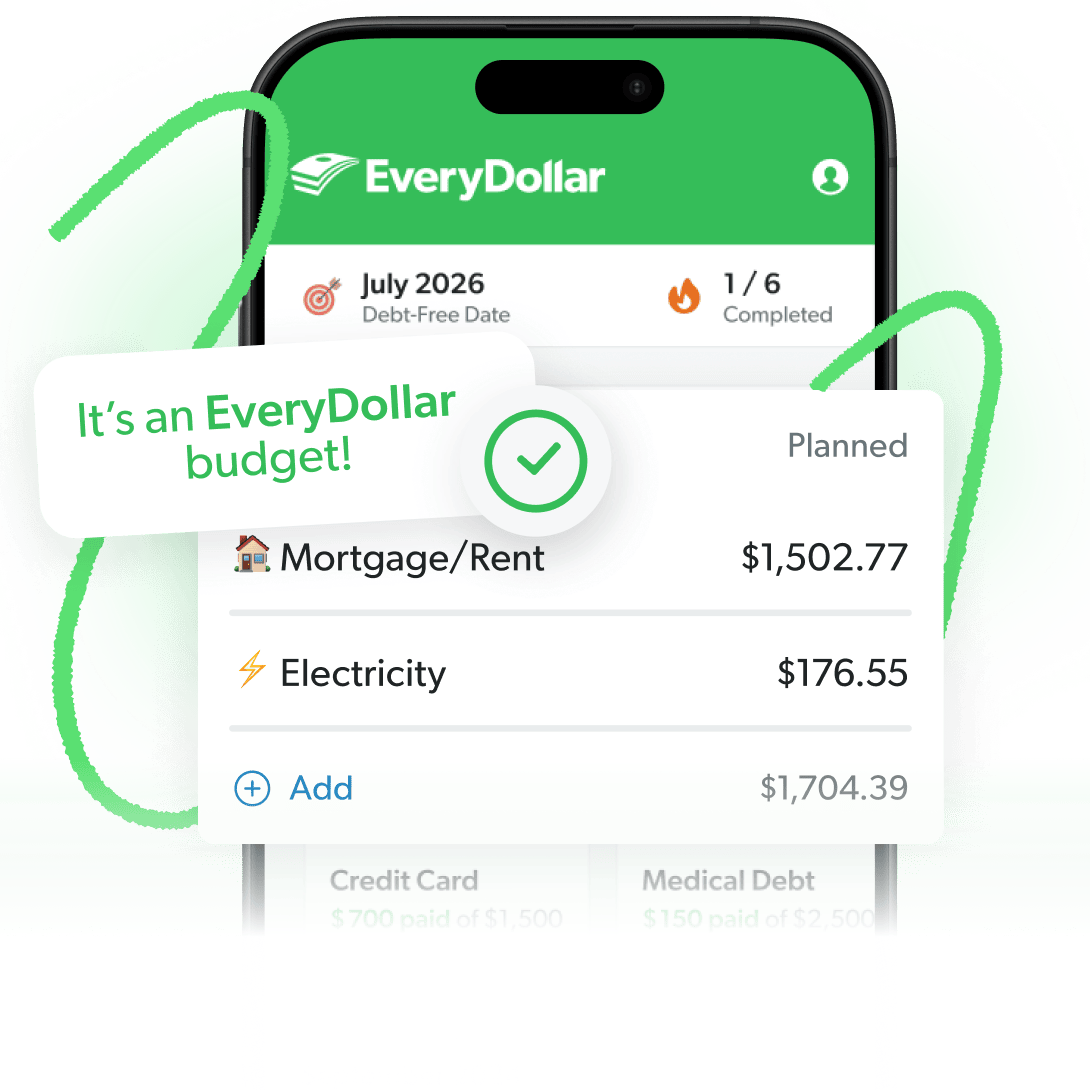
Find Margin You Didn’t Know You Had With EveryDollar
The EveryDollar budgeting app helps you find extra money every month so you can beat debt, build wealth, and make progress. Every. Day.
3. Calculate how much to save per paycheck.
Once you’ve set your savings goal, break it down to figure out how much you need to save per paycheck. Start with your take-home pay—the money that actually lands in your bank account after taxes, insurance and other payroll deductions come out.
Say you get paid twice a month and your gross pay is $3,000 per paycheck. Here’s what your pay stub might look like:
- Gross pay: $3,000
- Federal and state income taxes: -$370
- Social Security and Medicare: -$230
- Health insurance premium: -$150
- Take-home pay: $2,250
Your pay stub might have other deductions too, like dental insurance or union dues. Take those out, and what’s left is the number you budget and save from. (One exception: In Baby Step 4, calculate your 15% retirement contribution from your gross income, not your take-home pay.)
Gross Pay - Taxes - Insurance and Other Deductions = Take-Home Pay
Next, decide how much you need to save per month. For example, if your goal is to save $12,000 for your full emergency fund and you want to get that done in six months, you’d need to save $2,000 a month.
Then, consider how often you get a paycheck. Do you get paid monthly? Weekly? Biweekly? Divide your monthly savings goal by how many paychecks you get, and that’s how much you need to set aside every paycheck. In this case, if you get paid twice a month, you’d save $1,000 per paycheck.
With $2,250 in take-home pay, that leaves $1,250 per paycheck for everything else in your budget. If that’s too tight, push your deadline back a few months. Just don’t fudge the math.
Your Savings Goal ÷ Months Until Your Goal ÷ Paychecks per Month = How Much to Save per Paycheck
Where Should I Keep My Savings?
Keep your emergency savings in a high-yield savings account (HYSA) that’s separate from your checking account. For Baby Step 1, stash that $1,000 in a HYSA so it’s safe and easy to access when you need it. Then, when you hit Baby Step 3, keep your fully funded emergency fund there too so your savings can earn a little extra interest while you’re not using it.
But listen, this isn’t all about making bank on interest—you just need your emergency fund in a spot that’s easy to grab when life throws a curveball but not so easy that you're tempted to dip into it every time you scroll past a flash sale.
And when it comes to saving for things outside your emergency fund—like vacations, car repairs or even Christmas gifts—sinking funds are the way to go. Keep them separate from your checking and your emergency savings so you’re not accidentally robbing your future plans. Trust me, having money set aside for those big expenses will make you feel like a total boss when it’s time to pay!
How Can I Save More Money Each Month?
The best way to save more money each month is to get on a budget. From there, you can cut expenses, ditch your debt, increase your income, and adjust your tax withholdings.
Listen, saving more might feel impossible right now—especially if you’re living paycheck to paycheck and just barely scraping by each month. I’ve been there. But there are things you can do to find extra money!
Here are some ways to save more of your paycheck each month:
Get on a Budget
If you want to save more money, start by telling every dollar where to go with a budget.
I get it. So many of us struggle with saving. I used to have a very hard time with it. But getting on a budget was the key to breaking that paycheck-to-paycheck cycle because it taught me how to make a plan for every single dollar—including the dollars I want to save.
A budget is just a plan for your money—plain and simple. You’ve got to tell your paycheck where to go every single month. Otherwise, it’ll disappear before you know it. So if you’re not already, make this the month you start budgeting.
If you need help getting started, try EveryDollar, our budgeting app that helps you make a plan for every dollar you earn. On average, people who budget with EveryDollar uncover an extra $395.1 That’s money you can point straight at your savings goal.
Cut Expenses
One of the fastest ways to find more money to save is to spend less. This is when having a budget comes in clutch because it lets you see exactly what you’re spending your money on every month.
So, go through your budget—line by line—and see where you can cut spending. Is all your money going to UberEats and restaurants? Start meal planning and cooking at home. Maybe you need to lower your entertainment budget and cancel a few of those streaming services, or maybe you just need to slow your roll with Amazon by temporarily deleting the app.
Ditch Your Debt
Debt eats up money you could be using to save and build wealth. That’s why paying it off is Baby Step 2—and why we want you to get it out of your life as fast as possible.
The best way to knock out your debt is with the debt snowball method. Here’s how it works: Start by listing all your debts from smallest to largest balance. Make minimum payments on everything but the smallest debt—that’s the one you throw any extra money at until it’s gone. Then, use what you were paying on that debt to attack the next-smallest debt.
The debt snowball creates unstoppable momentum to help you pay off your debt faster than you ever thought possible! It worked for me, and I know it can work for you.
Increase Your Income
If there’s nothing left to cut from your budget, look for ways to bring in more money. Whether it’s a side hustle, part-time job or even switching careers, see what you can do to give your savings that extra push.
Retail stores always need cashiers, and you can even make your own schedule working for Uber, Lyft or DoorDash. But don’t sleep on offering your own services. Folks will pay a lot for personal services—like babysitting, lawn care, house cleaning and pet care. And there are even higher-paying jobs that don’t require a degree. Wouldn’t it be awesome if you could put an entire paycheck straight into savings?
Adjust Your Tax Withholdings
If you regularly get a big tax refund, check your withholdings to see if you’re having too much taken out of your paycheck throughout the year.
I know you probably think getting a large tax refund is a good thing. But technically, it just means you overestimated your tax withholdings and paid too much. You let the government borrow your money interest-free for the year. Absolutely not. That’s your money, and it’s time to take it back!
You can actually calculate your tax withholdings to better estimate how much to deduct from your paycheck for taxes. That way, you get to keep more of your income every month. Just be sure you put that extra toward your savings goal.
At the end of the day, how much you save from each paycheck comes down to where you are in the Baby Steps and what you're working toward. Once you've got a goal and a plan for your money, you can start making progress with every paycheck. And trust me, seeing that savings balance grow feels pretty dang good!
Next Steps
- Find out which Baby Step you’re on and what you should be saving for right now.
- Set a specific savings goal with a deadline and figure out how much to save from each paycheck.
- Download EveryDollar and add your savings goal to your budget so you can start making progress.
-
Is the 50/30/20 rule a good way to save?
-
You shouldn’t use the 50/30/20 rule, because a set savings percentage doesn’t account for where you are in your financial journey. If you’re paying off debt, for example, the Baby Steps have you keep a $1,000 starter emergency fund and throw any extra money at debt instead. And your savings goals change as you move through the Baby Steps.
-
Should I save money while paying off debt?
-
In Baby Step 2, keep the $1,000 starter emergency fund you saved in Baby Step 1 and throw every extra dollar at your debt snowball. If you’re facing a job loss, medical emergency, new baby or another major life event, you can pause the snowball and stack up cash until the storm passes. Then get right back to paying off debt.
-
What percentage of my paycheck should go to retirement?
-
Once you’re debt-free except for your mortgage and have a fully funded emergency fund, start investing 15% of your gross household income for retirement. That’s Baby Step 4. You can invest through tax-advantaged retirement accounts like a 401(k) and Roth IRA.
Get Weekly Insights Delivered Straight to Your Inbox
Did you find this article helpful? Share it!

About the author
Jade Warshaw

Get proven Ramsey answers fast.