
When Should You Buy Insurance on the Baby Steps?
 By
By 
Key Takeaways
- Insurance isn’t a Baby Step—it’s what protects your financial progress.
- Cutting insurance to speed up debt payoff is risky because one catastrophe can send you deeper into debt.
- No matter where you are on the Baby Steps, protect yourself with health, auto, home or renters, life, disability, and identity theft coverage.
- The goal is to have the right policy and coverage for your situation so a crisis doesn’t wreck your plan.
There’s one key mistake that can suddenly undo all the work you’ve put into the Baby Steps—and most people don’t realize it. It’s not skipping Baby Step 1. It’s not eating out once a month. It’s not keeping one emergency credit card frozen in a block of ice. Yes, those are all problems that will hold you back. But the mistake that could wreck your progress is not having enough of the right insurance.
Insurance? What? Yes! Many people starting the Baby Steps cut insurance to the bare minimum while paying off debt because that feels logical. After all, they’re thinking, I’m gazelle intense. Every dollar should go toward debt.
But this thinking creates a dangerous gap.
Insurance isn’t a Baby Step—it’s protection for every Baby Step. Without the right coverage, any one of these could wipe out years of financial progress:
- One accident
- One illness
- One lawsuit
- One identity theft event
Don’t wait until you’ve made it to a certain point to get the right coverage in place.
Quick Refresher: The Ramsey Baby Steps
If you’re reading this, you may know the Baby Steps by heart. But in case you’re still learning about them and just taking everything in, here’s a brief overview: The 7 Baby Steps are Dave Ramsey’s plan for eliminating debt and building wealth.

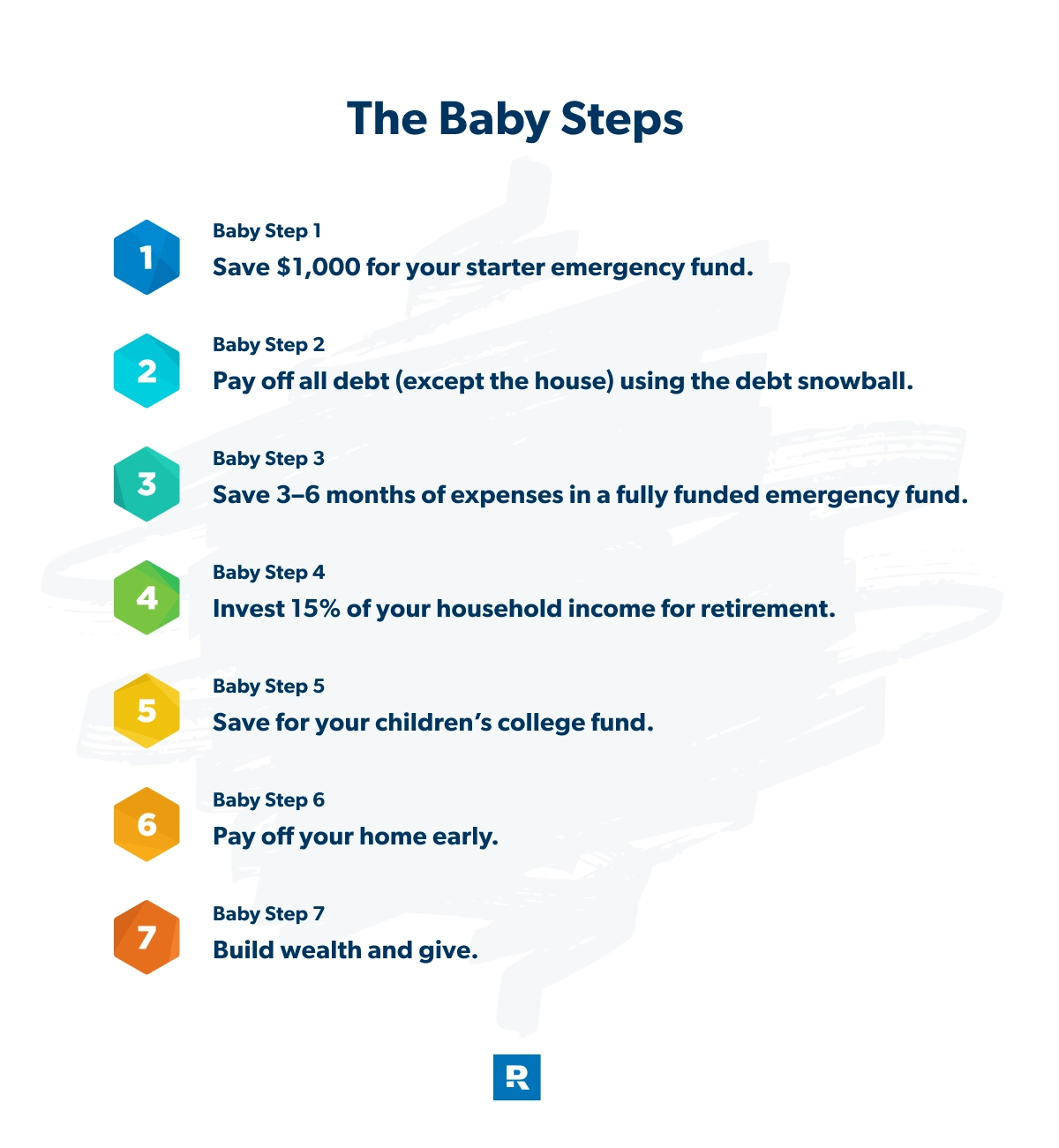 But this plan only works if your financial life is protected from major risks—and that’s the job of insurance. While you work the Baby Steps, you want to make sure nothing will derail it.
Why Insurance Isn’t Connected to a Baby Step
You’re on a journey, and you can’t control everything—stuff’s going to happen along the way. While emergency funds handle small problems, insurance handles catastrophes.
Just look at Kevin and Luna. They got mad—real mad—at their debt. They already have Baby Step 1 checked off and are gazelle intense on Baby Step 2. They’re each working two jobs, they’re not eating out, and they’ve cancelled all their subscriptions. They’ve sold their second car, and their son is scared he might be next. They’ve trimmed their budget until so lean it makes a vegan look fat next to it. They’ve been at it for a year and a half and can almost feel that Debt-Free Scream building in the back of their throats.
So why would they pay extra for more auto liability insurance? Or add $30 a month for life insurance and another $40 for long-term disability?
Well, Kevin has a second job as an Uber Eats driver. A 16-year-old runs a red light and T-bones him. Kevin’s neck is fractured, and his spinal cord is bruised. He’s going to be flat on his back for at least six months, with many more months of physical therapy. He won’t be bringing in a paycheck from Uber Eats or any other job. Their $1,000 emergency fund vaporized as soon as the ambulance picked him up. All their momentum has stopped. And as the bills for Kevin’s hospital stay, therapy and car repairs pile up, they feel all their months of bone-grinding work slipping through their fingers. They had put in so much effort. How could they end up headed into even more debt than they started with?
This is what happens when you don’t set yourself up for success on this journey of extreme sacrifice to build a future.
Any of these catastrophes could wipe you out if you’re underinsured:
- Major medical event
- Lawsuit after a car accident
- Housefire
- Death of a breadwinner
- Long-term disability
- Identity theft
Without insurance, debt can return overnight, savings can disappear, and your financial plans can collapse. Insurance protects everything you’re building.
The 6 Insurance Protections You Should Always Have in Place
Before you even cut up your first credit card (well, actually, you can go ahead and do that anytime), make sure these core protections are in place:
- Health insurance
- Car insurance
- Homeowners or renters insurance
- Life insurance (if you’re married or have children)
- Long-term disability insurance
- Identity theft protection
If any of these are missing, it doesn’t matter where you are on the Baby Steps—get them in place now! And it’s not just a matter of having any old policy—it should be the right policy. Everyone’s situation is different. Enough coverage for one person may not be enough for another. But don’t worry—we’ll tell you how to make sure you have just the right amount of coverage and aren’t paying any more than you need to.
Health Insurance
Bills from a serious medical event can reach tens or hundreds of thousands of dollars. Even a Baby Step 3 emergency fund wouldn’t cover that.
To make sure all your sacrifice and hard work doesn’t go to waste, get health insurance to protect your savings. Matthew T. from the Ramsey Baby Steps Facebook Community almost learned this lesson the hard way. He’s self-employed and went 20 years without health insurance.
“I just never wanted an additional monthly expense in the form of a health insurance premium,” he said.
But one day while listening to The Ramsey Show, he heard health insurance described as protection for his money and from bankruptcy—because one health issue could wipe him out.
“I once again went to the health care marketplace, only this time, I clicked Submit,” Matthew said.
Fast-forward 30 days: Matthew had to go to the ER—and after CT scans, an MRI and a cerebral angiogram, he was diagnosed with bilateral vertebral artery dissection with pseudoaneurysm. After three days in the hospital, his bill came to $169,912! Thank goodness Matthew bought health insurance 30 days earlier.
Generally, your best option for affordable health insurance is through an employer. But that’s not always available to everyone, like Matthew. Here are the main options:
- Employer coverage
- Marketplace plans (if you have your full emergency fund ready to go, a high-deductible health plan is often most affordable)
- Health care cost-sharing ministries
Don’t risk derailing all your progress. Never go without health insurance.
Car Insurance
Driving creates financial risk every day. (How many times have you gotten distracted and nearly hit someone?) Even if you’re an excellent driver, many other people aren’t. And sadly, in today’s sue-happy climate, an accident doesn’t even have to be your fault to end up in a lawsuit.
Here are a few risks you run by simply getting behind the wheel:
- Injuring someone
- Damaging property
- Being sued after an accident
If any of these happen, insurance is what keeps you from going backward—potentially very far backward—on your financial journey.
Yes, it’s illegal to drive without insurance, but many people don’t realize that state-mandated minimum coverage is usually not enough.
Make sure you have enough coverage to replace your car if you can’t pay for it out of pocket—and enough liability to make the insurance company eager to fight for you if someone sues you. Liability is one of the best buys in the insurance world—it usually only costs a few dollars a month to up your coverage by hundreds of thousands.
Homeowners or Renters Insurance
When it comes to protecting your house and belongings, there are two common mistakes: not getting enough homeowners insurance and skipping renters insurance altogether.
Just think about it for a second. What would you do if a fire wiped out all your belongings? If you’d get another credit card so you could have clothes to wear Monday morning, you don’t have enough insurance. If you’re renting, landlord insurance doesn’t cover your stuff. And if your whole house is gone? Even most people on Baby Step 7 can’t afford to get by without homeowners insurance.
Homeowners and renters insurance cover risks like:
- Fire
- Theft
- Storm damage
- Liability if someone is injured in your home
The point of having insurance during the Baby Steps is to keep you from going back into debt if something unexpected happens. You didn’t come this far to not even come this far!
Life Insurance
Life insurance is one kind of coverage that’s really easy to put off. You’d have to die for it to be useful, and you’re not planning on dying anytime soon! Prayers that you don’t—but no one knows for certain when their time will come. Just watch this woman’s powerful story:
What’s the whole point of this Baby Step journey anyway? To change your family tree! And what will happen to your family if you die in the middle of it? It’s not fun to think about—but without your income, they’d be in much worse shape than they are now.
You need life insurance if any of these apply to you:
- Married couple
- Parent
- Anyone financially supporting others
If you’re single with no dependents, you’re good to go without it.
Keep in mind, life insurance has one job: to replace your income if you die—which means you need a policy worth 10–12 times what you make in a year. Thankfully, if you’re young, a term life policy can be quite affordable.
Long-Term Disability Insurance
Becoming disabled while working is far more common than dying early. Your income is your most valuable financial asset while working the Baby Steps. Because of that, long-term disability insurance is an important piece of making sure you keep moving forward. It protects you if an illness or injury prevents you from working for more than six months.
Short-term disability insurance isn’t something we recommend (unless you can get it as a free employee benefit—in that case, go for it). You’re trying to save money, so the protections we recommend are meant to shield you from catastrophic financial problems—like losing your income for years. It’s not going to be fun, but you can handle a month or two without income—especially if you’ve got your Baby Step 3 emergency fund.
You can get long-term disability insurance through an employer plan or an individual policy. As usual, a plan through your employer will probably be cheaper, but don’t go without coverage. If your income stops, your financial progress does too. In fact, it starts going the wrong direction.
Identity Theft Protection
This is another type of coverage you could find easy to brush off. After all, identity theft doesn’t make headlines like wildfires or hurricanes. But it’s a real and growing modern financial risk. Giant companies like Google and Apple have had millions of users’ sensitive data exposed in cyberattacks.
Here are just a few problems identity theft can lead to:
- Direct theft from your bank accounts
- Fraudulent loans taken out in your name
- Months or years of recovery work
Identity theft protection typically includes:
- Credit monitoring
- Fraud alerts
- Dark web monitoring
- Identity restoration support including recovery payouts
In a digital world, your finances are linked to your identity—there’s pretty much no way around it. Don’t let a faceless criminal you’ll never track down put a stop to your momentum. Make sure you have identity theft protection in place.
That said, there’s a small exception here: If you’re gazelle intense on Baby Step 2 and paying for this protection would slow down your debt snowball, maybe skip it for now. But once you’ve got your momentum going, look into it ASAP.
When to Add Umbrella Insurance
Umbrella insurance isn’t necessary on day one. In fact, this one won’t come onto your radar until at least Baby Step 4. An umbrella policy provides extra liability protection above your home and auto policies. Most home and auto policies’ liability limits go to about $500,000. That means if you’re worth more than that, someone could sue you and go after anything you have above $500,000.
Umbrella insurance comes in handy if you’re sued after a serious accident in your car or on your property and damages exceed your policy limits.
For instance, let’s say your net worth is $800,000 (congrats!). Then imagine someone trips on your sidewalk, sues you for $800,000, and wins. If your home insurance liability limit is $500,000, you’ll have to hand over $300,000 and won’t get reimbursed by your insurance company.
So, we recommend purchasing umbrella coverage when your net worth reaches $500,000. This usually occurs around:
- Baby Step 4
- Baby Step 6
- Early Baby Step 7
Umbrella insurance is typically very affordable for the amount of protection it provides.
When to Buy Long-Term Care Insurance
Long-term care (LTC) insurance isn’t tied to a Baby Step. It depends more on your age and budget. We recommend buying an LTC policy when you turn 60 (not sooner and not later) to protect against the cost of:
- Nursing homes stays
- Assisted living
- In-home care
These costs can quickly climb into hundreds of thousands of dollars. But premiums can be expensive as well. Thankfully, most people won’t need to consider long-term care insurance until they’re older, which hopefully gives you lots of time to make financial progress and build wealth.
If you can afford to write a check for $300,000 and not bat an eye, you’re what we call self-insured, and you don’t need to buy LTC insurance. But if that would be catastrophic for your retirement and for your plans to leave a legacy, you should consider getting this coverage. If you’re late to the Baby Steps game and don’t have your finances in good enough order to afford the premiums yet, your only option may be to rely on Medicaid to cover this risk. With Medicaid, you’ll have little choice about the care you receive—and often Medicaid can take your house once you’re gone to recoup its costs.
We recommend getting an LTC policy at age 60 because:
- Waiting too long increases costs
- Buying too early can mean paying premiums for decades
LTC insurance is about protecting your retirement and any financial legacy you want to leave to your kids, as well as making sure they don’t have to bear the financial burden of your care.
Insurance and the Baby Steps Work Together
The Baby Steps provide a powerful road map to financial freedom. But roads have guardrails to reduce risk because life will throw you curves.
Yes, you still want to minimize unnecessary expenses. But cutting essential insurance isn’t saving money—it’s taking a dangerous risk.
Insurance makes sure things like this don’t undo everything you’re working so hard to build:
- A medical crisis
- A lawsuit
- A house fire or major damage
- A long-term disability
- Identity theft
That doesn’t mean you should go out and buy as much insurance as possible. You only need enough to make sure you don’t go backward if something bad happens.
Here’s what that looks like:
- Carry the right amount of coverage
- Shop for competitive rates
- Increase deductibles if you have enough money saved to cover them
- Avoid unnecessary add-ons
We wouldn’t give you all these instructions about insurance and then not give you a way to get help following them! If you realize you need more insurance or feel worried you may be paying for too much, we’ve got insurance pros who can help. Our RamseyTrusted® pros know the Baby Steps—and they’ll help you make sure you’re paying the best price for the right coverage.
Next Steps
- Learn more about Dave Ramsey’s 7 Baby Steps.
- Read up on all eight types of insurance—both the core protections and the ones to add later.
- Take our Coverage Checkup to find out if your financial foundation is protected.
- Figure out your net worth to see if it’s time to look into umbrella insurance.
- Protect yourself without overspending. Connect with a RamseyTrusted pro to get quotes today!
Get Weekly Insights Delivered Straight to Your Inbox
Did you find this article helpful? Share it!

About the author
Ramsey Solutions

Get proven Ramsey answers fast.