
What Medicare Advisors Recommend for Medicare Coverage
 By
By 
Key Takeaways
- For most people, Medicare advisors recommend Original Medicare (Parts A and B) plus a Medigap plan and Part D drug coverage for the best combination of flexibility and predictable costs.
- Original Medicare alone leaves significant coverage gaps. Advisors always pair it with Medigap or Medicare Advantage to fill them.
- When looking for the right fit, good advisors find plans that match people’s needs and then use their preferences to narrow down the choices.
- For people new to Medicare, advisors recommend starting with Medigap because you usually can’t get this plan later if you change your mind.
- There are three situations where advisors might recommend Medicare Advantage over Medigap: if you can’t afford Medigap premiums, if you missed your Medigap enrollment window, or if you live in a state that gives you universal access to Medigap.
Here's a Tip
For most people, Medicare advisors recommend enrolling in Parts A and B, adding a Medigap plan to cover out-of-pocket costs, and completing coverage with a Part D prescription drug plan. This combination gives you the flexibility to see any Medicare-accepting provider and keeps your long-term costs predictable. Medicare Advantage may be a better fit in specific situations.
Medicare coverage for most people usually turns out to be pretty straightforward: Original Medicare plus Medigap plus Part D. Getting there just takes a good advisor who knows your situation.
Ari Parker—lead advisor for Chapter, a Medicare guidance company—says when a Medicare advisor recommends coverage, they’re looking at both a person’s needs and wants.
“Based on someone’s particular health care providers, prescriptions and preferences, there is almost always one coverage that stands out as the right fit for that person,” he says.
But there are over 20,000 different plans out there.

That’s why everyone should talk to a Medicare advisor. They know how each plan relates to each nuance of your situation so they can recommend coverage that’s the ideal fit for you.
What Are the Different Parts of Medicare?
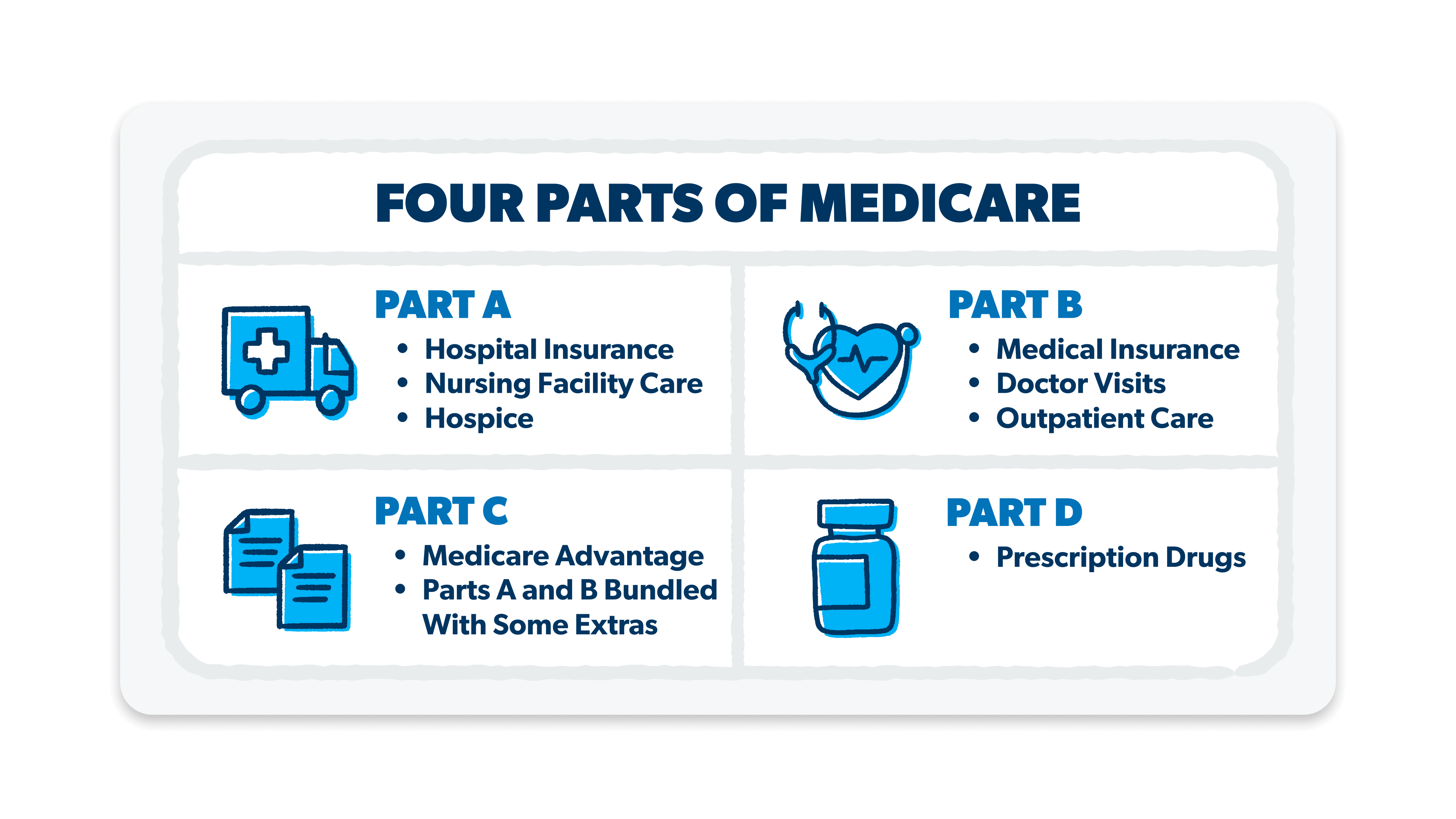
Medicare comes in four parts:
- Part A: hospital insurance
- Part B: medical insurance
- Part C: Medicare Advantage (a bundling plan run by private insurers that can include extra coverage)
- Part D: prescription drug coverage
Advisors draw on all four parts when building your coverage plan. Parts A and B together are called Original Medicare. People who opt for Original Medicare often buy extra coverage called Medigap that helps cover their share of Medicare costs.
Part C (aka Medicare Advantage) is Parts A, B and usually D bundled together, sometimes with a few other coverages like vision and dental (you will still have to pay your Part B premiums separately). Medicare Advantage plans have networks (specific providers you have to use), while Original Medicare lets people go pretty much wherever they want for care.
Now let’s look at each part more closely.
What Does Medicare Part A Cover?
Part A is your hospital insurance. It covers inpatient hospital stays, skilled nursing facility care, hospice and some home health care.
For about 99% of people, Part A premiums are free.[1] To qualify, you must have worked 10 or more years and paid into Social Security for that time.
The inpatient hospital deductible is $1,736 for 2026. After 60 days, you’ll also have to pay coinsurance.[2]
What Does Medicare Part B Cover?
Part B covers your medical expenses like doctor visits, outpatient care, preventive services, durable medical equipment, certain services not covered by Part A, and also some home health care.
Everyone has to pay premiums for Part B. In 2026, the standard monthly premium is $202.90. The yearly deductible is $283.[3] You also have to cover coinsurance with Part B.
What Does Medicare Part C (Medicare Advantage) Cover?
So far, it’s been fairly straightforward. Well, get ready to board the crazy train.
Part C is not actually a third part of Medicare coverage that helps pay for a third set of health-related expenses. Instead, it’s the name of a private Medicare plan that bundles parts A and B with some random extra coverages. These are decided by the insurer but can include dental, hearing and vision, along with prescription drug coverage (most of the time). You’ll only carry one Medicare card with this plan—which is the only simple thing about it.
Premiums, deductibles, copayments and out-of-pocket maximums all vary by insurance company.
What Does Medicare Part D Cover?
Part D is the only part that feels like it kind of makes sense because it covers prescription drugs. (D for drugs. Get it?) Part D is also through private insurance companies—not directly through the government.
Also similar to Part C, the costs for Part D vary based on the company you go with and the plan you choose. Some plans have no premium at all, while others do. In 2026, the average stand-alone Part D premium is $36 per month.[1] You’ll have a yearly deductible and a cost-share amount to cover with each drug.
Here’s some good news for this year: Thanks to the Inflation Reduction Act, your out-of-pocket costs for covered Part D drugs are capped at $2,100 in 2026. Once you hit that limit, you pay nothing for covered prescriptions for the rest of the year.[2]
Medigap vs. Medicare Advantage: Which Is Better?
While Medicare Advantage offers lower monthly premiums, most advisors recommend Medigap because you get more flexibility when choosing providers and lower out-of-pocket costs during a health crisis.
Here’s a quick comparison to help you see how the two paths stack up:
|
Feature |
Original Medicare + Medigap |
Medicare Advantage |
|
Monthly Premium |
Higher (Medigap + Part B premium) |
Often lower or $0 (plus Part B premium) |
|
Provider Flexibility |
Any doctor or hospital anywhere that accepts Medicare |
Must use plan network, referrals often required |
|
Out-of-Pocket (OoP) Predictability |
Very predictable, Medigap covers most cost-sharing |
Varies widely, max OoP up to $9,250 in-network (2026)[1] |
|
Long-Term Availability |
Guaranteed renewable as long as you pay premiums |
Plan can leave your area or change benefits annually |
|
Specialist Access |
See any specialist without a referral |
Usually requires referral and network restrictions apply |
|
Best For |
People who want maximum flexibility and peace of mind |
People who can’t afford Medigap or missed their enrollment window and can’t qualify for it now |
Here's a Tip
Your Medigap Open Enrollment Period is a one-time opportunity. It opens when you turn 65 and enroll in Medicare Part B, and it lasts for six months. During this window, insurance companies have to sell you any Medigap plan they offer—no questions asked. But if you miss that window and try to buy it later, you could be denied coverage or charged much higher premiums based on your health history. Whether you’re punctual to a fault or more of a “party starts at 7 so show up at 10” kind of person, this is one instance where you don’t want to be late!
How Do Medicare Advisors Choose the Right Plan?
Medicare advisors choose the right plan by doing two things in this order: First, they identify every gap in your current coverage, then they match plans to your specific health needs, prescriptions and provider preferences. The goal is always the same—find you the most complete coverage at the best price. Here’s how that process actually works.
Comprehensive Coverage Strategy
Every good advisor will tell you that your main concern is to make sure you’re fully covered. The difficulty is, there are lots of different ways you can achieve this with Medicare—and then there’s the fact that everyone’s situation is different.
Parker says Original Medicare by itself will have some serious gaps.
“What we’ll recommend is coverage that will cover those gaps,” he says.
Here’s what an advisor will consider when they evaluate plans and recommend one for you:
- Chronic conditions: Does the plan provide coverage for ongoing treatments and medications you may need?
- Location: What facilities and plans are available based on your address?
- Specialist needs: Does the plan let you use specific specialists and facilities?
- Premiums and out-of-pocket costs: What are the budget considerations for monthly premiums, deductibles and copayments?
- Provider preferences: Does the plan let you use the doctors and hospitals you like?
- Prescription needs: Are your regular medications covered and affordable under the plan?
- Out-of-state coverage: Does the plan cover out-of-state services in case you travel or live in multiple states?
Once an advisor understands your needs, Parker says they’ll find plans that meet those needs. Then they’ll use your preferences to narrow down the plans to find the right fit for you.
In the end, a good advisor will recommend the plan that gives you the coverage you need at a price that works with your budget.
Medicare Tips That Set You Up for Success
Government programs are the best . . . at being confusing. And Medicare is no exception. But you can download a guide that makes learning the basics of Medicare feel like talking to a no-nonsense friend over coffee.
Parts A and B Together (Original Medicare)
Everyone getting Medicare needs Parts A and B. Period. But that’s almost never enough by itself because Original Medicare still requires you to pay quite a lot out of pocket with no annual maximum. That leaves you pretty vulnerable financially.
You’ve got two options for combating that: Medigap or Medicare Advantage.
Supplemental Coverage (Medigap)
Medigap doesn’t cover more services—it offers extra coverage for what Medicare already covers. When you receive a Medicare-covered service, Medigap helps cover your share of the costs (deductibles, coinsurance and copays).
For folks new to Medicare, Parker recommends starting with a Medigap plan because you usually can’t get one later if you change your mind. You’re only guaranteed Medigap coverage during your initial opportunity to sign up for Medicare. If you don’t sign up for Medigap then, you have to go through underwriting (where the insurance company decides if you’re too risky to insure) and usually can’t get it at an affordable price.
“Our perspective is that far more people should be choosing Medigap than are doing so today,” Parker says. “That’s because they can never take it away from you as long as you pay your premiums.”
The biggest drawback to Medigap is the extra premium. But Parker says you should get Medigap if your goal is flexibility and peace of mind.
Advisors recommend Medigap if you like to have more control over who you see for care. For instance, if you’ve been seeing a doctor for years and don’t want to change, Medigap will let you keep them. This is also the recommended plan if you have health problems that require a lot of specialist referrals.
“Our perspective is that far more people should be choosing Medigap than are doing so today,” Parker says. “That’s because they can never take it away from you as long as you pay your premiums.”
Medicare Advantage Plans
For most people, Medicare Advantage isn’t the best choice. But occasionally, it’s the closest fit for their situation.
Advantage plans only really have a few financial “advantages.” These are:
- $0 premiums (sometimes)
- Dental, vision and hearing coverage (sometimes)
- Defined annual out-of-pocket limit
Yeah, we had to use the word sometimes twice up there. That’s because Advantage plans are offered through private insurance companies contracting with the federal government, so each one is different. Even the plans with $0 premiums are offered only because they often charge more for deductibles and copays.
Parker says there are three situations when he would recommend an Advantage plan to someone:
- They can’t afford the premiums for Medigap.
- They’ve missed their window to enroll in Medigap without underwriting, and it’s unavailable to them because of their health status.
- Their state gives them universal rights to Medigap (meaning they can sign up whenever), so they can try an Advantage plan first to see if they like it—with no consequences.
The $0 premium plans can work well for people who are healthy and don’t use the medical system much. However, you’d still need to weigh that with the downsides of Advantage plans, like being limited to in-network providers. And as you get older, you’ll likely use health care services more—but at that point, switching to Medigap won’t be an option for you.
An advisor might also recommend an Advantage plan for patients who expect to have a lot of medical expenses. But this would be for particular health problems that use the plan’s network of providers and specialists, and only when patients anticipate super high expenses every year. The plan would likely have premiums and an annual out-of-pocket maximum set lower than legally required.
Most Advantage plans make it hard to see specialists and use certain facilities, or they simply don’t cover them. You have to be very careful when selecting these plans.
How Do You Choose the Right Part D Plan?
To choose the right Part D plan, an advisor compares your specific medications to each plan’s formulary (the list of covered drugs), then compares premiums and pharmacy networks to find the lowest total annual cost.
You can either get a Part D plan on its own or through a Medicare Advantage plan. If you go with Original Medicare, you’ll need to pick out a Part D plan to complete your coverage. If you go for an Advantage plan, you’ll get the Part D plan that comes with whichever Advantage plan you choose. In other words, you don’t get to pick that out on its own. If you go this route, consider each Advantage plan’s drug coverage as you evaluate the plans overall.
A formulary is the list of drugs a plan covers. These are often broken down further into tiers to help regulate costs (least expensive drugs in the lowest tiers, most expensive drugs in the highest). Each plan has a different formulary, so an advisor will compare the medications you take to the plan’s formulary to know whether it’s a good fit.
Premiums on Part D plans can vary—a few even have no premiums. An advisor will do a cost-benefit analysis looking at three factors:
- Does the formulary match your medications?
- How much does the plan cost?
- Does the plan use your preferred pharmacies?
The advisor will then recommend the plan that most closely matches your needs for as little money as possible.
How Often Should You Review and Update Your Medicare Coverage?
Remember, your coverage needs can change. So what an advisor recommends today could be different in one, two or 10 years.
You and your advisor will check in before the Medicare Open Enrollment Period every year to make sure your coverage is still working for you and then make changes if something different would serve you better.
You’ll also want to keep your advisor informed of any big life changes. These could include loss of your spouse’s coverage, changes in your health, or a drastic shift in your finances, like a windfall inheritance or a lot of losing bingo nights. (Oh, wait—it’s Gen Z playing bingo now. Pinochle then?)
How Do You Find a Trustworthy Medicare Advisor?
A trustworthy Medicare advisor only cares about getting you the right plan for you.
We know, not every advisor on the other end of a phone number is solid. So how do you find a good one? Most advisors make more money selling specific plans, which means they’ll recommend those plans whether they’re good for you or not. Avoid them! Instead, look for an advisor who isn’t tied to any insurance company or plan and can compare lots of plans—not just a couple.
We’ve partnered with a group of Medicare advisors who meet all the standards. The advisors with Chapter are our official RamseyTrusted® partners for all things Medicare. They make money when you get covered—no matter what plan you pick. They compare 24,000 plans to make sure you’ve got the perfect fit.
And it doesn’t end there. Chapter’s advisors help you get the most out of your plan by scheduling doctor appointments, checking in on how your plan is working, helping you use your benefits, and more. They keep up with Medicare’s ever-changing rules so you don’t have to. If the rules or your situation changes, they’ll help you find a new plan so you can keep living out your retirement the way you want.
Next Steps
- Learn more about all the ways working with an advisor can make your Medicare journey easier.
- Gather your current prescription list before talking to an advisor so they can find the Part D plan with the lowest total annual cost for your medications.
- Review Medicare supplement plans (Medigap) to understand if Medigap is the right fit for your situation.
- Learn how Medicare enrollment works so you don’t miss key deadlines or face lifetime penalties.
- Contact a RamseyTrusted Medicare advisor at Chapter to get a personalized plan recommendation.
-
When is the best time to talk to a Medicare advisor?
-
You should contact an advisor about six months before you turn 65. This gives you enough time to understand your options and enroll during your Initial Enrollment Period without facing lifetime late-enrollment penalties.
-
Why do advisors recommend Medigap over Medicare Advantage?
-
Medigap is often recommended because it allows you to see any doctor who accepts Medicare and provides more predictable costs. Unlike Medicare Advantage, Medigap doesn’t have restrictive provider networks or require referrals for specialists.
-
Can a Medicare advisor help me save money on prescriptions?
-
Yes. An advisor can run your specific medications through a database of available Part D plans to find the one with the lowest total annual cost. Which plans cover which drugs changes every year, so this review can save you hundreds of dollars in out-of-pocket drug costs.
-
Is there a fee to work with a Medicare advisor from RamseyTrusted Chapter?
-
No, working with our RamseyTrusted partner Chapter is completely free for you. They’re compensated by insurance companies, but they recommend the best plan for your needs regardless of the commission.
Get Weekly Insights Delivered Straight to Your Inbox
Did you find this article helpful? Share it!

About the author
Ramsey Solutions

Get proven Ramsey answers fast.