


Watch The Ramsey Show
See our call-in show on YouTube.

Debt is the biggest thing standing between you and financial peace. The good news? There’s a proven plan to get out of debt and build wealth. It’s called the 7 Baby Steps and you can start them today.

Select the answer that most applies to you and continue the assessment.


There’s so much money advice out there that it can leave you feeling overwhelmed with no clear place to start. Put your specific situation into Ask Ramsey and get real help based on Ramsey principles.

Everyone and their Uncle Ted will tell you debt is necessary. But debt is a weight holding you back from financial peace. Debt costs you more than money—it steals your sleep and your future.

Every payment sends your money to banks and lenders instead of toward your future. They’re using your money to get ahead while you’re just trying to get your paycheck to stretch to the end of the month.

No matter what your past looked like, you can break out of this cycle for good. Join the millions who’ve used our proven plan to kick debt, save up, and build real wealth.

Debt is anything you owe that’s standing between you and your goals. That includes all types of debt—what you owe the credit card company, car dealership, etc. All of it keeps you from using your money for what you want. Knowing what debt is and where it’s hiding is the first step to getting rid of it for good.
The fastest and most effective way to get out of debt is the debt snowball method. Here’s how it works:

Say you owe $600 on a store card and $1,800 on a medical bill. You pay the minimum on the medical bill and throw $200 a month at the card. In three months, it’s gone. That $200 doesn’t go back to your spending. You roll it into the medical bill payment so you can knock it out even faster.
You might’ve heard of the debt avalanche, where you pay off the highest interest rate first. It might save you a little in interest, but you’re less likely to stick with it. As Dave Ramsey says, “Personal finance is 80% behavior and only 20% head knowledge.” The snowball works because the quicker you pay off those small debts, the more emotional momentum and encouragement you get to keep rolling.
Use this debt snowball calculator to enter your debts, get your debt-free date, and get a step-by-step plan to pay it off faster.
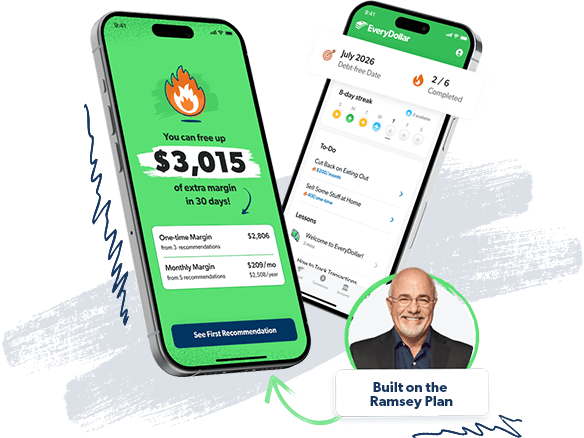
You can’t skip this step when getting out of debt: Build a budget and stick to it. With EveryDollar, you can budget from anywhere. Download our free EveryDollar app and start making a budget you can follow today.
Need more info? We’ve got you covered. Choose how you like to learn and we’ll point you to the right tools that’ll help you budget and pay off debt. Or take our Get Started Assessment to see what Baby Step you’re on.
See our call-in show on YouTube.

Tune in as our experts answer audience questions.

Find articles and guides on debt, wealth building and more.

Use Ask Ramsey to get customized advice built on Ramsey principles, powered by AI.
Debt is any money you owe to a bank, a company or another person. That includes credit card balances, student loans, car loans, personal loans, medical bills and even buy now, pay later plans. Every payment takes money out of your paycheck that you could be using to save, give or invest.
The fastest way to get out of debt is to put every extra dollar toward the debt snowball plan. Save a $1,000 starter emergency fund (Baby Step 1), then list your debts smallest to largest and start the debt snowball (Baby Step 2). Use a written budget to find extra money, sell things you don’t need, and pick up extra income to throw at your smallest debt. Each time a debt is gone, roll that payment onto the next smallest one, and your snowball will grow faster.
The debt snowball is how you do Baby Step 2, and it’s the proven way to pay off all your debt (except your house). List your debts smallest to largest, pay the minimums on everything but the smallest, and attack that one with every extra dollar. When it’s gone, roll its payment onto the next smallest debt. Your payment grows with every debt you knock out, like a snowball rolling downhill.
Pay off your smallest debt first, no matter the interest rate. Knocking out a debt quickly gives you a win, and wins keep you going. Once it’s gone, move to the next smallest. That momentum is what gets people all the way out of debt.
The debt avalanche method has you pay off the debt with the highest interest rate first, no matter the balance. On paper, it can save you a little more in interest, but it can take a long time to get your first win. The debt snowball goes from smallest to largest balance so you see progress fast and stay motivated. Personal finance is 80% behavior and 20% head knowledge, so the plan you’ll stick with beats the one that only looks best on a spreadsheet.
It depends on how much you owe and how much you throw at it each month. People who follow the debt snowball with focused intensity typically pay off everything but the house in about 18–24 months. A written budget and a side hustle will speed that up.
Stop using your cards (in fact, just cut them up!), then list every card balance from smallest to largest. Pay the minimum on all but the smallest and put every extra dollar on that one until it’s gone. Then roll that payment onto the next card. A written budget will help you find the money to do it.
Debt consolidation rolls several debts into one loan with one monthly payment. It sounds simple, but it doesn’t change the habits that got you into debt, and it can stretch your payoff out longer. We don’t recommend it. The debt snowball gives you a plan and the wins to stay on track.
No matter what you’ve heard about debt relief, what actually works is a plan and a budget. The debt snowball gives you the steps, and a zero-based budget helps you find the money to power it. There’s no quick fix, but there is a proven way out. It’s the same plan that’s helped millions of people win with money.
You can contact your creditors directly and ask about a lower interest rate or a payment arrangement, especially if you’re in a hard season. They don’t have to say yes, so don’t count on it. And this is a short-term tactic. What gets you out of debt is still the debt snowball and a budget.
Keep the debt snowball going unless there’s a true emergency. It’s only okay to pause if you’re expecting a baby, you lose your job, or you have a major medical emergency. Once you’re through it, get the snowball rolling again.
Yes. While you’re in Baby Step 2, pause all retirement investing so everything goes toward the debt snowball. Once you’re debt-free except for your house and you have a fully funded emergency fund, start investing 15% of your household income in Baby Step 4. Don’t cash out your 401(k) to pay off debt.
Your credit score is an “I love debt” score, and the only way to build it is to borrow money. When you get out of debt and stay out, your score will eventually drop. But that’s good! You don't need it. You can still rent an apartment by showing proof of income and a solid rental history. And you can buy a house with a lender that offers manual underwriting. It might take a little more work, but it's worth it. When you’ve got money in the bank, you don’t need to play the credit score game. You’re not here to impress a lender—you’re here to win with money.
Bankruptcy should be your very last option, after you’ve tried everything else. It’s not a clean slate and it won’t erase things like student loans or tax debt. Before you resort to bankruptcy, try building a budget, negotiating with your creditors, selling what you can, and bringing in extra income. If you’re still not sure what to do, talk to a financial coach.
Don’t bank on it. Forgiveness is rare. It only covers federal loans and has strict requirements, like 120 qualifying payments for Public Service Loan Forgiveness. Only apply if you’re already close to qualifying—because waiting on the government isn’t a strategy. Otherwise, get on a budget and use the debt snowball to pay your student loans off yourself.
Check out our debt articles covering everything from student loans and timeshares to dealing with collections.