
Should I Rent or Buy a House?
 By
Rachel Cruze
By
Rachel Cruze

Key Takeaways
- Renting isn’t a waste of money. It’s buying yourself time to get your finances in order.
- Buy only when you’re debt-free, have a full emergency fund, and can keep your mortgage payment within 25% of your monthly take-home pay.
- A 15-year fixed-rate conventional loan is the only mortgage I recommend. Nothing else gets you to a paid-off house faster.
- Buy if you’re ready to plant roots and build wealth. Rent if you need more flexibility.
You guys, I know it’s tough renting—especially when you’ve been dreaming of owning your own home for years. You might even clench your teeth a little when you see pics of friends standing next to Sold signs while you’re still signing lease renewals. But renting could be best for your current season, and that’s nothing to feel guilty about.
Here's a Tip
Buy a house only when you’re debt-free, have a fully funded emergency fund of 3–6 months of expenses, and can keep your mortgage payment within 25% of your monthly take-home pay—including principal, interest, property tax, home insurance, PMI and HOA fees. If that’s not you yet, renting is the smarter and safer option for now.
Is It Better to Rent or Buy in 2026?
Deciding to rent or buy always comes down to your personal finances and stage of life—not what the current market is doing. Someone might tell you it’s better to buy right now because the typical rent ($1,965) is nearly on par with the typical mortgage payment ($1,884).1 Others might tell you it’s better to rent right now because mortgage rates (around 6%) and home price growth (2%) are too high and may stay that way through 2027.2,3 But housing market trends are always changing, and no one can perfectly time a home purchase.

The only thing you can control is your own money. No matter what year it is, buying and renting always come with pros and cons—so the right choice depends on your unique situation.
Buying a home gives you ownership, privacy and home equity. But repairs, taxes, interest, insurance and homeowners association (HOA) fees can add up fast. Plus, you usually need to stay in a house at least two to three years to avoid losing money when you sell it. That’s why you want to be absolutely sure you’re ready to buy a house before you take this big step.
Renting, on the other hand, comes with less maintenance and gives you more flexibility to move. But you’ll have to deal with rising rent prices, less control over your space, and no equity (not to mention the possibility of loud neighbors or a grumpy landlord).
Location is also a big factor. If you want to live in the city or in a part of town with good schools and crazy expensive homes, renting might be more affordable than buying. Or you could buy a house in a more affordable area—but you may have to compromise on schools or your commute to work.
You’ll also want to think about your lifestyle. If you’re not ready to handle maintenance, repairs and the ongoing responsibilities of owning a home, renting gives you more breathing room. But if you’re basically Fix-It Felix and actually enjoy tackling projects, homeownership might not feel as intimidating.
At the end of the day, the right choice comes down to whether you’re financially ready and confident in your plan.
Renting vs. Buying: What’s the Real Difference?
If you’re not sure which option fits you right now, here’s a quick gut check:
|
Rent if . . . |
Buy if . . . |
|
You need flexibility to move easily when life changes |
You’re ready to stay in one place |
|
You want lower costs in the short term |
You can handle higher costs |
|
You don’t have extra time or money to handle repairs |
You’re ready to handle repairs and upkeep yourself |
|
Building equity isn’t your priority yet |
You’re ready to build equity over time |
|
You have little or no down payment saved |
You have a large down payment saved |
|
You’re okay with limited control over your space |
You want more control over your space |
|
You’re not in the right place to take on financial risk |
You’re ready to handle more financial risk |
Renting keeps your options open, while buying builds long-term wealth (but only if your finances are ready for it).
I’m a spender at heart, so hear me on this: A house is the biggest purchase you’ll ever make. Treat it like one, not like an impulse buy in your Amazon cart.
How Do I Know if I’m Ready to Buy a Home According to Ramsey?
You’re ready to buy a house when you’re debt-free (Baby Step 2), have a fully funded emergency fund of 3–6 months of expenses (Baby Step 3), and have saved a big down payment. Aim for 20% of the home price to avoid paying for private mortgage insurance (PMI)—which doesn’t benefit you. If you’re a first-time home buyer, a smaller down payment—at least 5%—is okay too. Make sure your mortgage payment is no more than 25% of your monthly take-home pay on a 15-year fixed-rate conventional loan.
Baby Steps 2–3 aren’t there to slow you down. They’re there so buying a house feels like a blessing instead of a burden because you know you can afford it. For the full breakdown of what “ready” looks like, check out this article: Am I Ready to Buy a House?

What Are the Pros and Cons of Renting vs. Buying a Home?
Now, let’s take a closer look at what’s great (and not so great) about buying and renting.
Buying Pros
- You can actually own the house. When you pay rent, that money doesn’t build any equity. But when you pay your mortgage, your money goes toward owning your home. And once your house is paid off, it’s yours! You have the satisfaction of knowing you made the American dream your reality.
- You can cash in on appreciation. Your home will likely increase in value over time depending on the market and how well you take care of it. What you buy for $350,000 today could sell for $400,000 down the road.
- You have tax advantages. Many costs of owning a home—like property taxes and mortgage interest—are tax-deductible.
- You have the freedom to renovate your house. As a homeowner, you can do whatever you like to your home. If you want to paint it hot pink from top to bottom, no landlord can stop you (although your spouse or HOA might have something to say about it).
- You have more privacy. Ricky and Lucy are arguing again—and because the apartment drywall is as thin as a playing card, every tenant can hear them. But having your own house means no Ricky, no Lucy, and no flimsy apartment walls to deal with. Just you, peace and quiet. Of course, if your dream home is a condo in the middle of bright lights and city life, this wouldn’t apply.
Buying Cons
- It’s more difficult to travel and relocate. Want to go to Southeast Asia for six months on a whim? Leaving your house isn’t as easy as getting out of a lease, packing your bags, and getting a one-way ticket to who-knows-where. Same goes for work-related relocations. You’ll have to rent out or sell your house—or else prep it to stay vacant for a long time.
- You have more expenses. I hate to break it to you, but homeowners insurance will cost a lot more than renters insurance. Combine that with a possible flood policy, HOA fees, property taxes and higher utility bills, and you’re looking at much higher monthly expenses.
- You’re your own landlord. A leaky roof could be a full-on crisis that’ll take dipping into your emergency fund to fix. But when you rent, a leaky roof just needs a bucket under the leak until your landlord fixes it.
- Upkeep takes time. Besides the money involved in keeping up a home, it also takes time and energy. Love lazy Saturdays? Well, the grass isn’t going to mow itself! And what about all those beautiful fall leaves? It’s on you to rake and bag them (or pay someone to do it for you).
- You have to save up money for a down payment and closing costs. This takes time and hard work. But you can do it if you set a clear savings goal and stick to it over the long haul.
Renting Pros
- You can move easily. Tired of the city you live in? Thinking about taking a year to travel the world? When you rent, you don’t have to stay in the same location. Plus, it’s much easier to get out of a lease than a mortgage.
- You don’t have to pay for maintenance. If the stove goes kaput or the pipes burst, you don’t have to make a trip to the appliance store or call the plumber—you call the landlord. One of the biggest perks of renting is that you never have to worry about surprise repair costs.
- It’s cheaper in the short term. Besides having virtually no maintenance costs in an apartment, renters insurance is way cheaper than homeowners insurance. Your move-in costs will also be lower since you pay a small security deposit instead of a giant down payment. Plus, once you’re in, you won’t pay HOA fees or PMI.
Renting Cons
- Rent rates will go up. Even if you found a killer deal in a hot area, inflation, competition and rising property values will cause your rent to go up year after year. A fixed-rate mortgage payment stays the same (even as your income increases).
- You have no financial incentives. No tax deductions. No equity. No rising property value. So even though you’re spending your rent money on an important living expense, you might feel like you’re not making progress with your money.
- You don’t have freedom to renovate. New tile would look great in the bathroom, but your landlord may not approve. You even have to ask for permission for simple changes, like paint colors.
There you have it! Whether you’re ready to buy or want to keep renting, you’ve got a better idea of what you’ll be getting yourself into.
Want More Expert Real Estate Advice?
Sign up for our newsletter! It’s packed with practical tips to help you tackle the housing market and buy or sell your home with confidence—delivered straight to your inbox twice a month!
Is Renting Always Cheaper Than Buying?
Renting an apartment is usually cheaper than buying a house—but not always. If you’re renting a house instead of an apartment, your rent could actually be higher than a mortgage on a similar home. A lot depends on location.
If you’re comparing costs, start by searching online for rentals in the neighborhood where you want to live. Rental listings should give you an idea of the cost of rent, plus utilities and other fees. Don’t overlook hidden fees. An apartment complex might tack on parking, elevator or garbage fees. And if you bring Rover along to your rental, you’ll usually have to pay a pet fee too.
In high-cost markets (looking at you, San Francisco), renting is often the more affordable option. But over time, the math can shift.
Here’s why: Rent typically goes up year after year, while a mortgage stays the same (unless you have an adjustable-rate mortgage, in which case your mortgage payment may go up too). That means if you rent long enough, you could end up paying more than if you had bought.
So, if you’re going to stay put for the long haul, it’s better to buy. And one day, when that house is paid off, imagine having no mortgage payment and all that equity to your name.
How Much House Can You Afford Based on Your Income?
Your max home price comes down to one number: your max monthly house payment. Keep that payment —including principal, interest, property tax, home insurance, PMI and HOA fees—within 25% of your monthly take-home pay. Once you know that number, check out home prices in your area and plug them into our Mortgage Calculator to see where you land.
Let’s pretend you’re buying a $300,000 home. With a 15-year fixed-rate mortgage at 6% interest with a 20% down payment, your total monthly payment would be about $2,525—including principal and interest ($2,025), property taxes ($275), home insurance ($125), and HOA dues ($100). To afford that, your monthly household take-home pay should be at least $10,100 ($10,100 x 25% = $2,525).
Expect to tack on about $350 a month for utilities like electricity, gas, water and sewer. Internet, streaming services and trash collection will add about another $200.4
Here’s how those monthly costs add up:
|
Expense Type |
Monthly Cost |
|
Mortgage |
$2,525 |
|
Utilities |
$350 |
|
Services |
$200 |
|
Total |
$3,075 |
If that last number gives you heartburn, you’ll need to look for a cheaper house or keep renting.
Rachel's Pro Tip
Your mortgage payment is predictable. Your HVAC dying in July is not. Set aside extra in your budget every month for the surprise repairs that come with owning a home—because they will come. And “I didn’t budget for this” isn’t a plan.
When Is Renting the Smarter Choice?
Here are some situations where renting is the smarter move:
- You’re still paying off debt. If you’ve got student loans, credit cards or any other debt hanging over your head, now is not the time to take on a mortgage. Renting gives you the breathing room to knock out that debt so you can buy with confidence later.
- You feel pressure to buy. A lot of people feel like buying a house is just what you’re supposed to do. But this isn’t a race. Don’t make one of the biggest money decisions of your life just because your friends are posting pictures with Sold signs.
- You’re tempted by a “great deal.” It may feel like you just found the deal of the century. But buying a house just because it’s a deal (when you’re not ready) is how people end up house poor. When it comes to real estate, you’re way better off buying the right home at the right time—not buying a house based solely on the market.
- You plan to move soon. If you’re not crazy about where you live, why would you buy a house there? And in the same vein, it doesn’t make sense to buy a house if you know you’re going to relocate for work or family reasons in the next year or two. Make sure you’re ready to put down roots before you buy.
- You’re in a season of change. Just graduated? Started a new job? Recently married? Big life transitions are a great time to stay flexible. Give yourself some space to figure things out before locking into a long-term commitment.
When Does Buying a Home Make Sense?
Renting can be the right move for a season, but here’s when buying starts to make a lot more sense:
- You’re financially ready. This means you’re debt-free, you’ve got a fully funded emergency fund, and you’ve saved a solid down payment. On top of that, your monthly payment fits comfortably within 25% of your take-home pay. That’s when buying starts feeling fun—because you know you can actually afford it.
- You plan to stay put. Buying tends to pay off when you know you’ll be in one place for a few years. It gives your investment time to grow and helps you avoid the costs that come with moving too quickly.
- You want long-term stability. With a fixed-rate mortgage, your payment stays predictable even when rent prices around you keep climbing. You can find some comfort in knowing your biggest expense isn’t going to surprise you next year.
- You’re ready for the responsibility. Owning a home means you’re the landlord now. When something breaks, it’s on you. But if you’re okay with that—and maybe even a little excited about picking out paint colors, tackling projects, or finally having a space that’s fully yours—you’re probably ready.
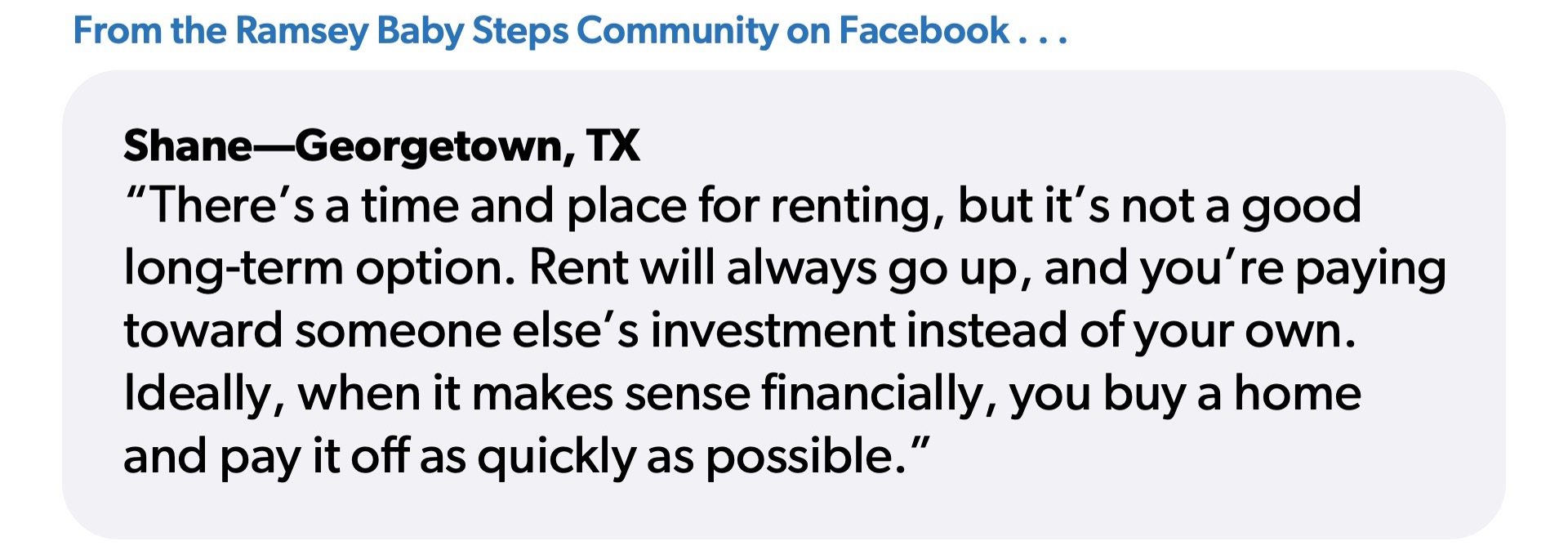
As Shane from THE Ramsey Baby Steps Community put it, “There’s a time and place for renting, but it’s not a good long-term option. Rent will always go up, and you’re paying toward someone else’s investment instead of your own. Ideally, when it makes sense financially, you buy a home and pay it off as quickly as possible.”
What’s the First Thing I Should Do If I Want to Buy a House?
If buying makes the most sense for your situation, it’s smart to partner with a pro who can help you navigate your options. Start with finding a local real estate agent who’ll give you trustworthy advice no matter your budget. To find ones I trust, try RamseyTrusted®. RamseyTrusted agents understand the money plan you’re on and won’t push you to overspend on a house just so they can bring home a bigger commission check. Only the top agents in your area earn the RamseyTrusted shield, so you can trust them to negotiate the best deal on the right house for you. Find a RamseyTrusted agent to help you navigate this crazy market with confidence.
Next Steps
- If you have debt, don’t have a full emergency fund, or need to save a bigger down payment, keep renting and take control of your budget with EveryDollar.
- If you’re in good financial shape to buy, start house hunting with a local RamseyTrusted real estate agent.
- If you’re unsure, take our quiz to learn more about whether you’re ready to buy a house.
Frequently Asked Questions
-
Is renting really a waste of money?
-
No, renting isn’t a waste of money. It’s a necessary housing expense that gives you flexibility and time to get your finances in order.
-
How long should you stay in a house before selling?
-
Most people should plan to stay at least two to three years to avoid losing money on buying and selling costs.
-
Is it cheaper to rent or buy in 2026?
-
Renting is usually cheaper in the short term, but buying can be more cost-effective long term if you stay in the home and build equity.
-
How much should I save before buying a house?
-
Aim for a 20% down payment to avoid paying PMI. If you’re a first-time home buyer, a smaller down payment—at least 5%—is okay too. On top of your down payment amount, set aside a chunk of money for closing costs. The median total for closing costs in the past year was $7,306, according to Ramsey Solutions’ Real Estate Report. Keep your 3–6-month emergency fund (Baby Step 3) completely separate and untouched the whole time you’re saving.
-
Should I buy a house if I have student loans?
-
Not yet. Pay off your student loans first using the debt snowball (Baby Step 2), build your emergency fund (Baby Step 3), then start saving for a house. Following Ramsey’s 7 Baby Steps in order helps your home be a blessing, not a burden.
Get Weekly Insights Delivered Straight to Your Inbox
Did you find this article helpful? Share it!

About the author
Rachel Cruze

Get proven Ramsey answers fast.