
 By
By

Link copied!
Unable to copy link. Please try again.
Key Takeaways
- Loud budgeting means openly choosing your financial goals over social pressure to spend—and saying no to spending without guilt or apology.
- The mindset shift is saying “I’m choosing not to spend” instead of “I can’t afford it.”
- Loud budgeting only works if there’s an actual zero-based budget behind it.
- Couples who agree on their budget ahead of time find loud budgeting easier.
Loud budgeting. Sounds kind of weird, right? I mean, do you need a bullhorn or something? But hold up . . . there might be something to this.
Here's A Tip
Loud budgeting is openly turning down spending that doesn’t fit your financial plan . . . and being unapologetic about it. It reframes “I can’t afford it” as “I’m choosing not to spend.” Loud budgeting works best when backed by an actual zero-based budget that gives every dollar a job before the month begins.
In the thick of our debt payoff journey, my husband and I turned down a lot of people (and a lot of spending) to hit our money goals. I didn’t have a name for that approach at the time except for “It’s not in the budget.” But now we have “loud budgeting”—a TikTok trend blowing up right now that’s helping us normalize talking about money in a real way. And I think it’s just the thing to help you stay on track with your money goals.
What Does Loud Budgeting Mean?
Loud budgeting is a way to say no when friends, family, Instagram influencers or whoever else invites (or pressures) you to spend money you don’t want to spend. A TikTok trend started by writer and comedian Lukas Battle, the loud budgeting movement is all about financial transparency.1

So whether you’re saving up an emergency fund or paying off debt—or, shoot, you just don’t want to spend your hard-earned cash on a new pair of Jordans because that’s what all your friends are doing—loud budgeting gives you permission to say, “No thanks, I’m good.”
I love that! You should never feel embarrassed or guilty about your boundaries when it comes to managing your money.
@rachelcruze Loud budgeting is a TikTok trend writer and comedian Lukas Battles started. He explained that loud budgeting is a way to say no when friends, family, Instagram influencers or whoever else invites (or pressures) you to spend money you don’t want to. Taking control of your budget isn’t just about how you handle money. It’s a behavior change that also affects how you talk about money with people around you. Loud budgeting fits right in to this behavior change because it’s all about being vocal with your money boundaries. Check out the article linked in my bio for five practical ways to get started. #budgetingtips #loudbudgeting #accountability
♬ original sound - Rachel Cruze
Apparently, my husband, Sam, and I were doing loud budgeting before it was cool . . . even before TikTok! Over 10 years ago, when we decided to take control of our money and pay off nearly half a million dollars in debt, we were merciless with our no. We made the hard decision to say no to things because we had a greater goal in mind. No fancy dinners, no vacations, no shopping sprees (window shopping only). And you know what? Sticking to our budget and our guns paid off. Within seven years, Sam and I paid off $460,000!
What Are the Benefits of Loud Budgeting?
Loud budgeting works because it turns vague promises to “spend less” into a specific, social commitment—and commitments you say out loud are a lot harder to break. In fact, a recent study from the Society for Personality and Social Psychology found that people who share their goals publicly stick with them at significantly higher rates.2
Here are some of the perks you’ll find when practicing loud budgeting:
- It creates clear spending boundaries. Telling people you’re not spending money makes your plan real and puts it into action.
- It reduces impulse spending. When you’ve made a commitment out loud to spend less, those little temptations in the checkout lane become less tempting.
- It makes saying no easier. It’s hard to say no when it feels so good to say yes. But the more you say it, the easier it becomes.
- It keeps you aligned with your actual goals. Talking about your budget out loud keeps your money goals top of mind and reminds you what’s actually important.
How Do You Start Loud Budgeting?
Taking control of your budget isn’t just about how you handle money. It’s a behavior change that also affects how you talk about money with people around you. Loud budgeting fits right into this behavior change because it’s all about being vocal with your money boundaries. And being vocal doesn’t mean “explaining” yourself. Listen, you don’t have to waste conversation calories justifying why you’re not spending money—just tell ’em you’re not doing it.
Also, loud budgeting isn’t about saying, “I don’t have the money to spend.” It’s about you taking ownership and saying, “I’m choosing not to spend.” And, that’s the kind of empowerment that’s going to hold you accountable as you work on your money goals. Come on now! This is the energy we need!
So, if you’ve got money and a plan for that money (a budget), you can hop right on this loud budgeting trend. Here are five practical ways to get started:
1. Know your budget and money goals.
You can’t loud budget unless you have an actual budget. Get started by tracking all your income and all your expenses for the month so you can see what kind of money you’re working with. Then create a zero-based budget that tells all your money where to go every month.
You can use pen and paper, but I recommend the EveryDollar app. It’ll give you a crystal-clear picture of exactly where your money is going and what your money goals are.
Here's A Tip
Never budgeted before? Like ever? Check out our budget calculator for a solid start.
2. Share your goals with who you want.
You don’t have to take to tell the whole world you’re loud budgeting. But if you don’t want to spend money to go along with your friends’ or family’s plans, let them know, “Hey, I’ve got a savings goal I’m working toward.”
But, Jade, what if my friends get mad when I tell them I don’t want to spend money on bottomless mimosa brunches every weekend?
Okay. First of all, it’s your money and no one else gets a say in what you spend it on! I’m proud of you for paying attention to your budget. Second of all, if your friends only hang around because of how you spend money, that ain’t a real friendship. Trust me—the real ones will stick around.
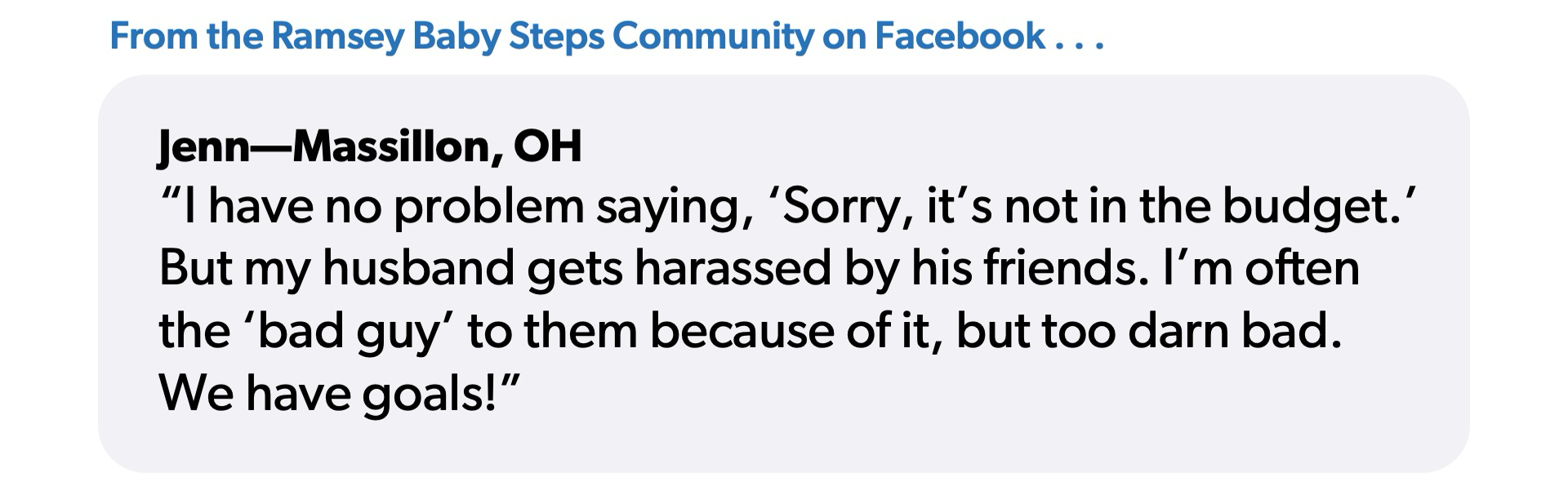
“I have no problem saying, “sorry, it’s not in the budget,’” said Jenn, a member of our Ramsey Baby Steps Community on Facebook. “But my husband gets harassed by his friends. I’m often the ‘bad guy’ to them because of it, but too darn bad. We have goals!”
3. Be positive, but don’t dive into details.
Again, personal finance is personal. It’s nobody’s business how much money you have or why you choose to save, spend, or give. But do stay positive and keep your response short and sweet.
4. Don’t get caught up in comparison.
Like I said earlier, when your friends are spending on fun things but you’re choosing not to—the FOMO gets real. And that’s okay. Loud budgeting is about owning your unique situation, not trying to keep up with the Joneses.
5. Suggest more affordable or free options.
So you’re saving money right now? Cool—you can spend your time instead. Get creative and think of ways to hang out with your friends and family that don’t involve spending a ton of money. You can grab half-price happy hour drinks instead of a late dinner and drinks, go for a cup of coffee instead of a shopping spree, or take a walk and bring your own snacks instead of buying tickets to a show. Quality time with your favorite people is priceless.
What Should You Say When You’re Loud Budgeting?
You don’t need a speech. You need one clear sentence. Loud budgeting works best when your no is short, kind, and doesn’t invite negotiation. Something like:
- “That’s not in our budget right now.”
- “We’re focused on other goals.”
- “I’d love to hang out, but let’s do something cheaper.”
- “We’re being more intentional with our money.”
Here’s the point: Don’t get all long-winded. Even though it’s called loud budgeting, you’re not literally yelling. You’re just letting the people near you know that you’re taking your finances seriously.
And if you’re married, get on the same page with your spouse first. When you’ve already agreed on the budget together, saying no isn’t awkward.
Who Is Loud Budgeting For?
Loud budgeting is for anyone who wants to set better boundaries around how they use money, especially in social situations where spending is low-key expected.
Let me put it this way: Do you have money? Do you spend it, save it, give it away, and have goals for it? Then loud budgeting can work for you—whether you’re paying off debt, building an emergency fund, saving for a house, or just choosing not to blow money on things that don’t matter to you.
Listen, if your cousin in Atlanta invites you to Usher and Chis Brown’s upcoming concert, it’s entirely possible that you have plenty of money in your checking account to buy those tickets. But does that mean you have to—especially when you’re saving for a shiny new-to-you car? No! That’s where loud budgeting comes in clutch. You can politely tell your cousin no because you have other goals. That’s what this trend is all about.
What Are Examples of Loud Budgeting?
Loud budgeting shows up every time you choose a less expensive option (or no option) instead of spending money that doesn’t fit your plan.
Here are some scenarios paired with money-saving tips to put loud budgeting into action:
- Spending a night out with friends? Offer to get drinks or dinner—not both.
- Cuddling up with your boo for date night? Stream a movie at home instead of buying movie theater tickets and expensive snacks.
- Catching up with a coworker? Go for a walk and coffee instead of buying lunch.
- Spending quality time with your extended family? Hit up a park and bring a picnic or start a pick up soccer or basketball game.
- Hosting a Bible study or book club? Throw a potluck at home instead of going to a restaurant.
- Eyeing your favorite artist’s new concert tour? Get some nosebleed seats instead of front-row tickets.
- Planning a group vacation with friends? Suggest a weekend road trip instead of a week in Cancún.
- Need to get gifts for Christmas? Set a spending cap and tell your family up front.
- Wanting to free up cash? Cancel the streaming service you barely use and tell your roommate you’re cutting back.
I’m willing to bet that if you pause for a second before agreeing to spend money, you can come up with other options that are affordable and probably more enjoyable.
How Is Loud Budgeting Different From Regular Budgeting?
Budgeting is the plan you make for your money. Loud budgeting is how you protect that plan in social situations. One is math, the other is behavior. So you actually need both to succeed.
Let me break it down like this:
- Regular budgeting happens on paper or in an app like EveryDollar. Loud budgeting happens in real conversations with your friends and family.
- Regular budgeting is private. Loud budgeting is public.
- Regular budgeting tells your money where to go. Loud budgeting tells other people where your money is or isn’t going.
Loud budgeting works because it has a plan behind it—a skeleton inside the body. Without an actual budget, loud budgeting is all talk.
Get Started on Your (Loud) Budget Today
The cool thing about loud budgeting is that you’re in the driver’s seat. You set your spending limits and choose which opportunities you say yes or no to. And you might even inspire your friends and family to pay more attention to their money while you’re at it!
The more content you are with your money situation, and the more you speak up about what you can afford (or not), the more you’ll hit your goals. Come on, you’ve got this. And if you need a little help along the way, I want you to check out the free EveryDollar app. It’s what my husband and I use for our budget, and I know it can help you too. Try it out!
Next Steps
- Know your budget. List your income and expenses every month so you have a plan for your money. (I use the EveryDollar app!)
- If an experience or purchase doesn’t fit in your budget, suggest free or more affordable options.
- Be secure in your no. Sometimes it’s uncomfortable to rock the boat, but that’s exactly what will help you hit your money goals.
Loud Budgeting FAQ
-
What does “loud budgeting” mean?
-
Loud budgeting is publicly saying no to spending that doesn’t fit your financial plan, and being unapologetic about it. It reframes “I can’t afford it” as “I’m choosing not to spend.”
-
Does loud budgeting actually work?
-
Yes, but loud budgeting works best when it’s backed by an actual zero-based budget that gives every dollar a job before the month begins.
-
Is loud budgeting only for people in debt?
-
No. It’s for anyone with financial goals who faces social pressure to spend money that derails or delays those goals.
-
Can loud budgeting hurt relationships?
-
Maybe, but real friends respect your boundaries. If someone only wants to hang out when you’re spending, that’s not a real friendship.
Get Weekly Insights Delivered Straight to Your Inbox
Did you find this article helpful? Share it!

About the author
Jade Warshaw

Get proven Ramsey answers fast.