
Best Places to Live in Louisiana
 By
By 
Key Takeaways
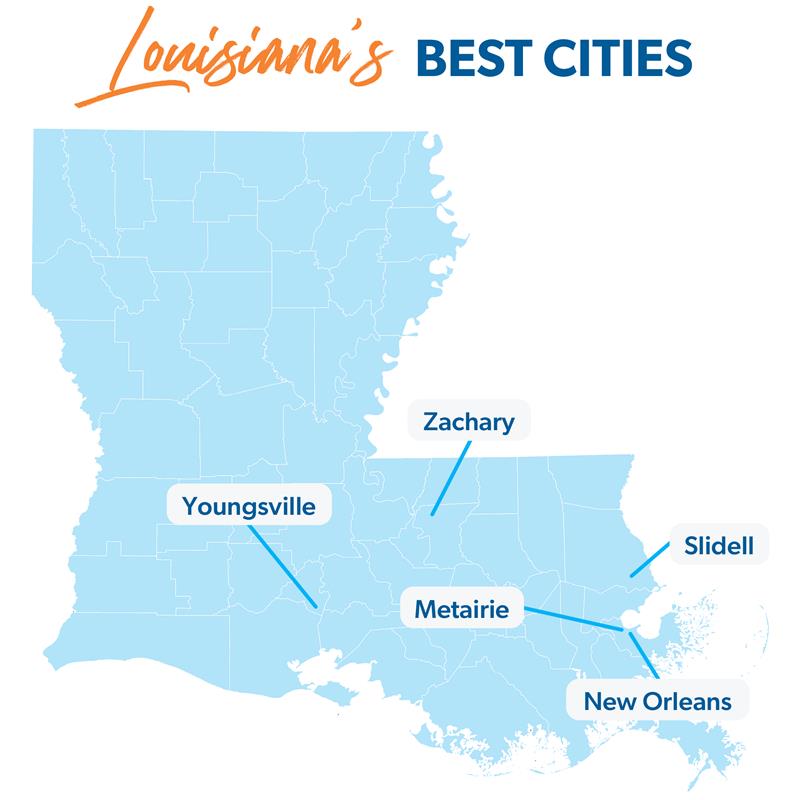
- Youngsville appeals to families looking for strong schools, lower crime and a tight-knit suburban community near Lafayette.
- Zachary offers small-town living with access to Baton Rouge jobs, along with a highly rated school district that draws many families.
- New Orleans provides the state’s most vibrant culture and broadest job market, but housing costs and neighborhood differences require careful research.
- Suburbs like Metairie and Slidell give residents access to the New Orleans metro economy while offering a quieter pace and more residential feel.
If there’s anything we could say about Louisiana, it’s this: The music is loud, the flavors are bold, and the traditions run deep. If that sounds like your kind of place, moving to Louisiana might be worth considering.
But of course, every state has trade-offs—and the Bayou State is no exception. Before you pack your bags, it’s important to understand what you’re getting into so you can make a wise move for your family and your money.
Pros of Living in Louisiana
If you value affordability and culture, Louisiana has some clear advantages. For starters, your dollar tends to stretch further here. The cost of living sits below the national average, which can make everyday expenses a little more manageable.
Take housing, for example. The median home price in Louisiana is $270,513, compared to $403,450 nationally (yeesh!).1 That difference can go a long way toward helping you stay on budget.
Home affordability isn’t the only draw. Generations of French, Spanish, African and Native American influence have shaped Louisiana into one of the most unique states in the country. You’ll hear jazz drifting through the streets of New Orleans, find small-town festivals happening nearly year-round, and enjoy some seriously good food (homemade gumbo, anyone?).
Plus, Louisiana’s warm, subtropical climate is a big perk for anyone who’d rather trade snow boots for flip-flops.

Don’t buy or sell without an agent you can trust.
There are RamseyTrusted real estate agents all over the country who are ready to help you win.
Cons of Living in Louisiana (What to Know Before You Move)
We’ll be straight with you—living in Louisiana isn’t always sunshine and crawfish boils. A recent analysis ranked Louisiana’s economy as the worst in the nation, and almost 1 in 5 residents live below the poverty line. 2,3 That impacts job opportunities, schools and health care across the state.
A large share of jobs comes from oil, gas and chemical production. According to the Louisiana Mid-Continent Oil and Gas Association, the energy industry accounts for about 25% of the state’s economy and supports roughly 15% of total employment.4 These jobs can pay well, but they tend to rise and fall with the market—and they’re concentrated in certain areas. Outside of larger cities like New Orleans and Baton Rouge, job opportunities can feel limited, depending on your career field.
Environmental and public health issues are another challenge. The stretch of industrial plants along the Mississippi River between Baton Rouge and New Orleans has raised pollution concerns for years. Many rural communities also struggle with access to quality health care.
This isn’t meant to bash Louisiana—it’s meant to help you plan wisely. Lower home prices can be appealing, but a cheaper house won’t fix an unstable income. Before moving, make sure you’ve lined up employment, researched neighborhoods, and run the numbers on your long-term goals.
Best Cities to Live in Louisiana
Now that you’ve got a realistic picture of the state as a whole, let’s look at some of the best places to call home.
Louisiana is a big state with a lot of personality packed into its cities and towns. Some offer fast-paced urban life, while others move a little slower and feel more tight-knit. The right fit depends on your stage of life and what you want day-to-day living to look like.
Below are several top cities in the Bayou State, selected based on factors like population, housing costs, job opportunities and overall livability. Of course, any “best places” list is somewhat subjective. To round things out, we spoke to former residents who know these areas firsthand.
The cities below are listed in no particular order. Use the stats and details as a starting point, then explore the ones that stand out to you.
Youngsville
For the first city on our list, let’s take a trip down to the Deep South. If you’re looking for a quieter, family-focused place to put down roots, Youngsville is worth considering. Located just outside Lafayette, this fast-growing suburb makes it easy to commute for jobs in oil and gas, health care, education and technology while still enjoying the slower pace of a smaller community.
Youngsville’s economy shows real stability, with unemployment below the state average and a strong median household income. On top of that, crime rates here run lower than in many larger Louisiana cities, and the schools rank among the strongest in the state—two factors that matter if you’re raising a family. 5,6
When it comes to day-to-day life, Youngsville keeps things simple and community-oriented. Neighborhoods like Sugar Mill Pond have walking paths and regular events that bring neighbors together. Weekends often revolve around youth games at the Youngsville Sports Complex, followed by dinner at one of the area’s locally owned restaurants serving up that unmistakable Louisiana flavor.
Youngsville may not give you skyscrapers or nonstop nightlife—but if your priorities are safety, solid schools and a family-friendly community, it checks a lot of the boxes.
|
Population |
19,0387 |
|
Median Household Income |
$105,8768 |
|
Median Monthly Rent* |
$1,9509 |
|
Median Home Price |
$349,00010 |
|
Unemployment Rate** |
3.4%11 |
|
Average Annual Rainfall |
50.8 inches12 |
*Median monthly rent refers to all apartment types.
**This unemployment rate is for Lafayette Parish, which includes Youngsville.
Zachary
Baton Rouge may get most of the attention as Louisiana’s capital, but plenty of families choose to live just outside the city limits. After all, smaller communities often mean less traffic, less crime and a little more breathing room. And that’s where Zachary stands out.
Located about 25 minutes from Baton Rouge, Zachary offers a quieter, more laid-back lifestyle while still keeping job opportunities within reach for commuters.
“Young professionals like that they can enjoy a quieter community while still being close to Baton Rouge for restaurants and nightlife,” said David Madaffari, a Zachary-based RamseyTrusted® real estate agent. “And for retirees, it’s a comfortable place to settle down—especially with golf communities like those around Copper Mill Golf Club and easy access to health care and amenities in Baton Rouge.”
The area also has more history than many newcomers realize. Just minutes away, Port Hudson State Historic Site hosts annual reenactments of the Civil War battle fought there.13 Closer to home, Zachary’s Downtown Historic District offers a different kind of local charm, with a popular farmers market, an annual Christmas parade, and other community events that bring neighbors together.
And when it comes to housing, you’ve got plenty of options. Popular neighborhoods like Americana and Copper Mill offer a tight-knit community feel, while more rural properties give you privacy and even a little acreage.
One of Zachary’s biggest draws is its school district, which consistently ranks among the top in Louisiana.14 That alone makes it a popular move for families.
“A lot of families initially come for the schools, but what keeps them here is the lifestyle and true small-town feel,” Madaffari added.
|
Population |
20,37015 |
|
Median Household Income |
$84,48016 |
|
Median Monthly Rent* |
$2,02517 |
|
Median Home Price |
$314,99018 |
|
Unemployment Rate** |
3.7%19 |
|
Average Annual Rainfall |
54.1 inches20 |
*Median monthly rent refers to all apartment types.
**This unemployment rate reflects the Baton Rouge metro area, which includes Zachary.
Best Places to Live in the New Orleans Metro Area
The New Orleans metro area offers a mix of big-city energy and suburban breathing room. While New Orleans itself is the cultural and economic hub, many surrounding communities give you access to the same job market with a different pace of life.
Living in the metro area often means balancing opportunity with lifestyle. You might work in the city but choose to live in a quieter suburb—or decide the convenience of being close to everything is worth it. Below, we’ll break down what the region looks like overall before diving into specific cities and communities.
New Orleans
New Orleans—nicknamed the Big Easy—is the largest city in the state and is probably best known for Mardi Gras, which draws hundreds of thousands of (often rowdy) visitors each year. And while you may hear tourists call it N’awlins, locals will quickly tell you that’s not how they say it.
Mardi Gras is just one part of what makes New Orleans unique. Beyond the parades, you’ll find historic neighborhoods like the Garden District, swamp tours just outside the city (keep an eye out for alligators), live jazz on nearly every corner, and a culture that blends French, Spanish, African and Caribbean influences.
The French Quarter, which was settled way back in 1718, still features historic architecture and street names that reflect the city’s roots. (Fun fact: Bourbon Street was actually named after the French royal House of Bourbon—not the whiskey.)
As the state’s biggest metro area, New Orleans offers more job opportunities than most Louisiana cities. Tourism fuels much of the economy, along with oil and gas, advanced manufacturing, trade and logistics through the Port of New Orleans, and shipbuilding operations.
Of course, it’s not perfect. Housing costs run higher than in many other parts of the state, and some neighborhoods struggle with crime and flood risk. For that reason, some families choose to live just outside the city for more space and a little added peace of mind—while still commuting in for work.
|
Metro Area Population* |
362,70121 |
|
Median Household Income |
$56,63122 |
|
Median Monthly Rent** |
$1,22623 |
|
Median Home Price |
$299,00024 |
|
Unemployment Rate |
4.3%25 |
|
Average Annual Rainfall |
54.4 inches26 |
*Metro area population numbers include the city together with the surrounding urban and suburban areas.
**Median monthly rent refers to two-bedroom apartments.
Metairie
If you like the idea of working in New Orleans but sleeping somewhere a little quieter at night, Metairie is worth a look. It’s technically an unincorporated community, but for most people, it functions like a classic suburb.
The name Metairie comes from the French word for a small tenant farm, which fits since the area started out as farmland. Today, it’s well developed but still offers lots of outdoor space. For example, Lafreniere Park covers 155 acres and is a go-to spot for walking, biking and community events. Lake Pontchartrain borders the north side of town, giving residents easy access to fishing, boating and weekend time on the water.
Football fans will also appreciate that the New Orleans Saints’ headquarters is located here. Running into a Saints player at the grocery store? Not impossible.
If you’re comparing options, nearby Kenner offers a similar suburban feel and may come with slightly different price points—so it’s worth checking both before making a move.
|
Median Household Income |
$73,04227 |
|
Median Monthly Rent* |
$2,00028 |
|
Median Home Price |
$299,00029 |
|
Unemployment Rate |
4.3%30 |
*Median monthly rent refers to all apartment types.
Slidell
Sitting on the northeastern shore of Lake Pontchartrain, Slidell is another option for those who want access to New Orleans without living in the middle of it.
If you love being on the water, Slidell delivers. The area sits in the heart of Bayou Country, with easy access to wildlife management areas, boat docks and scenic bayous. Fishing, boating and weekend time on the lake are part of everyday life here (not just vacation plans!).
When it’s time to eat, you’ll find everything from upscale Southern spots like Palmettos on the Bayou to laid-back local favorites like Southside Café, known for its comfort food.
The trade-off? The local job market is more limited than what you’ll find in New Orleans. Many residents commute across the Lake Pontchartrain Causeway—the world’s longest bridge over water—to work in the metro area.31 That commute is manageable, but it’s something to factor into both your schedule and your gas budget.
Slidell can be a strong fit if you value outdoor living and a slower pace. Just make sure the commute and career options line up with your long-term plan.
|
Median Household Income |
$70,49732 |
|
Median Monthly Rent* |
$1,69533 |
|
Median Home Price |
$254,95034 |
|
Unemployment Rate |
3.9%35 |
*Median monthly rent refers to all apartment types.
Ready to Move to Louisiana?
Whether you’re drawn to a growing suburb like Youngsville, a capital-area community like Zachary, or the energy of the New Orleans metro, the key is finding the right fit for your goals and your budget.
If you’re seriously considering a move to Louisiana, don’t go it alone. A RamseyTrusted real estate agent can help you navigate the market, avoid overpaying, and find a home you can truly afford. They know the area, they understand smart money principles, and they’re focused on helping you make a confident decision.
With a solid plan in place, you can settle into a home you love and build a future you’re excited about—right here in the Bayou State.
Next Steps
- Decide where in Louisiana you want to move.
- Interview at least three trusted agents from that area.
- Choose one who’s right for you and start your moving journey!
Get Weekly Insights Delivered Straight to Your Inbox
Did you find this article helpful? Share it!

About the author
Ramsey Solutions

Get proven Ramsey answers fast.