
How Long Does It Take to Pay Off Debt?
 By
By
Key Takeaways
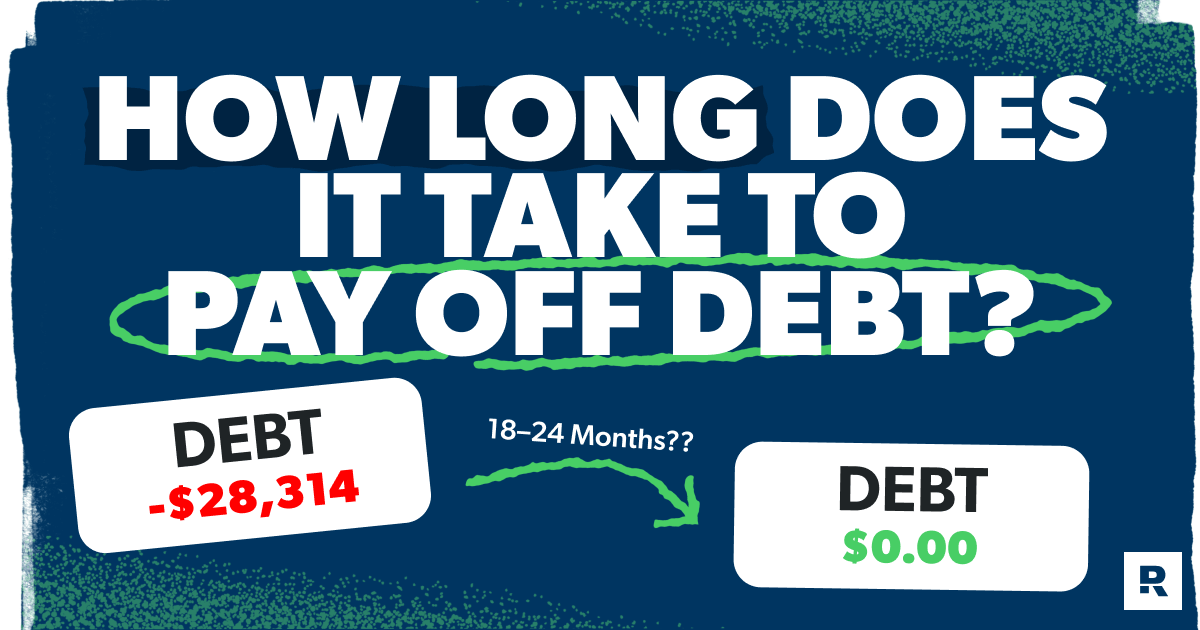
- Most families working the debt snowball are debt-free in 18–24 months—but your timeline depends on your balance, income and how hard you attack your debt.
- Families with consumer debt between $20,000 and $50,000 typically take 18–48 months to pay it off using the Ramsey plan.
- Six-figure debt usually takes 2–5+ years to pay off, though people who stick to the Ramsey plan with more intensity have finished faster.
- Throwing an extra monthly payment at your debt is the single biggest lever you control. The Debt Snowball Calculator shows you exactly how much that payment moves up your debt-free date.
You're saddled with a pile of debt and wondering when you'll ever be free. You want an end date. Not a pep talk, not a formula—an actual month and year you’ll make your last debt payment and never have think about a minimum balance again! But right now, that number feels impossible to pin down.
Quick Answer
The average family working the debt snowball becomes debt-free in 18–24 months. Families with $20,000–50,000 in consumer debt typically finish in 18–48 months. How long it takes to pay off debt depends on your balance, income, expenses and how hard you attack the plan.The truth is, timelines vary. But in the last 30 years, Ramsey has helped millions of people say goodbye to debt and build wealth with a proven plan that works. Here's what to expect if you follow the Ramsey plan.
How Long Does It Take to Get Out of Debt While Following Ramsey Principles?
It really depends on how much debt you have. The average family following Ramsey principles becomes debt-free in 18–24 months. But families carrying $20,000–$50,000 in consumer debt typically finish in 18–48 months.

But what exactly are those principles? They’re the 7 Baby Steps—a step-by-step plan to get rid of debt, build lasting wealth, and achieve financial peace. We’re talking paying off debt, getting an emergency fund going, saving for the future, eventually paying off your house, and more. And it’s done one step at a time. It’s not easy, but it’s absolutely possible.
Starting the plan is not a guarantee though. How long it will actually take you to pay off debt depends on your debt balance, income and expenses—but the x factor is your intensity. If you’re sick and tired of being in debt, attack it with everything you have. Get a second job and sell so much stuff the kids will think they’re next!
What Is the Debt Snowball Method?
The debt snowball method is a payoff strategy where you list nonmortgage debts from smallest to largest, attack the smallest with every extra dollar, and make minimum payments on the rest. Once a debt is gone, you roll that payment into the next debt to build momentum. The debt snowball is Baby Step 2 in the 7 Baby Steps.
The debts you’re paying off in the snowball include credit cards, car loans, student loans, medical bills, personal loans, etc.
The debt snowball works in three steps:
- List every nonmortgage debt you owe, smallest balance to largest—ignoring the interest rate.
- Pay the minimum on every debt except the smallest. Throw every extra dollar you have at that one.
- Once that debt is gone, roll its full payment into the next debt on the list and keep rolling until you’re done.
When the snowball starts to roll and debts start to fall off, it’s a great feeling and gives you the motivation to keep going. As Dave Ramsey has said for decades, “Debt is not a math problem. It’s a behavior problem.”
What Affects Your Debt-Payoff Timeline?
Four things influence your debt-free date:
- Total balance: This is the starting point for every calculation you make.
- Income and budget margin: This includes how much money you bring in each month and how much money is left after your zero-based budget covers everything else. If you don’t have much margin to work with, it can delay debt payoff.
- Extra monthly payment: This is where you put your budget margin to work. It’s the amount above the minimum payment that you throw at the smallest debt.
- Interest rate: This changes how much of each payment goes toward the balance itself.
An interest rate is the price you pay to borrow money and shows up as an annual percentage. A higher interest rate means more of each payment goes toward borrowing costs instead of paying down the principal, which can extend your debt-free timeline.
Your extra monthly payment is the one you control most directly—and the one that moves your date the fastest.
Ramsey Debt-Payoff Timelines
These are typical ranges for people following the Ramsey plan with real intensity. Your date depends heavily on your extra monthly payment.
|
Total Debt |
Typical Payoff Range |
|
Under $10,000 |
6–12 months |
|
$20,000–$50,000 |
18–48 months |
|
$50,000–$100,000+ |
2–5+ years |
Here’s what those numbers look like with real balances:
|
Debt |
Balance |
Minimum Payment |
|
Medical bill |
$500 |
$50 |
|
Credit card |
$2,500 |
$63 |
|
Car loan |
$7,000 |
$135 |
|
Student loan |
$10,000 |
$96 |
|
Total |
$20,000 |
$344 |
If you add $500 extra a month on top of those minimums, you can pay off $20,000 in less than 24 months. Attack the medical bill first, then the credit card, then the car, then the student loan. Plug in your own numbers with the Debt Snowball Calculator to see your exact debt-free date.
What About Student Loans?
Federal student loans are set up on a standard 10-year repayment plan, but plenty of borrowers stretch that to 20 years or more by paying only the minimum.1
So, how long does it take to pay off student loans on the Ramsey plan? Most people cut years off that 10-year timeline by attacking their loans with the same intensity they’d use on any other debt in Baby Step 2. Student loan policies can change, so use the Student Loan Payoff Calculator for current numbers and to see your own timeline.
Real Ramsey Debt-Payoff Examples
Let’s look at a few real-world examples of the debt-payoff plan in action. These stories came from The Ramsey Show as well as THE Ramsey Baby Steps Community on Facebook, where real people celebrate their wins (big and small).
Cavan and Ashley from South Bend, Indiana, who recently did their Debt-Free Scream on The Ramsey Show, paid off $30,000 in 12 months earning $30,000 to $65,000 a year.
“We needed to figure out our money with a real plan, so we got EveryDollar,” Cavan said. “We made our first budget because someday, we want to have a house . . . and we want to go out on a date every once in a while.”
Jessie from Kokomo, Indiana, shared, “We are debt-free outside of our mortgage. $258,255.72 in debt paid off in seven years making $80,000 to $130,000 a year . . . The biggest loans were our student loans, but we had a little of everything.”
Keith and Candice from Abbeville, South Carolina, also recently celebrated their Debt-Free Scream on The Ramsey Show. They paid off $201,555 in five years with an income of $140,000.
“We failed Financial Peace University twice . . . and we stayed broke for 27 years,” Keith said with a laugh. “But then I said, ‘I’m tired of this’ . . . We sold the truck, the camper, the Sea Doo . . . There was nothing left . . . We were able to pay off a lot of debt just by working hard at it.”
|
Example |
Total Debt |
Time to Pay Off |
Income Range |
|
Cavan and Ashley—South Bend, IN |
$30,000 |
12 months |
$30,000–$65,000 |
|
Jessie—Kokomo, IN |
$258,000 |
7 years |
$80,000–$130,000 |
|
Keith and Candice—Abbeville, SC |
$201,000 |
5 years |
$140,000 |
How Can I Get Out of Debt Faster?
You can speed up almost any debt snowball using these six methods:
- Cut expenses ruthlessly: Cancel subscriptions you forgot about, pause eating out, sell what you can live without.
- Increase your income: Pick up overtime, get a side hustle like driving for a rideshare app, or sell stuff you don’t need.
- Throw every windfall at debt: Tax refunds, bonuses, inheritances, all of it.
- Apply extra payments to the principal: This matters most on student loans. And be sure to call your servicer to confirm the extra money is actually going toward the principal, not interest.
- Stay on a written, zero-based budget: Every single month. And use the EveryDollar budgeting app to track your transactions.
- Break the tie: If two debts have the same balance, pay off the one with the higher interest rate first. This is the one exception where the interest rate matters.
One more thing: It’s okay to temporarily pause your debt snowball for a big life event. Say you’re having a baby and need to start piling up cash to cover expenses or you have to dip into your $1,000 starter emergency fund to cover a car repair. Don’t try to do everything at once—you won’t get ahead that way. Take care of emergencies first. And once everything’s back to normal, rebuild the $1,000 and get right back to attacking debt.
Plan Your Debt-Free Date With Free Ramsey Tools
Now that you know what it takes to get out of debt, use these three free tools to turn an estimated timeline into your real debt-free date:
- The Debt Snowball Calculator: Plug in your balances and extra payment to see your exact debt-free date.
- The EveryDollar budget app: Create your zero-based budget so every dollar has a job, including the extra ones going to debt.
- The 7 Baby Steps: See where debt payoff fits into your overall plan for true financial peace.
Get Started With EveryDollar
EveryDollar can help you get on and stay on a budget, as well as keep you focused on your long-term money goals that come after that debt-free date. Start your zero-based budget for free with EveryDollar and speed up that snowball.
Next Steps
- List every nonmortgage debt you owe, smallest balance to largest.
- Build a zero-based budget in EveryDollar and find out how much extra you can put on top of your minimum payment.
- Plug your balances and extra payment into the Debt Snowball Calculator to see your debt-free date.
- Attack your smallest debt with every extra dollar, then roll the payment forward to the next one.
FAQs About Debt-Payoff Timelines
-
How long does Baby Step 2 usually take?
-
Most families finish Baby Step 2 in 18–24 months. Those with larger balances or less margin can take up to 48 months or longer. The number that matters most is your extra monthly payment, not the calendar date.
-
What if I have low income and high debt?
-
If you have a low income, you’ll likely need a longer timeline, more aggressive expense cuts, and a serious look at increasing your income. The debt snowball will still work for you, but it’ll just take some more time and intensity.
-
Do I pay minimums on everything except the smallest debt?
-
Yes. Pay the minimum on every debt except the smallest and throw every extra dollar you have at that one until it’s gone.
-
Should I include my mortgage in Baby Step 2?
-
No. Baby Step 2 covers every nonmortgage debt—credit cards, car loans, student loans, medical bills and personal loans. You’ll pay off your mortgage on Baby Step 6.
-
What happens if I need my emergency fund during Baby Step 2?
-
First, pause your extra debt payments, then rebuild your $1,000 starter emergency fund. Once you’ve done that, you can get back to the snowball. Don’t rack up new debt to cover something your savings should have handled.
-
Should I put a raise or bonus toward debt or savings?
-
If you’re in Baby Step 2, it goes toward debt. Every windfall—raises, bonuses, tax refunds—accelerates your snowball and shortens your timeline.
-
Does the interest rate matter if two debts have the same balance?
-
Yes. When two balances are the same, pay off the higher-interest one first. The snowball’s smallest-to-largest order matters most when there’s an actual difference between balance sizes. But note that this is the only exception to the interest rate rule.
Get Weekly Insights Delivered Straight to Your Inbox
Did you find this article helpful? Share it!

About the author
Ramsey Solutions

Get proven Ramsey answers fast.