
What Is Financial Freedom? 15 Ways to Achieve It
 By
By

Key Takeaways
- Financial freedom (or financial peace) is the sense of control, confidence and freedom you experience when you’ve taken control of your money instead of letting it control you.
- Achieving financial freedom takes work, self-discipline and time. You’ve got to budget, eliminate debt, set your goals, and—when you’re ready—invest.
- Ramsey's 7 Baby Steps are the road map to financial freedom you’ve been looking for.
What if an expensive, urgent car repair was barely an inconvenience? What if you didn’t have to pay for date night with a credit card? And what if you actually had a retirement to look forward to?
It sure would be nice if you could move on from the place where you can barely handle your money anxiety to a place where you can pay cash for whatever you need—whenever you need it!
What Is Financial Freedom?
Financial freedom (or what we like to call financial peace) is the sense of control, confidence and freedom you experience when you’ve taken control of your money instead of letting it control you.
And don’t get it twisted—it's not about being rich or having a certain amount of money in the bank. It's about having peace of mind with your finances. For most folks, that means getting out of debt, having enough money to cover emergency expenses, and then building wealth so they can retire with dignity.
At the end of the day, financial freedom gives you options. It means living like no one else so that later, you can live and give like no one else.
How Do I Achieve Financial Freedom?
This isn’t a get-rich-quick strategy. Financial freedom isn’t freedom from the responsibility to handle your money well—quite the opposite! But have no fear: you can do this. One step at a time.
Ramsey’s 7 Baby Steps
Becoming debt-free and building wealth for the future is a process that takes hard work. But you’ve got this! It’s a lot more doable if you do it in what we call the 7 Baby Steps:
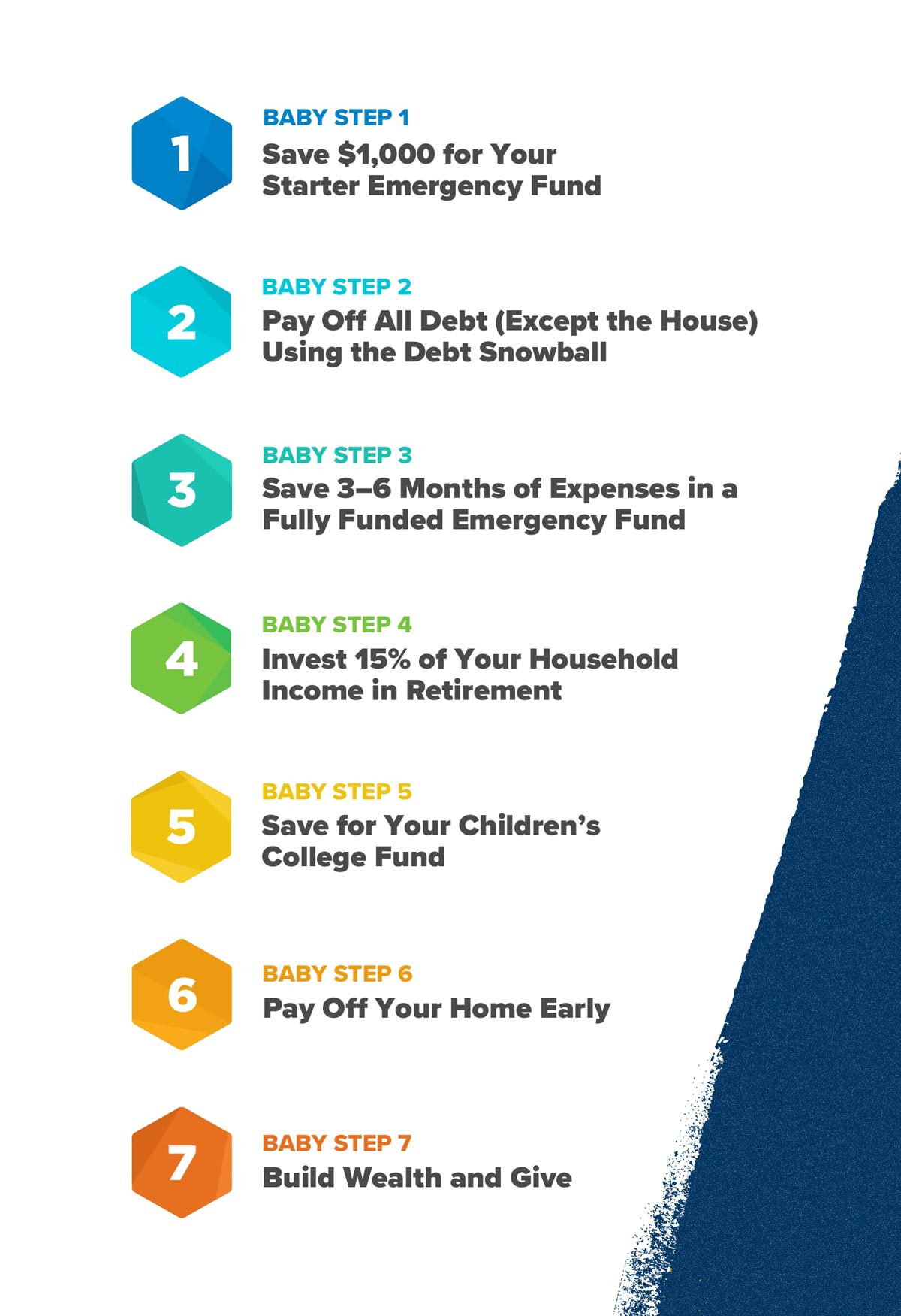

Now that we’ve covered the basics, let’s dig into the practical details so you can start your journey toward financial freedom right now.
1. Make an EveryDollar Budget
Have you ever felt like there’s too much month at the end of the money? That’s why you need a budget. If you don’t have a plan for your money (and give every dollar a job), you’ll never get ahead. Instead, you’ll find yourself in constant survival mode. That’s not financial freedom—it’s a recipe for financial disaster.
A budget is a very powerful tool. Use it well, and you’ll be able to earn financial peace and build a high net worth. Without a budget, financial freedom will always feel like a goal that’s just out of reach.
Here’s what a solid budget looks like:
- It tells every dollar where to go, which means all your income minus all your expenses should equal zero.
- It helps you track your spending throughout the month.
- It’s dynamic. If you consistently find yourself overspending or underspending in certain areas, you can (and should) make adjustments.
- It’s new every month. While you might have a few fixed expenses every month (like your rent), no two months are ever exactly alike. That means you need to sit down and make a new budget every month.
Here's a Tip
A budget is about cash flow, sure. It’s also about intentionality and discipline. Doing life with a budget isn’t actually about crunching numbers—it’s about changing the way you behave with money. Living within the boundaries of your budget will help relieve a lot of money stress.
Success doesn’t happen by accident, and neither does financial freedom. Budgeting is the first step to building wealth on purpose (this is a process, y’all). Start budgeting with confidence and take control of your money today by downloading EveryDollar—the budget app built on the proven Ramsey plan.
2. Kick Debt Out of Your Life—For Good
If you have debt (like credit cards, student loans or car loans), it’s time to kick it to the curb. Why? Because as long as you’re sending hundreds of your hard-earned dollars in payments to banks and lenders every month, you’ll never earn your financial freedom.
Your income is the most powerful wealth-building tool you have. And you won’t reach your money goals if all you’ve got to work with are the leftovers your lenders leave you.
Paying off your debt helps you lay a solid foundation to build wealth that’ll last. Make sure you have $1,000 set aside for emergencies before you start tackling your debt (that’s Baby Step 1). Don’t let an unexpected expense derail your progress.
The best way to get out of debt is with the debt snowball method. Here’s how it works:
- List your debts from smallest to largest, regardless of interest rates.
- Make minimum payments on all your debts except the smallest debt.
- Focus on paying off that smallest debt as quick as you can (throw any extra cash at it too) until it’s gone forever.
- Take what you were paying on your smallest debt and add it to your payment on the next-smallest debt until that’s gone too.
- Keep your snowball rolling. Knock out your debts one by one until you’re debt-free!
Paying off debt is hard work, but doing it with Ramsey's 7 Baby Steps is very satisfying—there’s nothing like the feeling of actually keeping the hard-earned cash you bring in every month.
The 7 Baby Steps Explained
3. Set Smart Financial Goals
Everyone dreams of financial freedom (because it’s a great dream!). But a dream without a goal is just a wish (and hope isn’t a strategy). That’s why setting financial goals—like getting out of debt or saving for retirement—is so important on your journey to financial freedom.
But if you’re going to set goals that actually function, here’s what they need to look like:
|
Goal Quality |
What It Means |
Questions to Ask Yourself |
|
Specific |
The goal is clear, detailed and focused—not vague or general. |
What exactly do I want to accomplish? Why does it matter? What part of my life does it affect? |
|
Measurable |
You can track progress and know when you’ve reached the finish line. |
How will I measure success? What number, amount or milestone will show progress? |
|
Time-Bound |
The goal has a deadline that creates urgency. |
When will I finish this goal? Is the timeline realistic? What milestones can I hit along the way? |
|
Personal (“Yours”) |
The goal matters to you—it’s not something you’re doing to please someone else. |
Do I genuinely want this? Is this my goal or someone else’s expectation? |
|
Written Down |
The goal is documented somewhere—on paper, a worksheet or an app. |
Did I write this down where I’ll see it often? Does the written version clearly express my intention? |
|
Shared With Others |
Someone you trust knows your goal and can support and encourage you. |
Who can I share this with? Who can help hold me accountable? |
Let’s say you really want to get out of debt. That’s a fantastic goal to have, but it’s incomplete. So let’s finish it:
How much debt do you want to pay off? Is it $20,000? That’s specific, so now we’re getting somewhere.
When do you want to be debt-free? How does 12 months sound? That’s got a deadline and it’s measurable. Sweet!
But is it doable? $20,000 in 12 months means committing to about $1670 a month. That’s big, but it’s only for a year.
Will paying off $20,000 in 12 months move you toward your next step (like saving for a down payment on a home)? You bet it will!
Imagine how quick you’ll get to that goal if you can save $20,000 a year instead of sending it to creditors.
If it makes you weird to put your goals on paper and stick them to your bathroom mirror, go ahead and be weird. Why wouldn’t you give yourself every advantage as you work toward your financial freedom?
4. Be Smart About Your Career Choice
It’s worth mentioning again that your biggest wealth-building tool is your income. That means your career choice carries more weight than most people think it does.
Don’t stay at a dead-end job longer than you have to, especially if it’s making you miserable. Find work you enjoy that also supports your financial security goals. Position yourself to make progress and enjoy the journey at the same time.
If you’re wondering what you should look for, start by asking yourself a few honest questions:
- Where do you want to be in 10 years? Will your current job get you there or not?
- Is there potential to boost your income over time? Even if you’re not making your dream salary on day one, your income should increase as your value increases.
- Can you grow here? Find a job with opportunities for you to move up and grow, both personally and professionally.
- Do you enjoy this work? You’ve got one life, so don’t spend your valuable time at a job you hate. Find something you’re passionate about that lets you use your gifts and skills.
- Do the benefits support your financial freedom goals? Your retirement savings and health insurance options can dramatically affect your ability to build wealth.
Want to learn more about finding and doing work that gives you a great income along with a big impact? Bestselling author and career expert Ken Coleman has answers for you in his book Find the Work You’re Wired to Do.
5. Save Money for Emergencies
If you’re on the road to financial freedom, don’t forget to pack your fully funded emergency fund for the trip. It can help you cover those super fun surprise events in life like car repairs, broken appliances and medical deductibles. That’s why you need to increase your emergency fund to cover 3–6 months of expenses (once you’re out of debt, of course).
Think of it this way: If you don’t have an emergency fund to help you get through a rough patch, how are you going to pay the bills, put food on the table, or stay current on the mortgage? That thought should send a shiver down your spine and motivate you to pile up some cash for a rainy day.
Besides, once you have your fully funded emergency fund, you’ll have more flexibility in your budget. You’ll even be able to say yes to a shopping splurge (or that fancy latte) with zero guilt.
6. Plan for Big Purchases
Since you’re not taking on more debt, you’ll need to plan ahead and save for big purchases that aren’t emergencies.
Here's a Tip
Summer vacation isn't an emergency, so don't treat it like one. Save up ahead of time so you can enjoy your vacation instead of worrying about the bills following you home.

Ramsey’s Complete Guide to Investing
Whether you’re a total beginner or experienced investor, this free guide will teach you what you need to know to invest with confidence.
Create a line item in your monthly budget and divide the total amount your purchase will cost by how many months you have to save. For example, if you’re budgeting $10,000 for a new-to-you car and you decide you’re going to buy it two years from now, that means you need to create a budget item that allows you to save roughly $417 a month for the next 24 months.
With your budget, a full emergency fund, and a plan in place to cover big purchases, you’ll have a great financial foundation to start investing . . . and that’s where things get really exciting!
7. Invest for Your Retirement Future
Now that you have a short-term savings plan, you’re ready to partner with a financial advisor who can help you make the most of your long-term investment options. The good news is, the sooner you start investing, the more your money will grow over time. That’s the power of time and compound growth.
Here’s how the process works. Once you’re debt-free and have a fully funded emergency fund, invest 15% of your income toward retirement. Definitely take advantage of the tax-favored retirement accounts available to you at work, like your 401(k) or 403(b). And if your employer offers a match on contributions to your 401(k), take it—because who says no to free money? Nobody we know.
Here's a Tip
According to Ramsey Solutions’ National Study of Millionaires, 8 out of 10 millionaires invested in their company’s 401(k) plan, which played a huge role in their financial freedom.
If you have access to a Roth 401(k) at work with good mutual fund options, that’s awesome! Depending on how much you earn, you could invest your full 15% there. But if you have a traditional 401(k), invest up to the match, then invest what’s left of your 15% in a Roth IRA. And if you still have part of your 15% left after maxing out a Roth IRA, go back to your 401(k) to invest the rest.
Why do we recommend a Roth plan? Because the money you invest grows tax-free (which means you don’t have to pay taxes on the contributions you made when it's time to make withdrawals in retirement). And wouldn’t you much rather pay taxes on a small amount now than a huge amount in retirement?
8. Look for Ways to Save Money
Telling every dollar where to go (instead of wondering where it went) is an EveryDollar budget. It’s the best way to see exactly what you’re spending your money on every month. If you haven’t created a budget yet, it’s time to dig into the why behind your spending habits.
We get it. It’s normal to hurry through life and figure things out as they come. But normal’s broke. (That’s why we’ve always encouraged you to be weird.) Remember that gym membership? You haven’t used it lately, but it’s still costing you. And those streaming services you pay for every month but almost never use—would you really miss them if you unsubscribed?
Little things can make a big difference, especially over time. Here are a few ways you can save some money right now and give yourself a raise:
- Buy generic over name brand.
- Plan your meals and take leftovers to work.
- Brew your own coffee at home.
- Pause or cancel subscriptions and memberships.
- Reduce energy costs by adjusting the thermostat at home and carpooling.
- Use cash-back apps, coupons and free offers.
And guess what? We found that 93% of millionaires still use coupons to save money on their purchases.1
9. Live Below Your Means
There’s no way around it: Earning your financial freedom requires you to live on less than you make. (Have we mentioned that you need a budget?) You’re going to have to learn how to say no to the stuff you can’t afford to buy right now so you can build wealth for the long run.
Pro tip: Most Baby Steps Millionaires grew their nest eggs the old-fashioned way: by maintaining a reasonable standard of living while investing consistently over time. Common sense works every time it’s tried.
Now, are we saying it's bad to own stuff or want nice things? Nope! We just don’t want your stuff to own you. If you buy that car or that house with money you don’t have to impress people you don’t even like, you’ll find yourself in a vicious cycle of debt and overspending. That’s the opposite of financial freedom.
10. Help Your Kids Save for College
If you’re already contributing 15% of your income to retirement and you want to start saving for your kids’ college fund, you can start by investing in an Education Savings Account (ESA).
Like a Roth IRA, the money you contribute to an ESA grows tax-free, which means you won’t pay taxes on it when it’s used to cover college expenses. You can contribute up to $2,000 per year per child to an ESA. Income limits do apply, and your investment pro can help you find out if those impact you.2
If you want to save more than an ESA allows (or you don’t qualify to contribute to one), talk to your financial advisor about a 529 plan. Money you save in these plans also grows tax-free for education expenses.3
The best thing about saving for your kids’ college education is that by helping them avoid student debt, you’re setting them up for financial freedom too. Now that’s the kind of legacy we’re talking about.
11. Pay Off Your Mortgage Early
Think about it: What would your life look like without a mortgage payment? When you—not the bank or your mortgage lender—own your home, the grass under your feet just feels different. That’s another great snapshot of what financial freedom looks like. Yep. Imagine your feet. In your grass. It's a thing.
Making an extra house payment every quarter could help you pay off your house years ahead of schedule and save you tens of thousands of dollars in interest payments. But there’s more than one way to get it done. Use our Mortgage Payoff Calculator to find out how you can shorten your mortgage term.
12. Make Your Health a Priority
A healthy diet and regular exercise are good for your health—that’s a given. But what if we told you they’re good for your bank account too?
Yep—poor health could cost you your financial freedom. That’s because more health problems mean more doctor visits (and medical bills), and that means higher insurance premiums.
The annual cost of treating certain diseases linked to poor diet is about $300 per person, or $50 billion nationally.4 Poor eating habits also drive higher rates of conditions like diabetes and hypertension.5 About 1 in 10 adults in the U.S. now owe some kind of medical debt—that’s 23 million Americans with medical debt totaling close to $200 billion.6
The results are in: When you take care of your physical, mental and spiritual health, you’re taking care of your financial health too.
13. Get the Right Insurance in Place
What does insurance have to do with financial freedom? A lot, actually! Championship sports teams don’t just focus on offense—they pay attention to defense too. And that’s what insurance is: It’s the defensive strategy that protects your finances.
Without the right insurance in place, one bad accident or lawsuit could put your financial freedom at risk. Budgeting, saving and investing help you build wealth, but insurance helps you protect your wealth.
Here are seven types of insurance you simply shouldn’t go without:
- Term life insurance
- Auto insurance
- Homeowners/renters insurance
- Health insurance
- Long-term disability insurance
- Long-term care insurance (once you turn 60)
- Identity theft protection
Don’t pay too much for coverage, either. Want some help with that? Talk to a pro to findthe right insurance for you.
14. Work With a Financial Advisor
Like the proverb goes, if you want to go fast, go alone. But if you want to go far . . . you’re going to need some help.
You don’t want to leave your financial future to chance. Get the expertise of a financial advisor to help you navigate your investment options and brave the ups and downs of the stock market.
A financial advisor can:
- Help you set goals and make decisions about your investment strategy
- Work with you to rebalance your funds regularly, optimize asset allocation, and minimize your risk
- Help you create a realistic plan for what financial freedom looks like for you
- Recommend investment options beyond retirement accounts when you’re ready
- Help you decide on a withdrawal rate tailored to your needs
15. Be Generous With Others
The whole reason we encourage you live like no one else is so that one day, you can live–and give–like no one else.
That’s why your financial freedom is about so much more than just being able to cover the stuff life throws at you along the way. In fact, the best part starts when you realize you can meet the needs of others. Imagine blessing a struggling family by paying for their car repair! Financial peace isn’t just about you—it’s about leaving a legacy.
And you don’t have to wait until you earn your financial freedom to be generous. Let’s go back to that budget for a second.
We've always said you should start your budget with a line item for giving (even if you’re focused on paying off debt or building your emergency fund). In the beginning, what looks like generosity for you might seem pretty small to others. But it’s a solid foundation to get started with—and once you’ve earned your financial freedom, you can go a little wild!
Imagine how much fun you’ll have leaving outrageously huge tips just because you can. Or buying that single parent a car so they can get to work and pick up their kids from school. Or covering someone’s rent or house payment because they need hope and help. That’s what we’re talking about! And it’s the best reason to push for your financial freedom in the first place.
Next Steps
- Financial freedom starts with taking control of your money—and the best way to do that is by getting on an EveryDollar budget today.
- Want to see how much wealth you can build over time? Use our Investment Calculator to find out how much you could have saved by the time you plan to retire.
- Saving for retirement is a key part of achieving financial peace. If you’re ready to invest, connect witha SmartVestor pro who can help you make a plan.
This article provides general guidelines about investing topics. Your situation may be unique. To discuss a plan for your situation, connect with a SmartVestor Pro. Ramsey Solutions is a paid, non-client promoter of participating Pros.
-
When should I start investing?
-
Ramsey’s path to financial peace follows 7 Baby Steps. We always recommend waiting to start investing until you’ve paid off all debt (except your mortgage) and have a fully funded emergency fund with 3–6 months of living expenses.
The sooner you can start investing, the more time your money will have to grow. But it’s never too late to start! We’ve seen plenty of people become successful investors later in life.
-
Can I earn my financial freedom and still be in debt?
-
Nope. (That’s the short answer.)
The long answer is actually best phrased as another question: If you still owe monthly payments to a bank or lender, are you really free? If you’re not debt-free, you’re not financially free.
There are lots of voices out there saying debt is okay—even good—and that you can build wealth by using it as leverage. But debt equals risk. If you owe, you don’t own.
So do yourself a favor and get out of debt like your life depends on it. Gazelle intensity, baby!
Get Weekly Insights Delivered Straight to Your Inbox
Did you find this article helpful? Share it!

About the author
Ramsey Solutions

Get proven Ramsey answers fast.