
What Is a Bitcoin Mortgage and Should You Get One?
 By
By 
Key Takeaways
- A Bitcoin mortgage lets you use Bitcoin—instead of cash—to fund your down payment, but it creates two loans and multiplies your risk.
- For a $40,000 down payment, you’d have to hand over $100,000 in Bitcoin, and you won’t get it back until you pay off the down payment loan—which you’ll repay over the same 15- or 30-year term as your mortgage.
- Bitcoin lost more than 76% of its value from its peak in November 2021 to its low in November 2022.1 If your Bitcoin is tied up in a loan and the value drops, you’re stuck with the loss.
- Miss your mortgage payments for 60 days and the lender can sell your Bitcoin. Miss them for 180 days and the lender can start the foreclosure process on your home.
- A better option is to sell your Bitcoin. It’s not an investment. It’s just a step above gambling. Use the cash as your down payment and get a 15-year fixed-rate mortgage.
Saving for a home keeps getting harder. The median age of first-time home buyers just hit 40—up from 33 in 2021.2 A lot of people are fed up with waiting, and some are looking at Bitcoin (a cryptocurrency—digital money not backed by any government or bank) as the answer. One lender now lets buyers use Bitcoin to fund a down payment without selling it. At Ramsey, we call this a dumb idea. Let’s unpack why.
Here's a Tip
A Bitcoin mortgage lets you use Bitcoin as collateral for a down payment instead of cash. You take on two loans bundled into one monthly payment: a standard Fannie Mae mortgage on the home and a separate Bitcoin-backed loan that funds your down payment.
How Does a Bitcoin-Backed Mortgage Work?
A Bitcoin mortgage means taking on two loans.
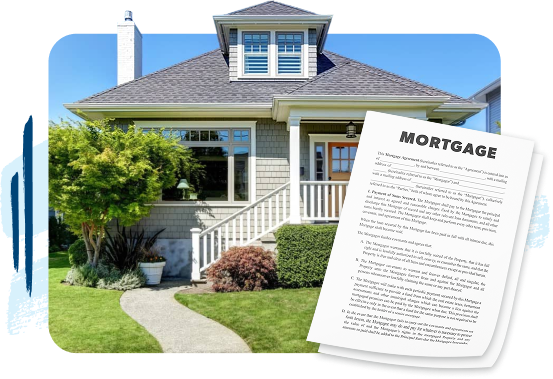
The first loan is backed by Fannie Mae, a government-sponsored company that buys mortgages from lenders and sells them to investors. Loans backed by Fannie Mae are the most common types of mortgages. But Fannie Mae won’t accept Bitcoin directly as collateral (security for the loan).
So Better Mortgage, a digital mortgage lender, adds a second loan: a Bitcoin-backed loan that covers your cash down payment, secured by both your Bitcoin and a second lien on the home. A lien is a legal claim the lender holds on the property until the loan is paid off.
Right now, Better Mortgage is the only U.S. lender offering a Bitcoin-backed mortgage that meets Fannie Mae’s mortgage guidelines. Because it originates both loans, it combines them into one monthly payment—but you’re still legally on the hook for two separate debts.
How Much Bitcoin Do You Need?
Better Mortgage only gives you 40 cents of down payment credit for every dollar of Bitcoin you pledge. For a $40,000 down payment, you’d have to hand over $100,000 in Bitcoin.
Once you transfer your Bitcoin to Better Mortgage’s custodial account on Coinbase—a platform where people buy, sell and hold Bitcoin and other digital currencies—you lose access to it. You can’t sell it, trade it or move it. It stays locked until you pay off the down payment loan.
Bitcoin Mortgage vs. Conventional Mortgage for a $400,000 Home
|
Bitcoin Mortgage |
Conventional Mortgage |
|
|
What you need at closing (assuming a 10% down payment) |
$100,000 in Bitcoin (equal to a $40,000 down payment) |
$40,000 in cash |
|
Number of loans |
Two |
One |
|
Available mortgage options |
15- and 30-year fixed-rate only |
15- and 30-year fixed-rate and more |
|
If Bitcoin crashes |
Your Bitcoin is locked—so you’re stuck with the loss |
You paid in cash—so you lose nothing |
|
If you’re 60 days late on your payments |
Lender can sell your Bitcoin |
Lender charges late fees, and late payments damage your credit score |
|
If you’re 180 days late on your payments |
Foreclosure process starts |
Foreclosure process may start (timing varies) |
|
Available lenders |
One—Better Mortgage |
Many—including Churchill Mortgage |
|
Ramsey recommendation |
What Are the Risks of a Bitcoin Mortgage?
You’ll pay interest on two loans at once and lock up 2.5 times your down payment’s worth in Bitcoin.
Your Bitcoin can still increase in value while it sits in custody. But you can’t access those gains until you pay off the down payment loan—which you’ll repay over the same 15- or 30-year term as your mortgage.
The only way a loan like this works in your favor is if the value of Bitcoin grows fast enough to offset the amount of interest you’ll pay on the two loans. Are you hearing alarm bells yet? History shows Bitcoin can lose most of its value in a single year.3 Its price is driven entirely by what someone else is willing to pay for it at any given moment.
Traditional currencies fluctuate too, but Bitcoin is far more volatile because it’s newer, less regulated, and has no government backing. That’s why Ramsey calls cryptocurrency speculation, not an investment. It’s just a step above gambling. Tying it to your home doesn’t change what it is—it just raises the stakes.
“I would never own one penny of freaking Bitcoin . . . I don’t buy currencies. They’re not investments—they’re speculation.” — Dave Ramsey
What Happens if Bitcoin’s Value Drops?
A Bitcoin mortgage has no margin calls—that means the lender won’t force you to add more collateral or automatically sell your Bitcoin just because the market crashed. But you can’t do anything to minimize your loss because your Bitcoin is locked. Here’s how it would play out:
Stage 1: Bitcoin crashes.
Say Bitcoin drops around 76%—the same as the 2021–2022 crash.4 Your $100,000 in Bitcoin is now worth $24,000.
Stage 2: You just watch.
Your Bitcoin is locked in Better Mortgage’s custodial account. You can’t sell it, move it, or access it to cut your losses.
Stage 3: Your loans don’t adjust.
The debt you took on when Bitcoin was worth $100,000 doesn’t change just because Bitcoin’s value does. You still owe the same monthly payment on both loans—backed by collateral now worth less than a quarter of what you pledged.
Stage 4: The pressure builds.
If you’re using Bitcoin as a safety net instead of having a cash emergency fund, your safety net is gone and you’re in danger of losing your Bitcoin and your home. It’s one more reason why we always say you need an emergency fund separate from your down payment before you buy a house.
The problem isn’t that the lender comes after you the moment Bitcoin’s price drops. It’s that you have no way to respond to a crash. With stocks, a downturn hurts—but you still have control over what you do next. With a Bitcoin mortgage, those options are gone—your collateral is locked, your payments are fixed, and all you can do is keep making your payments no matter what the market does.
Is a Bitcoin Mortgage a Good Idea?
No. Not for first-time home buyers, not for experienced investors, not for anyone.
A Bitcoin mortgage funds your family's most valuable asset with an “asset” that’s no better than a bet. Your home is where your family lives, not a financial experiment.
Bitcoin-backed mortgages and any other shortcut to homeownership—like low- and no-down-payment loans and buying a home without an emergency fund saved separately from your down payment—always end up being riskier and more expensive. Yes, buying a house costs more than ever. But that doesn’t make shortcuts a good idea—they’ll only turn your home into a burden.
What’s the Right Way to Buy a Home?
Follow Ramsey’s 7 Baby Steps to make homeownership a blessing instead of a burden:
- Baby Step 2: Pay off all consumer debt.
- Baby Step 3: Build a fully funded emergency fund.
- Baby Step 3b: Save your down payment in cash. It’s okay to pause retirement investing (Baby Step 4) during this step—just don’t pause it for more than two years.
Aim for at least a 20% down payment so you can skip private mortgage insurance (PMI), which only protects your lender and can add hundreds of dollars to your mortgage payment. If you're a first-time home buyer, a smaller down payment—at least 5%—is okay. But be ready to pay for PMI as part of your monthly mortgage payment.
If you have Bitcoin and you’re thinking about using it toward a home purchase, sell it and use the proceeds toward a cash down payment instead. Even if you end up having to pay capital gains tax, that’s still better than locking your crypto in a custodial account for decades while you pay interest on two loans.
Keep your mortgage payment to no more than 25% of your take-home pay. That includes principal, interest, property taxes, home insurance, PMI and homeowners association (HOA) fees. If the home you want pushes you beyond that 25% limit, keep saving and look at less expensive homes in your area.
Get a 15-year fixed-rate conventional mortgage. Not a 30-year mortgage. Not an FHA or VA loan that comes with fees and higher interest rates. And certainly not a Bitcoin-backed product with two loans. A single conventional 15-year fixed-rate mortgage will save you money over the long term without the extra risk. For a $360,000 mortgage, choosing a 15-year (6% interest) over a 30-year (6.5% interest) saves you more than $270,000 in total interest, according to our Mortgage Payoff Calculator.
Our friends at Churchill Mortgage will help you find a mortgage you can afford—no speculation, no gambling.
Next Steps
- Pay off all debt using the debt snowball method and build a full emergency fund before buying a house.
- Use our Home Affordability Calculator to set your home savings goal.
- Download our free EveryDollar budgeting app to start saving.
- Get preapproved with a trusted mortgage lender like our friends at Churchill Mortgage before you start house shopping.
Frequently Asked Questions
-
Can you use Bitcoin as a down payment?
-
Yes—through Better Mortgage’s Bitcoin mortgage product, currently the only option in the U.S. that meets Fannie Mae’s mortgage guidelines. But using Bitcoin as a down payment means taking on two loans, locking up your crypto for years, and paying interest on both debts at the same time. Use cash as a down payment instead.
-
Is a Bitcoin mortgage safe?
-
No. A Bitcoin mortgage adds risks a conventional mortgage doesn’t. You’d be locking up a volatile asset—that has lost more than 76% of its value in roughly a year—as collateral for your down payment.1 If Bitcoin crashes again while it’s locked, you’re stuck with the loss and you're still responsible for two loans. If you miss payments, you could lose both your Bitcoin and your home.
-
What happens to your Bitcoin if you can’t make payments?
-
Miss your mortgage payments for 60 days and the lender can sell your Bitcoin at whatever price it’s worth at that moment. Miss payments for 180 days and the lender can start foreclosure on your home. You don’t get to choose when or how your Bitcoin is sold.
-
Are there other lenders offering Bitcoin mortgages?
-
Not yet. Better Mortgage launched the first Fannie Mae-approved Bitcoin mortgage in the U.S. in early 2026 and is currently the only lender offering this product. That means there’s no healthy competition in the marketplace and no leverage if anything goes sideways with the rate, the terms or the product itself.
-
What’s the difference between a Bitcoin mortgage and a traditional mortgage?
-
A traditional mortgage is one loan secured by the home you’re buying. A Bitcoin mortgage is two loans: one secured by the home, one secured by your Bitcoin (which comes with a second lien on your home). Both are separate legal debts bundled into a single monthly payment. With a traditional mortgage, your down payment is made in cash at closing—and you’re done. With a Bitcoin mortgage, your collateral stays locked in a custodial account until you pay off the down payment loan.
-
What is the Fannie Mae Bitcoin mortgage?
-
The Fannie Mae Bitcoin mortgage is a home loan offered by Better Mortgage that lets qualified buyers use Bitcoin as collateral for a separate loan to fund their down payment. You still take out a standard Fannie Mae-backed mortgage on the home, but you’ll also take out a second loan secured by your Bitcoin.
-
What is the Ramsey way to buy a home?
-
The Ramsey way to buy a home is to save a cash down payment, buy a home you can afford, and get a 15-year fixed-rate conventional mortgage with payments no more than 25% of your take-home pay. We don’t recommend borrowing against Bitcoin or other risky assets to buy a house.
Get Weekly Insights Delivered Straight to Your Inbox
Did you find this article helpful? Share it!

About the author
Ramsey Solutions

Get proven Ramsey answers fast.