
How to Budget on Commission Income
 By
By 
Key Takeaways
- Make a budget every single month. Commission income is not an excuse to skip it.
- Find your realistic income floor: the number you’re pretty sure to hit even in a slow month.
- In your budget, give first, save second (or attack debt), then cover the Four Walls.
- Build a prioritized list for every dollar that comes in above your floor so extra income always has a job.
When you work on commission, it’s all up to you to leave the cave, kill something, and drag it home. One month, you might be selling stuff left and right, and the next, you might have a stack of unpaid bills on the kitchen table (that also doesn’t have any food on it). That irregular income makes budgeting tricky—but not impossible.
Here's a Tip
Budgeting on commission means finding your reliable income floor, building a zero-based budget around it, and keeping a prioritized list ready for every dollar that comes in above that number so you’re never scrambling when income swings.
You can absolutely take control of commission income. You just need a system built for variability. Here’s exactly how to build it.
What Is Commission Income?
Commission income is money you earn based on a percentage of the sales or transactions you complete. The more deals you close, the more money you make. And that’s great if you’re always crushing your sales goals. But in a slow month, you could be feeling the pressure to pay your bills!
Some roles are commission-only. Others offer a base salary plus commission on top. A base gives you a little bit of security, but the variable nature of commission is what makes budgeting feel complicated. Here are some common commission-based jobs:
|
Job Type |
How Commission Usually Works |
|
Real estate agent |
2–3% of home sale price, split with brokerage |
|
Sales representative |
5–20% of closed deals, sometimes tiered by volume |
|
Insurance agent |
Percentage of policy premium, often recurring |
|
Mortgage loan officer |
Basis points on loan amount at closing |
|
Recruiter |
15–25% of first-year salary for placed candidates |
|
Car salesperson |
Per-vehicle flat fee or percentage of dealer profit |
Why Is Budgeting on Commission Income So Hard?
Budgeting on commission is tricky because your bills are fixed and your income isn’t. Your mortgage doesn’t know you had a slow sales month. Neither does your grocery store. (Wouldn’t it be nice if they gave you free ice cream when you were struggling?)
The main problem you have to solve is budgeting for predictable expenses with unpredictable income. Many people handle this one of two ways, and both usually backfire:
- Overoptimism: They budget based on their best month and overspend when income dips.
- Avoidance: They wing it, live month to month, and hope the numbers work out.
You don’t get a pass on budgeting just because your income is irregular. You just need to approach your monthly budget a little differently. And the good news is that it’s not that complicated! But first, let’s look a little closer at how commission differs from other irregular income.
How Is Commission Income Different From Other Irregular Income?
Irregular income comes in many forms: freelance projects, seasonal jobs, gig work. But commission income has some unique characteristics that affect how you plan.
|
Income Type |
Key Difference for Budgeting |
|
Commission only |
Income is tied to deals closing, so timing is often outside your control. |
|
Base + commission |
A base provides a guaranteed floor, and commission adds extra variable income. |
|
Freelance/contract |
You can often take on more work to increase income when needed. |
|
Seasonal |
Slow periods are predictable. |
|
Gig work |
Flexible hours let you scale your income up or down week to week. |
Commission earners often have a higher income ceiling than salaried workers, but that ceiling comes with a less predictable floor. The real key to budgeting with commission income is to create a zero-based budget set to your lowest average monthly income.
How Do You Create a Zero-Based Budget on Commission Pay?
A zero-based budget means your income minus your expenses equals zero. Every dollar is assigned a job before the month begins. Here’s how to build one when your income changes:
- Find your realistic income floor. Look back at your past few months of commission checks. Find the floor—not your absolute worst-case scenario, but the number you’re pretty sure to hit even in a slow month. That’s your budget baseline.
- List your expenses. Budget first for the Four Walls: food, utilities, housing and transportation. Then add what you plan to spend on saving, giving and other essential expenses. Your nonessential expenses (like streaming services, restaurants and fun money) come next. In a tight month, they might not make the cut.
- Make it zero. With a zero-based budget, income minus expenses equals zero. That doesn’t mean your bank account hits $0. (It’s good to keep a small cushion of $100–300.) It just means every dollar has a name before the month begins. Work your way down your list of expenses until your income runs out for that month.
- Use EveryDollar. EveryDollar makes it easy to build your budget, adjust when a commission check arrives, and track every dollar throughout the month.
Build your budget before the month begins, not after the money arrives. Commission earners who plan ahead stay in control of their budget even when a deal falls through at the last minute. A budget isn’t a slow cooker. You can’t set it once and walk away. If you get a bigger paycheck than expected in the middle of the month, adjust your budget to keep it at zero.
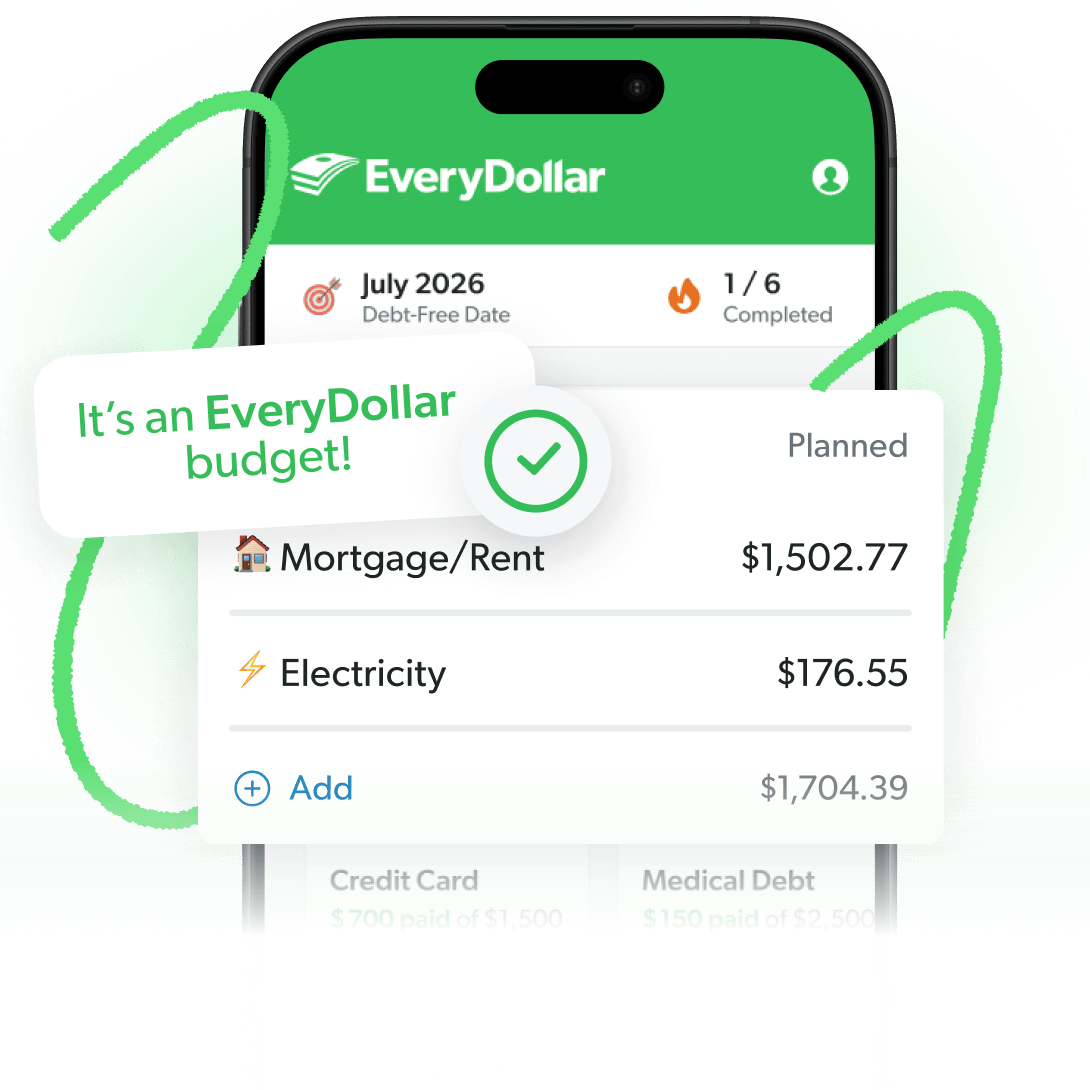
Find Margin You Didn’t Know You Had With EveryDollar
The EveryDollar budgeting app helps you find extra money every month so you can beat debt, build wealth, and make progress. Every. Day.
Should You Budget Based on Your Lowest Commission Month?
Budgeting to your absolute worst commission month (say, a month with zero commission) is probably a little too conservative and could make budgeting feel impossible. Instead, find your income floor, the number you’re pretty sure to earn, even in a bad month. You want a number that reflects your past earnings, not a “sky-is-falling” number. And listen, working on commission can be scary, but if you’ve had some level of success in sales or another commission-based industry, don’t operate out of fear.
Tim, who is from Jacksonville, Florida, and a member of the Ramsey Baby Steps Community on Facebook, offered this bit of encouragement about working on commission: “Bet on yourself. I work in the financial services space. It might seem intimidating at first, but if you believe in what you do and you are doing right by people, then the only thing limiting you is your work ethic and your ability to grow outside of your comfort zone.”
To find your income floor:
- Look at the past 6–12 months of commission checks.
- Identify your genuinely slow months—not disasters, but realistic bad months.
- Use your worst month (or an average of bad months) as your budget baseline. If you’re new to commission, estimate conservatively and adjust as your history builds.
Here’s an example of what that might look like:
Past six months of commission: $2,000, $5,000, $4,500, $9,000, $4,800, $5,200
Absolute lowest: $2,000 (due to a horrible month)
Realistic income floor: $4,500 (you hit this number 5 out of 6 months)
If you have a month that comes in below your floor, go back into EveryDollar, adjust your income, and cut nonessentials until you’re back to zero.
How Do You Handle Income Above Your Budget Baseline?
The key to budgeting with commission is making a prioritized list of everything that didn’t make it into your baseline budget. And you need to do this before the money arrives. Then, as commission checks come in above your floor, you work down your list in order. Every extra dollar already has a job waiting for it. A big check doesn’t mean it’s time to skip dinner at home and head out to a fancy steak dinner.
What you put on the list depends on which Baby Step you’re on. Your list might look something like this:
- Saving for $1,000 emergency fund (Baby Step 1)
- Debt payments (as part of the debt snowball)
- Saving for a slow month
- Saving for a fully funded emergency fund (Baby Step 3)
- Restaurant money
- Retirement savings
The point is that it’s written down before the money hits your bank account, so a big month isn’t an invitation to spend big. It’s an opportunity to make real progress on your goals.
And if you do experience big swings in income, setting aside money in a peak-and-valley fund can help you stay on budget.
How Much Should You Keep in a Commission Buffer Fund?
You may have heard advice to keep a separate “buffer fund,” a dedicated savings account to smooth out commission income swings. It’s a commonly recommended strategy to deposit all your commission income into a holding account, pay yourself a consistent salary each month, and let the buffer absorb the variation.
Instead of a buffer fund, we recommend a peak-and-valley fund. This is a savings account you put money in when your monthly commission income is great and take money out when it’s not so great or isn’t enough to cover your expenses. For instance, if you’ve budgeted $5,000 for expenses one month but your commission is $4,000, you can pull $1,000 from your peak-and-valley fund to make up the difference.
How much you put in a peak-and-valley fund really depends on how big a valley you expect to hit. Look back at the past few months (or year) and find your biggest budget deficit. And when you have a good month, load up your peak-and-valley fund with that amount and maybe a little extra.
You don’t want to take money out of your emergency fund to cover a slow month—because that’s not really an emergency. A peak-and-valley fund will help you protect your emergency fund so it’s there when an actual emergency happens.
Here's a Tip
When working on straight commission, lean toward having a six-month emergency fund.
What Bills Should You Pay First in a Commission Budget?
Same order, every month, regardless of what comes in. Start here:
- Giving
- Saving (or debt snowball if you’re in Baby Steps 1–2)
- The Four Walls: food, utilities, shelter, transportation
- Other essentials: insurance, minimum debt payments, childcare
- Nonessentials: the fun stuff (only after everything above is covered)
In a tight month, nonessentials might not make the cut. That’s okay. The goal is to make sure your necessities are protected no matter what the commission check looks like.
How Do You Handle Taxes on Commission Income?
Commission income is taxed as regular income. But since it’s variable, getting your withholding right takes more attention than a standard salary.
- W-2 employees: If you’re a W-2 employee receiving commission, your employer withholds taxes. Check that your withholding actually covers what you owe, because a big commission month can affect your tax bracket.
- 1099/self-employed: If you’re self-employed, you’ll owe self-employment tax plus income tax. Set aside 25–30% of every commission check and make quarterly estimated payments to avoid a penalty at filing.
If you’re self-employed, set aside money for taxes as soon as you get paid. Put it in a separate account and treat it like it’s gone.
What If You Have a High-Income Month?
If you have a huge month, work your prioritized list. That’s it.
A great commission month isn’t a signal to make it rain dollar bills. Open your list and work it down from the top. Go as far as the money takes you.
If you’re working on the debt snowball, throw every extra dollar at the next debt. If you’re building your emergency fund, fill it faster. If you’re debt-free with a fully funded emergency fund, invest more and start working toward paying off your house.
Lifestyle inflation is the quiet killer of commission income. When a strong quarter becomes a new car payment or a bigger rent check, you’ve turned a temporary income boost into a permanent expense. Suddenly your slow months aren’t just slow, they’re a crisis!
Common Mistakes People Make With Commission Income
|
The Mistake |
What to Do Instead |
|
Budgeting based on your best month or your average |
Find your realistic income floor—the number you’re virtually certain to hit |
|
Skipping the budget in slow months |
Budget every month, no exceptions |
|
Using credit cards to bridge income gaps |
Your peak-and-valley fund and prioritized list should absorb gaps |
|
Spending big after a big month |
Work your prioritized list before you spend anything extra |
|
Skipping tax set-asides |
Pull taxes from every check the day it arrives |
|
Waiting until the end of the month to adjust |
Update EveryDollar every time a commission check hits |
Commission Income Budget Example With Real Numbers
Here’s what a zero-based commission budget looks like for a sales rep with a realistic income floor of $4,500 and typical months ranging from $4,500–8,000. This person is paying off debt as part of Baby Step 2.
Monthly Baseline Budget — Built on $4,500 Floor
|
Category |
Budget Amount |
Notes |
|
Giving (10%) |
$450 |
First line in the budget every month |
|
Debt snowball (Baby Step 2) |
$600 |
Includes minimum payments |
|
Rent/mortgage |
$1,100 |
Four Walls |
|
Groceries |
$400 |
Four Walls |
|
Utilities |
$150 |
Four Walls |
|
Transportation |
$350 |
Four Walls (gas + car insurance) |
|
Health insurance |
$290 |
Essential expense |
|
Phone |
$80 |
Essential expense |
|
Personal spending/misc. |
$80 |
What’s left (nonessential) |
|
TOTAL |
$4,500 |
Income − expenses = $0 |
If your commission is higher than $4,500, start working on your prioritized list. Notice what doesn’t change month to month: Giving comes first, the debt snowball keeps moving, and the Four Walls are always covered.
Commission income will always be variable. But with the right budget, your financial life doesn’t have to be. Give every dollar a name—even before you know exactly how many dollars are coming in. You don’t have to wait for a good month to take control of your money. Start now, with whatever your income looks like.
Next Steps
- Look at the past 6–12 months of commission income and find your realistic floor.
- Use EveryDollar to build a zero-based budget on that floor.
- Write your prioritized list. Decide right now what each extra dollar will do before it arrives.
-
Can I budget if my commission is completely unpredictable?
-
Yes, that’s exactly when budgeting matters most. If you’re new to commission and don’t have an earning history yet, estimate conservatively and build your budget from there. With each month, you’ll get a better read on your realistic income floor.
-
Can I follow the Baby Steps on commission income?
-
Absolutely. Commission earners often move through the Baby Steps faster than salaried workers because their earning potential is higher. The key is the prioritized list: When big months hit, that extra income goes straight to your current Baby Step.
-
How do I budget if I have a base salary plus commission?
-
Build your baseline budget on your base salary alone, or on your base plus a conservative commission estimate you’re virtually certain to hit. Treat everything above that baseline as extra income and work your prioritized list with it.
-
How often should I update my budget?
-
Update your budget every time a commission check arrives, not just once at the start of the month. Log in to EveryDollar, work your prioritized list, and adjust as you go. Then, before the next month starts, make a new budget.
Get Weekly Insights Delivered Straight to Your Inbox
Did you find this article helpful? Share it!

About the author
Ramsey Solutions

Get proven Ramsey answers fast.