
How to Read Your Credit Card Statement
 By
By
Key Takeaways
- Your statement’s new balance shows what you owed when your billing cycle closed—not necessarily what you owe today.
- Paying only the minimum can keep you in debt longer and cost you more in interest.
- Check the interest charges and year-to-date totals to see how much carrying credit card debt is actually costing you.
- Review your transactions every month so you can catch billing errors or unauthorized charges.
- Use your statement as motivation to start the debt snowball, stop adding new charges, and pay off your credit cards for good.
You open your credit card statement, skim down to the amount due, and toss the rest aside. But if that’s all you look at, you’re missing some pretty important numbers—like how much you’re paying in interest and fees.
Quick Answer
A credit card statement is the monthly record of everything you charged, paid and got charged interest on. Behind all that fine print is proof of exactly how much your debt is costing you in real dollars every month. Read it closely and use what you find as fuel to pay off that balance for good.So pull out your latest statement. We’ll start with some common terms you’ll see, then break down each section and what it all means for your money.
Statement Terms at a Glance
Before we jump in too deep, let’s look at some common terms you’ll probably see along the way. Knowing what these mean will make the rest of your statement a whole lot easier to understand.
|
Statement Term |
What It Actually Means |
|
New balance |
What you owed at the end of the billing cycle after purchases, payments, credits, interest and fees were factored in |
|
Minimum payment |
The smallest amount you're required to pay—and a painfully slow, expensive way to pay off a card |
|
Annual percentage rate (APR) |
The interest rate you're charged if you carry a balance |
|
Interest charged |
The amount of interest your credit card company charged you during that billing cycle |
|
Available credit |
How much of your credit limit you have left to borrow—not how much money you have |
|
Minimum payment warning |
A required disclosure showing how long payoff could take (and how much you could pay) if you only make minimum payments |
Now that you know some of the lingo, let’s walk through the main sections of your credit card statement and what you need to know about each one.
What Is the Account Summary?
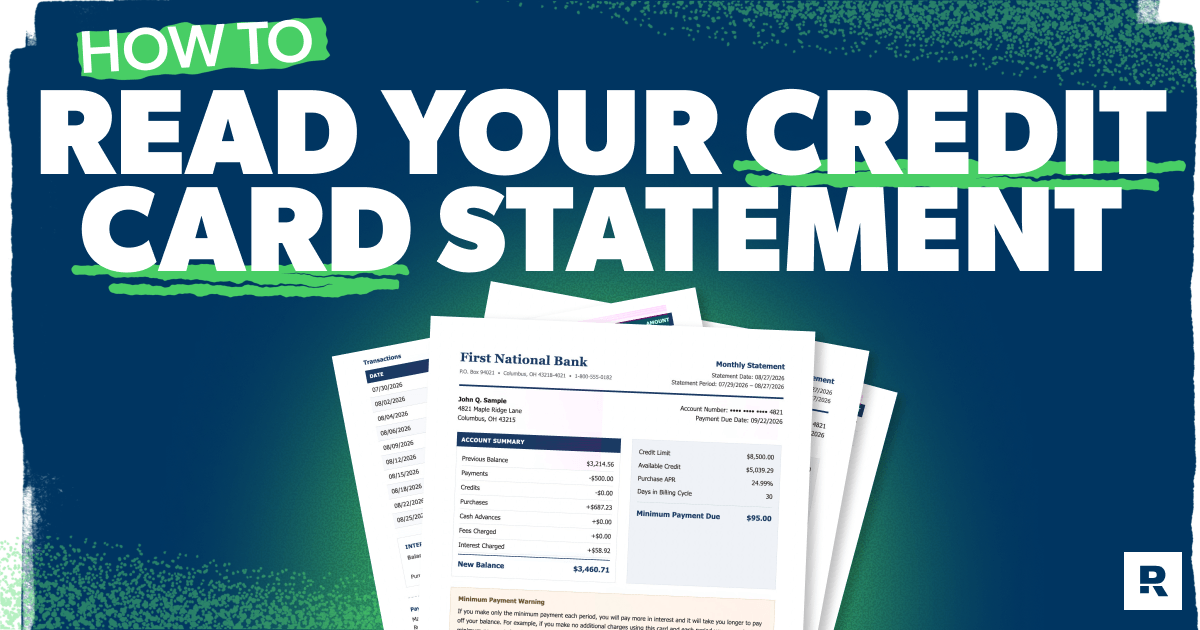
The account summary gives you a quick snapshot of everything that happened on your account during the billing cycle. You'll see things like your previous balance, payments, credits, purchases, balance transfers, cash advances, interest charges and fees all in one place.
Once everything has been added up, your statement will show a new monthly balance (that's how much you owe as of the end of that billing cycle). Keep in mind, your statement balance might be different than the current balance you see when you log in to your credit card account.
You'll also see your available credit (that's how much you have left to borrow). If you charged anything in the past month on your card, that number will be lower than it was on your previous statement.
Lastly, you'll see your due date—the date you need to pay up before bad things start to happen, things like interest rates and fees beginning to climb on your balance. And nobody wants that!
How Do I Read the Payment Information?
The payment information section shows your new balance, due date and minimum payment—the smallest amount you're required to pay. But don't mistake that minimum for a target.
Compared to your account balance, your minimum payment amount will seem extremely low, sometimes representing just 3% of your total account balance or a set dollar amount. And while paying the minimum may keep your account current, it'll also keep that debt hanging around a whole lot longer.
Listen closely: Paying only the minimum isn't the way to get rid of credit card debt. You can avoid interest on purchases by paying your statement balance in full by the due date. Better yet, you can avoid the whole credit card circus by saying goodbye to your credit card for good. But more on that later . . .
Your statement will also tell you when your payment is due and what time it has to be received to count as on time. Miss that cutoff, and you can say hello to that late fee and goodbye to that money you were going to use for your afternoon latte.
What Are Late and Minimum Payment Warnings?
Your credit card statement includes warnings that show what can happen if you pay late or only make minimum payments. These disclosures are required by federal law, and they're worth paying attention to.
Not only can the warning tell you what you could be charged for a late payment, but the minimum payment warning also shows how long it could take to pay off your balance if you only make minimum payments—and how much you could end up paying in the process.
Here's a Tip
Don't skip that minimum payment warning. It's right there in black and white: Making minimum payments can stretch your debt out for years and cost you a whole lot more in interest. Read that box, then use it as motivation to get that credit card out of your life for good.
What Does the Account Changes Section Tell Me?
The account changes section lets you know about important changes to your credit card terms, like an increase in your APR. In many cases, your credit card company has to give you 45 days’ notice before increasing your APR or making certain other significant changes to your account terms.1
But that doesn't mean every rate increase comes with 45 days’ warning. There are exceptions—for example, a variable APR can go up or down automatically as market interest rates change.
So if you get a notice that your rate or other account terms are changing, don't toss it aside. Read it closely so you know what's changing, when it takes effect, and what it could cost you.
What Will I See in the Transactions Section?
The transactions section shows the purchases, payments and credits that hit your account during the billing cycle. Depending on your statement, you'll usually see details like the transaction date, post date, description and amount for each one.
This is one section you definitely don't want to skim. Look through the transactions every month and make sure you recognize every purchase and that the amounts are correct. If something looks off, don't ignore it.
If there are other users on a particular account, like a spouse or dependent, this section will tell you which user made which transaction on the account. Note: All transactions should be listed in the order they were made, from oldest to newest.
How Much Am I Paying in Interest and Fees?
Your statement also includes a section that shows exactly how much your credit card company charged you in interest and fees during the billing cycle. That's real money leaving your pocket without buying you a single thing.
That's right—using borrowed money can cost you money! This section literally shows you how much money they're taking out of your pocket. And it's all the way down on your credit card statement for a reason. They don't want you to find it. Nope, that's not a smudge or a shadow. That's just the fees they're trying to hide from you.
Like we've said before, the longer you carry a balance, the more interest and fees can build up. At this point, we're guessing your blood pressure is starting to rise—and with good reason. Seeing those charges in actual dollars can be a pretty powerful reminder of why getting out of credit card debt matters.
What Do the Year-to-Date Totals Show Me?
The year-to-date totals show how much you've paid in interest and fees so far that year. It's one of the clearest ways to see what carrying credit card debt has actually cost you over time.
When it comes to annual calculations, there shouldn't be many surprises—although this is another opportunity to see just how much money you've been paying back over the course of the year. Fair warning: If you look closely enough at this number, you might get so angry that you decide to use the debt snowball to pay off the entire thing.
How Is My Interest Charge Calculated?
The interest charge calculation section shows the APR and other information your card company used to calculate the interest you were charged. If you have different types of balances—like purchases, cash advances or balance transfers—you may see them listed separately because they can have different APRs.
This is where you'll get an up-close-and-personal look at just how much you've been dinged by unnecessary interest rates throughout the course of the year.
It might seem small at first, but imagine what happens when people don't bother to look and that number gets bigger and bigger and bigger. Pretty soon, it becomes easy to see how 54% of Americans say they're living paycheck to paycheck.
Credit card statements vary depending on the lender, and unfortunately, we don't have time to dig in to each one here. Just know that sometimes you'll also see other sections like rewards or cash-back bonuses, credit counseling notices, payment coupons and more.
But instead of dreading that credit card statement landing in your mailbox (or your inbox) each month and sifting through a mess of financial terms, make a plan to stop relying on credit cards altogether.
How Do I Use My Statement to Get Out of Debt?
Use your credit card statement as motivation to start the debt snowball and pay off those balances for good.
Start by looking at how much you've paid in interest and fees. Those numbers show you in real dollars what carrying credit card debt is costing you. Let that make you mad enough to do something about it.
And don't stop there. Look back at a few months of statements to see where your money has actually been going. Shannon, a member of THE Ramsey Baby Steps Community Facebook group, recommends doing exactly that: “I would say print out 3 months and look at what you are spending where. Almost anyone can squeeze more money out of their budget if they are willing to make the necessary sacrifices.”
Then put that money to work. List every credit card you have from smallest balance to largest, pay minimums on all of them except the smallest, and throw every extra dollar you can find at that one. When it's gone, roll that payment onto the next card until every last balance is gone.
To speed up the process, you need a plan for the money coming in too. EveryDollar helps you build a budget, take control of your spending, free up more money for your debt, and make sure you’re not adding to those balances along the way.
Next Steps
- Face the numbers. Pull your latest credit card statements and add up how much you've paid in interest and fees.
- Start the debt snowball. List your cards from smallest balance to largest, pay minimums on everything but the smallest, and attack that one first.
- Stop adding to the balance. Track your spending with EveryDollar and stick to your budget while you knock out the debt.
-
What's the difference between my statement balance and my current balance?
-
Your statement balance is what you owed when your last billing cycle closed. Your current balance reflects transactions that have posted since then, so it can change throughout the month. Think of your statement balance as a snapshot and your current balance as the live version.
-
Where do I find the total interest I've paid this year?
-
Look for the year-to-date totals on your credit card statement. This section shows how much you've been charged in interest and fees so far that year. Take a good look at those numbers—they'll show you in real dollars just how much carrying credit card debt has been costing you.
-
What happens if I only pay the minimum payment?
-
Paying only the minimum can keep you in debt for years and cost you a whole lot more in interest. Check the minimum payment warning on your statement to see how long payoff could take and how much you could end up paying. Then make a plan to knock out that balance for good.
-
How long should I keep my credit card statements?
-
How long you should keep credit card statements depends on what you might need them for. Once you've reviewed a statement and resolved any issues, you generally don't need to keep it unless it supports tax records, warranties, returns or an ongoing billing dispute. And when you're done with it, shred it.
Get Weekly Insights Delivered Straight to Your Inbox
Did you find this article helpful? Share it!

About the author
Ramsey Solutions

Get proven Ramsey answers fast.