
Are Condos a Good Investment?
 By
By

Key Takeaways
- A condo can be a good investment if it’s in a great location with a financially healthy homeowners association (HOA).
- Condos typically cost less than single-family homes and can appreciate over time.
- A well-run HOA can save you time and money, while a poorly managed one can become expensive.
- Before buying an investment condo, complete the Baby Steps, pay off your home, and pay cash for the property.
So, you just got back from a relaxing vacation at a beachfront condo and you’re thinking, What if I owned my own place here? Or maybe you’re buying your first home and like the idea of skipping the yard work. Either way, you’re probably wondering if buying a condo is a smart move.
The short answer is yes—condos can be a good investment if you buy the right one. They’re often more affordable than single-family homes and can appreciate over time. But like any real estate purchase, not every condo is a winner.
Before you sign on the dotted line, it’s important to know what separates a great condo from a money pit. Here’s what to look for so you can buy with confidence.
Are Condos a Good Investment?
Let’s cut to the chase: Yes, condos are a fine investment. The key is choosing a condo in a desirable location with a financially healthy, well-managed HOA. (More on that later.)
Like any real estate purchase, condos have advantages and trade-offs. Here’s a quick snapshot of the biggest pros and cons to keep in mind.
Pros
- Condos are often more affordable than single-family homes.
- They generally appreciate in value over time.
- The HOA handles many exterior maintenance and repair projects, saving you time and hassle.
- Major maintenance costs for shared areas are spread among all owners instead of falling on one homeowner.
- Many condo communities offer amenities like pools, fitness centers and shared green spaces.
Cons
- You’ll pay ongoing HOA dues in addition to your mortgage and other housing costs.
- HOA rules may limit pets, renovations, parking or short-term rentals.
- You have less control over future HOA fee increases.
- A poorly managed HOA can lead to neglected maintenance or expensive special assessments.
- Condos generally don’t appreciate as quickly as single-family homes because you don’t own the land.
If those pros outweigh the cons for you, a condo could be a smart investment. But as with any of the different types of homes you can buy, it’s important to do your homework before making an offer.
Is a Condo a Good First Home?
For many first-time buyers, the answer is yes. And one of the biggest reasons is affordability.
Don’t get us wrong: Buying a condo is still one of the most expensive purchases you could ever make. But a condo is typically tens of thousands of dollars cheaper than a single-family house.
For perspective, the bigwig number crunchers at the National Association of REALTORS® found that the U.S. median sales price of condos was $363,600 in the first quarter of 2026, while the median sales price of single-family homes was $404,300—meaning condos were $40,700 less expensive!1
Condos can also be a great fit if you want a lower-maintenance lifestyle. Instead of handling exterior upkeep yourself, you’ll share responsibility for many common repairs and maintenance projects through the HOA.
What Should You Look for in a Condo HOA?
Look for an HOA with healthy finances, clear rules, and responsible leadership. A well-run HOA can save you time and money by keeping the property in great shape and helping you avoid expensive surprises. But a poorly managed HOA can quickly become a headache. That’s why it’s worth doing a little homework before you buy.
An HOA is basically a set of rules and fees designed to maintain the value of a condo complex. It keeps everything in tip-top shape and looking pretty. The HOA is made up of owners who actually live in their unit or a group of outside investors. Every month or quarter, the HOA collects a fee from each unit that gets stashed in a piggy bank fund until it’s time to handle maintenance and repairs for shared items like roofing, parking and pools.
But don’t assume the HOA’s insurance has you covered. You’ll still need your own condo insurance to protect the inside of your unit and your personal belongings.
A well-run HOA can be one of the best parts of condo living for first-time buyers. Instead of worrying about mowing the lawn, replacing the roof, or repairing the pavement, you can leave those responsibilities to the HOA. And because the costs are shared among all the owners, you’re not footing the bill by yourself.
But a poorly run HOA can turn your dream condo into an expensive mess. Big repairs sometimes get neglected for so long that the HOA board suddenly tags each unit with a huge bill to make up for HOA fees that were too low. Or your board members might be so drunk on so little power that they’ll drive you absolutely nuts by nitpicking every little thing—like how you park your car crooked or choose the wrong color for your curtains.
So do a little homework before you buy, and you’ll be much more likely to spot the flowers among the weeds. Here are the key things to check:
Financial Health
Ask to see the HOA’s budget and reserve fund. An HOA with healthy reserves is more likely to handle major repairs without charging owners costly special assessments.
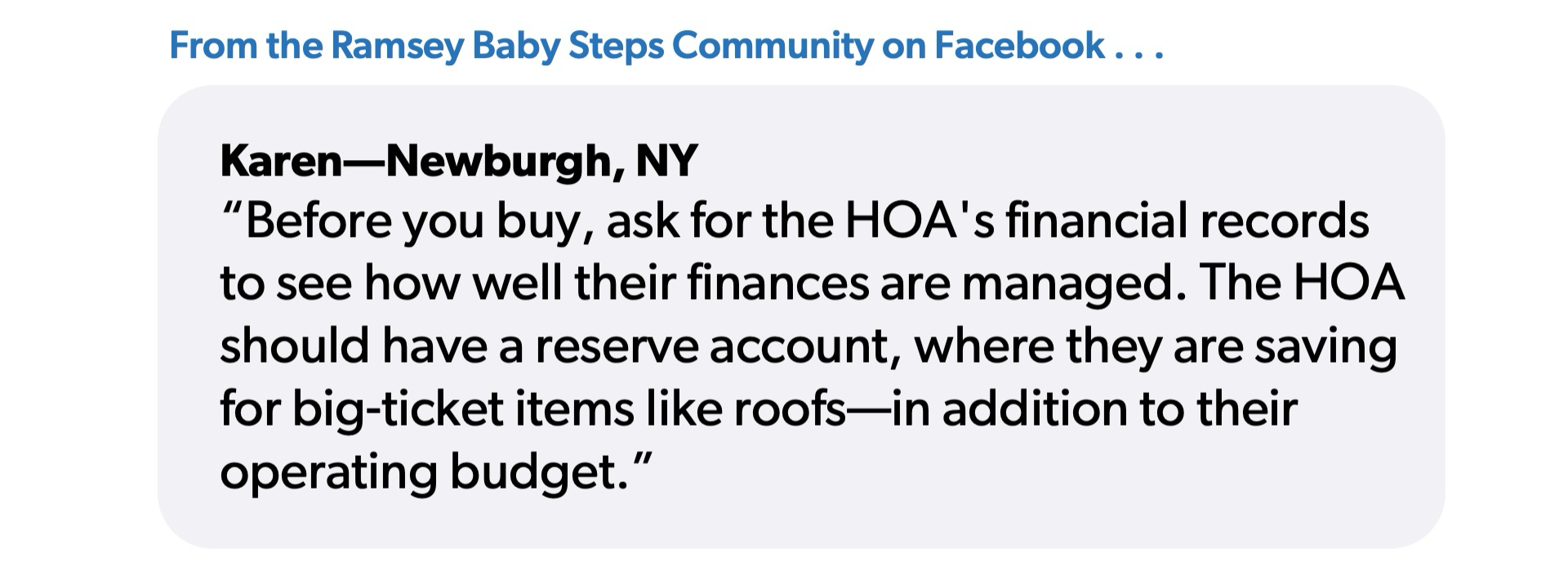
As Karen, a member of our Ramsey Baby Steps Community, put it: “Before you buy, ask for the HOA’s financial records to see how well their finances are managed. The HOA should have a reserve account, where they are saving for big-ticket items like roofs—in addition to their operating budget.”
Rules and Restrictions
Read the HOA’s bylaws carefully. Some associations limit pets, renovations, parking, or short-term rentals through Airbnb or VRBO. Make sure the rules fit your lifestyle and plans.
Maintenance Responsibilities
Find out exactly what the HOA covers and what you’re responsible for. Knowing where your dues go can help you avoid expensive surprises later.
Leadership and Reputation
Review recent meeting minutes and, if possible, talk to current residents. Frequent complaints, deferred maintenance, or recurring special assessments are all signs you may want to keep shopping.
Do Condos Appreciate in Value?
Yes, condos generally appreciate in value. That’s true of any piece of property—as long as it doesn’t have wheels or come from a trailer park. But, if you’re trying to decide between a condo or a house, keep in mind that a single-family home is usually going to grow in value faster than a condo will.
Now, that’s not the same for every situation. If you find a condo in a cool location and a single-family house in a lousy location, the condo will probably appreciate faster.
Are Condos Good Rental Investments?
Yes—a condo can be a solid rental investment when you’re financially ready and choose the right property. But before you buy, make sure you’re in a position to invest without putting your own financial future at risk.
If you want to build and maintain wealth, don’t jump into investing in a condo or any type of property without first following Dave Ramsey’s 7 Baby Steps. These financial milestones set you up for success so that investing doesn’t interrupt your other money goals. For example, we don’t recommend you invest in a condo unless you’ve already paid off your own home and can pay for the investment property with 100% cash. It’s not worth having a second mortgage hanging over your head.
Once you’re clear on that end, you’re ready to buy a condo! When you’re first starting out, it’s a good idea to invest in a local piece of real estate, as opposed to a long-distance one. That way, it’ll be easier for you to keep an eye on it as you gain experience handling a rental property. To make sure you don’t get stuck with a clunky condo, follow these tips:
Buy where people actually want to live.
You don’t need to chase the hottest vacation town or the next “up-and-coming” neighborhood. Look for a place where people already want to live because there are good jobs, solid schools, and plenty of things to do. The nicest condo in a struggling area is still going to have a hard time finding great tenants.
Make sure there are more owners than renters.
Ask about the current “owner-occupancy rate,” which is just a fancy way of saying how many owners live there as opposed to renters. More owners than renters usually mean people take better care of the property because they have skin in the game.
Plus, too many renters usually go against the guidelines set for normal financing options. That means the head honchos who make up lending rules for FHA, VA and conventional loans won’t approve a buyer for those common types of mortgages.
You’ll be paying cash, so while this won’t affect your ability to pay, it could affect your resale value. Here’s how: The only people interested in the condos will be cash buyers and investor buyers. And those types of buyers are bargain hunters who are only looking for the cheapest deal.
Don’t fall in love before you run the numbers.
A condo might have an amazing view or a gorgeous kitchen, but neither one pays the bills. Before you buy, add up all the costs—HOA dues, insurance, property taxes, maintenance, and anything else that comes with owning the place. If the math doesn’t work, walk away. You can always find another condo.
Know the HOA’s rental rules.
Don’t assume you can rent your condo however you want. Some HOAs limit the number of rentals, require owners to live in the unit before renting it out, or ban short-term rentals altogether. Read the rules before you buy so you don’t end up with an investment that can’t do what you bought it to do.
Buy a place you’d be proud to rent out.
Here’s a simple gut check: Would you want your family to live there? If the answer is no, don’t expect great tenants to line up at your door. But if it’s clean, safe, well maintained and somewhere you’d happily recommend to a friend, you’re probably on the right track.
Plan for vacancy and repairs.
Even the best rentals won’t be occupied 100% of the time. Build some breathing room into your budget so an empty month or an unexpected repair doesn’t become a financial emergency.
Is a Vacation Condo a Good Investment?
A vacation condo can be a great investment if you buy the right property and the numbers make sense. But it also comes with more moving parts than a long-term rental, so don’t let the ocean views or mountain sunsets cloud your judgement.
Let’s say you want to buy a condo near a favorite vacation spot. Just imagine: You’d have your own private getaway on the beach. You could say “So long!” to those brutal winter months without moving away from family and friends. And, when you’re not using it, it doubles as a vacation condo you can rent out to others. Cha-ching!
Before you jump in, look at more than the purchase price. Compare what similar vacation rentals charge, how often they’re booked throughout the year, what the HOA allows, and how much you’ll spend on management, maintenance and cleaning.
Now, if you buy a condo near a beach, lake, or tourist hot spot like the Grand Canyon or Disney World, then you should have yourself plenty of renters to choose from at any time of year. But, because you’ll have a revolving door of renters instead of one occupant and you won’t be living near the property, you’ll probably need to hire a management company to handle upkeep and administrative work for you—and that can cut into the profit.
The plus side is that you can charge more per stay than the monthly rate for a single-tenant condo. And you can use the space yourself anytime you want.
Before you buy, ask yourself these four questions:
- Would this still be a good investment if bookings slowed for a few months?
- Can the rental income cover the HOA dues, insurance, taxes and management fees?
- Does the HOA allow short-term rentals?
- Would you still feel good about the purchase if you never used the condo yourself?
If you can’t confidently answer yes to most of these questions, keep looking. The right vacation condo is out there, and it’s worth waiting for.
Ready to Buy a Condo?
Whether you’re buying a condo for yourself or as a rental property, there are lots of details to consider. Lift off some of that weight with the help of a real estate agent. You can find the best ones in your area—or near your vacation spot—by using our RamseyTrusted® program. Our team vets and coaches agents from all over the country to make sure we only recommend ones who get the job done right.
Next Steps
- Compare the total cost of owning the condo—not just the purchase price.
- Review the HOA’s finances, rules and reserve fund before making an offer.
- Connect with a RamseyTrusted real estate agent to find a condo that fits your budget and investment goals.
This article provides general guidelines about investing topics. Your situation may be unique. To discuss a plan for your situation, connect with a SmartVestor Pro. Ramsey Solutions is a paid, non-client promoter of participating Pros.
-
Do HOA fees make condos a bad investment?
-
Not automatically. HOA fees cover shared expenses like roofing and exterior maintenance. The bigger issue is whether the HOA is financially healthy. Review its financials before you buy to avoid costly surprises.
-
Should I buy a condo before I pay off my other debt?
-
No. Pay off your debt, build your emergency fund, and follow the Baby Steps first. If you’re buying an investment condo, pay off your primary home first and buy the property with 100% cash.
-
Can I rent out my condo on Airbnb or VRBO?
-
Maybe—but don’t assume you can. Many HOAs restrict or ban short-term rentals. Check the HOA rules before you buy so you know what’s allowed.
-
Are condos a good choice for first-time home buyers?
-
They can be. Condos often cost less than single-family homes and require less maintenance. Just make sure the HOA is financially healthy—a poorly managed one can quickly become an expensive headache.
-
How does a condo compare to a house as a long-term investment?
-
In general, houses appreciate faster because you own the land, and land drives appreciation. If long-term investment potential is your top priority, a house in a good location will usually come out ahead.
Get Weekly Insights Delivered Straight to Your Inbox
Did you find this article helpful? Share it!

About the author
Ramsey Solutions

Get proven Ramsey answers fast.